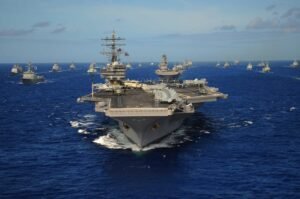
The war on Iran cannot be explained solely through security concerns or the nuclear dispute. It forms part of a longer pattern of conflict in the Middle East, reflecting the convergence of several strategic objectives, including deterrence, regional power balancing and the preservation of a regional hierarchy in which Israeli military predominance occupies a central place.[i] Israeli military superiority has rested on sustained American backing, yet Iran remained capable of imposing strategic costs without achieving military parity.
A regional order built on Israeli military predominance requires periodic reinforcement when challenged. States capable of challenging that predominance can therefore be regarded as strategic threats. Iran became the immediate target because its regional influence, missile capabilities and advancing nuclear programme combined to place it in that position. The dynamic, however, goes beyond Iran. Similar pressures could emerge where the regional balance is perceived to challenge the current status quo.
The terms “war deal” and “peace deal” are used below because both describe political bargains rather than formal legal agreements over the course of the war. The former captures the convergence of Israeli strategic objectives with broader American interests in deterrence, regional stability and alliance management. The latter emerged once Washington judged that the principal military objectives of the war had largely been achieved and the strategic and political costs of continued war increasingly outweighed its expected benefits.
Explaining the war deal
The war on Iran emerged from a political bargain in which U.S. and Israeli strategic interests substantially converged. Washington and Tel Aviv did not share identical objectives, but both viewed Iran as a challenge to the regional balance. The nuclear dispute provided the most visible justification for military action, but it also became intertwined with broader concerns about deterrence, regional order and alliance credibility. In this sense, war became politically conceivable once Iran came to be understood as a proliferation concern as well as a strategic obstacle to the prevailing regional balance.
The objectives of the war extended beyond containing Iran’s nuclear programme. The 2026 war on Iran could be considered as an extension of the war in Gaza, during which the exchange of missile attacks between Iran and Israel made clear that Iranian missile capability had become a direct strategic concern for Israel. The recent war may have aimed to limit that capability too. It also belongs to a broader regional practice visible in the Iran-Israel exchanges of 2024 and in Israel’s strikes on Syrian military assets after HTS-led forces entered Damascus in December 2024. In these cases, the reduction of Syrian and Iranian military capacity appears as a part of the emerging regional dynamics.
Modern Middle Eastern war is rarely a break from the regional order. It more often functions as one of its instruments.
On a wider regional level, the war reinforced Gulf perceptions of Iran as an immediate security threat, particularly after Iranian strikes on Gulf territory transformed a longstanding concern into a direct strategic reality. Although Gulf and Israeli interests also remained distinct, both became more exposed to Iranian retaliation. This was likely to deepen Gulf reliance on U.S. security guarantees while making further normalisation easier to present as part of a broader regional response to Iran. The result was a significantly weakened Iran without necessarily eliminating it as an enduring strategic competitor.
Modern Middle Eastern war is rarely a break from the regional order. It more often functions as one of its instruments. Wars have repeatedly altered political alignments without producing definitive settlements, while coercive diplomacy has frequently operated alongside military pressure rather than following it.[ii] Ofer Israeli’s account of conflict regulation without resolution supports this interpretation.[iii] The war on Iran emerged from this broader pattern because Iran’s resilience increasingly complicated the evolving regional balance.
The nuclear file became only one component of a broader strategic assessment of Iran. Before the war, the Iranian challenge centred on enrichment and breakout risk, but that account alone cannot explain the scale of the confrontation. Vali Kaleji argues that the dispute had already expanded to encompass Iran’s missile programme and regional influence.[iv] The post-Cold War regional order evolved in a manner that favoured Israeli military predominance alongside expanding normalization with several Arab states. Iran complicated that reality less through military parity than its capacity to absorb punishment while continuing to impose strategic costs. Iraq’s marginalisation after 1990 widened the space for Israeli regional integration, while simultaneously leaving Iran as the principal state capable of challenging the emerging regional order. Although Israel regarded Iran as its primary strategic adversary, only American military support made a war of this scale politically and militarily feasible.[v]
The current negotiations may therefore interrupt the war, but not the structural conditions that made it possible.
The regional environment made the military action politically feasible. Many Arab governments, particularly in the Gulf, already regarded Iran as a significant security challenge and therefore had little strategic interest in defending its regional position. The war consequently required neither broad Arab participation nor active regional endorsement, only the absence of effective opposition. Resistance remained largely rhetorical because Iran was widely viewed as a regional rival rather than a strategic asset. In this setting, military action was understood primarily as preventive rather than reactive.
Several strategic conditions converged to make the war deal possible including Israeli security concerns, American interests, and Gulf perceptions. Yet Middle Eastern wars rarely produce decisive political settlements. Instead, they reshape regional balances before giving way to coercive diplomacy, without necessarily resolving the underlying conditions that produced violence. The current negotiations may therefore interrupt the war, but not the structural conditions that made it possible.
Understanding ‘the’ peace deal
This peace deal (the current negotiations between the United States and Iran) differs from the principal agreements that have shaped modern Middle Eastern diplomacy. Camp David, Oslo, Wadi Araba, and the Abraham Accords centred on recognition or normalisation between Israel and Arab states. The US-Iran deal belongs to a different category. It does not rest on reconciliation or territorial settlement, although the Trump administration presented it as an opportunity to “turn over a new leaf” and “change relations in the Middle East permanently”.[vi] Instead, it marked the point at which Washington judged that the principal military objectives had largely been achieved, namely, the destruction of Iran’s military capabilities. Earlier discussion of regime change or support for protesters therefore appears to have functioned more as political rhetoric rather than as the central organizing objective of the war.
Trump described Iran’s nuclear facilities as “completely and totally obliterated,” called the strikes a “spectacular military success,” and insisted that “Fordow is gone”.[vii] Whether these statements fully reflected conditions on the ground is less important here than what they reveal about Washington’s political framing of the conflict. The transition to negotiation became possible once the Trump administration concluded that the damage inflicted on Iran justified a shift to diplomacy.
A comparison with the Board of Peace Deal is instructive. In that case, the U.S. assumed the principal diplomatic and administrative role within a peace mechanism formally designed for Gaza. Although Israel accepted the invitation to join the board, it did not attend the Davos signing ceremony on 22 January 2026. Reconstruction was therefore presented as an international administrative and financial undertaking rather than as a question of legal or political responsibility for the destruction of Gaza.[viii] The mechanism therefore separated reconstruction from liability, allowing Israel to remain central to the broader political arrangement.
A similar pattern appears in the Iran agreement. Washington continued to support many Israeli strategic objectives while pursuing broader American interests. One arrangement addressed the political aftermath of the war while the other sought to manage escalation costs. The Iran agreement therefore functions less as a conventional peace settlement than as a mechanism for stabilizing the regional balance after war.
The agreement does not result in a departure from the war deal, but adapts it to a new political context.
Israel’s refusal to treat the agreement as binding on the Lebanon front illustrates the continuing divergence between de-escalation with Iran and military pressure on Hezbollah. Yet, since both Washington and Tehran have reasons to preserve the framework, Israeli operations in southern Lebanon will likely be allowed to continue. These simultaneous tracks produced a public narrative of tension between Trump and Israeli Prime Minister Benjamin Netanyahu. This too could prove useful as Washington looks to present itself as the power that ended the war. Negotiations with Iran reduce the risks of escalation, while continued pressure on Hezbollah preserves many of the strategic effects produced by the war. In that sense, the agreement does not result in a departure from the war deal, but adapts it to a new political context.
Iran demonstrated that it could survive war without capitulation. Its significance lies less in the damage inflicted than in its continued capacity to impose strategic costs. The Strait of Hormuz remains a source of leverage, while Hezbollah continues to generate strategic uncertainty. The effect of the agreement is to accommodate a weakened Iran within a revised balance of power. In this respect, the peace deal is not unusual. Middle Eastern arrangements have often followed shifts in the balance of power, serving less to resolve underlying disputes than to manage their consequences.
A broader strategic paradox nevertheless remains. A substantially weakened Iran may prove more compatible with the existing regional balance than either a fully restored or completely eliminated Iran. Israel’s security policy has long been shaped by the perception of enduring regional threats that justify military preparedness. From this perspective, a weakened but resilient Iran provides a reference point for regional deterrence while lacking the capabilities to overturn Israeli military superiority. Whether intentionally produced or not, this outcome preserves an unresolved tension in which Iran remains a managed competitor within a regional hierarchy that continues to operate in a state of rivalry.
Appointment with Iran
In 2006, Pervez Musharraf recalled that Pakistan was presented with an American ultimatum after 9/11: cooperate with Washington or face the possibility of being bombed “back to the Stone Age”.[ix] Pakistan’s experience illustrates how American diplomacy during periods of crisis can combine coercion with subsequent negotiation. Pakistan’s role in the U.S.-Iran talks is therefore significant because it brings the experience of navigating intense American pressure through strategic brokerage. An appointment with Iran begins from this historical context. Rather than marking the emergence of trust between Washington and Tehran, it reflects a familiar regional pattern in which coercion creates the conditions for mediation, and mediation seeks to manage the consequences of coercion.
Pakistan possessed nuclear weapons, yet ultimately accommodated American demands when refusal appeared to carry existential risks. Iran has endured sustained military pressure without collapsing, but endurance should not be equated with unlimited capacity. From Washington’s perspective, the war had already demonstrated its willingness to impose significant military costs. The negotiations therefore rest on a dual recognition that coercive leverage remains available while Iran retains sufficient resilience to make a negotiated settlement preferable to escalation. In this sense, diplomacy limits the conflict without eliminating the conditions that produced it. Trump’s warning during the opening stages of the negotiations that “if they [Iranian delegation] don’t behave, we’ll go right back to dropping bombs” illustrates how the threat of renewed coercion continued to shape the framework within which de-escalation is pursued.[x]
The appointment with Iran is not a peace settlement in the classical sense. It is better understood as a controlled diplomatic encounter in which Iran enters negotiations weakened but not defeated, while the United States enters from a position of military advantage yet with increasing incentives to avoid further regional escalation. The negotiations therefore extend beyond securing a temporary ceasefire. They can be understood as seeking to establish a regional balance in which Iran’s military capabilities are constrained while preserving American and Israeli strategic interests.
[i] Comparable examples include the Peloponnesian War, where Thucydides attributed war to the systemic implications of Athenian power; the coalition wars against Napoleon Bonaparte, which restored the European balance after 1815; the Gulf War, which re-established an American-led regional hierarchy in the Middle East; and the 2003 invasion of Iraq, which removed its principal regional challenger. In each case, war functioned to preserve an existing distribution of power rather than resolve an immediate dispute.
[ii] Aldalala’a, N., & Shukri, S. F. (2025). Shifting geopolitics: The Gaza war and the contours of a nascent Middle East security community. Intellectual Discourse, 33(2), 411-436. https://doi.org/10.31436/id.v33i2.2344.
[iii] Israeli, O. (2026, June 9). The Middle East is not stabilizing, it is learning to manage instability. Manara Magazine. https://manaramagazine.org/2026/06/the-middle-east-is-not-stabilizing//
[iv] Kaleji, V. (2026, February 26). US-Iran negotiations beyond nuclear issues could lead to failure. Manara Magazine. https://manaramagazine.org/2026/02/us-iran-negotiations-could-lead-failure/.
[v] Aldalala’a, N., & Shukri, S. F. (2025).
[vi] AP News. (2026, June 22). Vance says talks with Iranian officials set good foundation for a deal to end the war. https://apnews.com/article/united-states-iran-war-nuclear-negotiations-4bbde727c7095c4ad9da0285ca79f1e1.
[vii] Reuters. (2025, June 22). US bombs Iran: Trump says Iran’s nuclear sites obliterated by US strikes. https://www.reuters.com/world/israel-iran-live-trump-address-nation-after-us-bombs-nuclear-sites-iran-2025-06-22/.
[viii] The White House. (2026, January 22). President Trump ratifies Board of Peace in historic ceremony, opening path to hope and dignity for Gazans. https://www.whitehouse.gov/releases/2026/01/president-trump-ratifies-board-of-peace-in-historic-ceremony-opening-path-to-hope-and-dignity-for-gazans/.
[ix] Musharraf, P. (2006). In the line of fire: A memoir. Simon & Schuster.
[x] Reuters. (2026, June 18). “US and Iran presidents sign ceasefire agreement, but Trump says he could still resume attacks”. https://www.reuters.com/world/middle-east/g7-leaders-demand-ceasefire-lebanon-welcome-iran-deal-2026-06-17/.