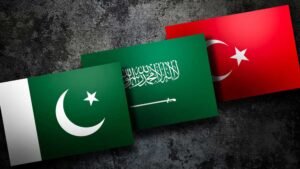

The Makkah Joint Defence Agreement (MJDA), signed by Pakistan, Turkiye and Saudi Arabia[i] on 7th August 2026, represents an important development in the evolving security architecture of the Middle East. At its core, the agreement reflects a strategy of middle-power hedging. Rather than seeking an alternative to the Western-led security order, the three states are attempting to diversify their security partnerships and reduce excessive reliance on any single external guarantor. If successful, the MJDA could offer a model for greater regional agency within, rather than outside, the broader security architecture. Its credibility will depend largely on whether it can achieve one of its principal objectives: collective deterrence.[ii]
The agreement seeks to establish such deterrence by treating an attack against one signatory as an attack against all three. In principle, this raises the potential costs of aggression by introducing the prospect of a coordinated response. Yet the extent of each member’s involvement appears to remain deliberately undefined and may vary according to the nature and intensity of a crisis. Far from necessarily weakening the pact, this ambiguity could reinforce its deterrent effect by complicating an adversary’s calculation of the likely response. More broadly, the MJDA is better understood as an attempt to diversify regional security arrangements than to replace them. Its significance lies not in constructing a rival bloc, but in creating an additional layer of cooperation among three middle powers that remain embedded in the wider Western security architecture.
The U.S. response lends some support to this interpretation.[iii] Washington did not publicly treat the agreement as a challenge to the existing regional order, while President Trump described himself as ‘very happy’ with the arrangement. This response suggests that greater regional security autonomy need not necessarily come at the expense of existing partnerships with Washington. The MJDA’s importance, therefore, lies precisely in this middle ground: it expands the strategic options available to its members without requiring them to abandon the security relationships on which they have traditionally relied.
This reflects the agreement’s broader objective: not to divide the region into competing blocs or construct a parallel security order, but to reduce dependence on a single security provider. Recent crises in the Middle East have exposed the vulnerabilities inherent in excessive reliance on external guarantees and have strengthened incentives for regional states to develop additional mechanisms of deterrence.
Pakistan enters the arrangement with longstanding defence ties to both Saudi Arabia and Turkiye[iv], as well as substantial military experience that could contribute to the credibility of collective deterrence. Turkiye brings significant conventional capabilities[v], experience as a NATO member and a rapidly expanding defence industry. Saudi Arabia, meanwhile, contributes considerable economic weight[vi], diplomatic influence and political reach, in addition to its strategic importance in global energy markets. The value of the MJDA therefore lies not simply in the aggregation of military capabilities, but in the different forms of leverage that each member brings to the partnership.
Recent Houthi missile and drone attacks on Saudi territory have further exposed the Kingdom’s vulnerability to asymmetric threats, particularly against civilian and critical infrastructure. These developments reinforce Riyadh’s incentive to diversify its security partnerships and strengthen regional deterrence.
For Riyadh, the MJDA provides an additional mechanism[vii] through which it can address these vulnerabilities while deepening strategic ties with two important regional partners. Saudi Arabia has accordingly presented the agreement as a means of reinforcing its defence rather than constructing a sectarian military bloc or fuelling a regional arms race.
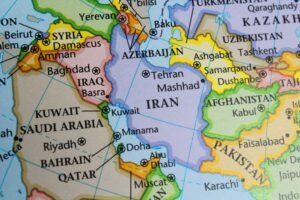
This distinction is important given speculation that the agreement could develop into an anti-Iran alignment. Such an interpretation is difficult to reconcile with the publicly stated positions of both the signatories and Tehran. Saudi officials have explicitly rejected the characterisation of the MJDA as a sectarian bloc, while Iranian Foreign Ministry spokesperson Esmaeil Baqaei stated that there is no reason to regard the agreement as being directed against Iran.[viii] More significantly, Tehran has acknowledged its potential as an indication of a wider regional shift towards greater security self-reliance. Iran’s response therefore suggests that the MJDA need not be understood through the conventional logic of competing regional blocs. It can instead be viewed as part of a broader effort by regional powers to diversify their security relationships amid growing uncertainty over the durability of existing security guarantees.
Turkiye has adopted a similar position[ix], rejecting suggestions that the agreement targets any particular state and instead emphasising deterrence, dialogue and regional stability. Ankara has also encouraged wider participation in the arrangement. Its contribution could be particularly important in translating the MJDA’s political commitments into practical cooperation. Joint military exercises, defence-industrial collaboration and maritime security initiatives would give the agreement an operational dimension and help ensure that collective deterrence rests on demonstrable capabilities rather than political declarations alone.
Egypt has emerged as a potential future participant, while Qatar and Kuwait have also been discussed as states that might eventually find value in the arrangement. Their inclusion would broaden the agreement’s geographical reach and add further political, economic and military capabilities.[x] Expansion, however, would also introduce a central challenge: the greater the number of participating states, the more difficult it may become to achieve political consensus during a crisis. Differences in threat perceptions, regional priorities and relations with neighbouring states could complicate decisions over when – and to what extent – the collective-defence commitment should be activated. The credibility of an expanded MJDA would therefore depend as much on effective crisis consultation as on the capabilities its new members could provide.
Pakistan’s experience in South Asia could be particularly relevant in this regard. Having operated for decades in a security environment marked by recurrent crises[i], military competition and the persistent risk of escalation, Pakistan has sought to combined conflict prevention with deterrence. Elements of this experience could inform the MJDA’s approach to crisis management by placing greater emphasis on consultation and de-escalation before a confrontation develops into open conflict. Deterrence and conflict resolution should therefore not be treated as competing objectives. If structured effectively, the former can create the political space necessary for the latter.
The agreement could also carry implications for South Asian security. For Pakistan, the prospect of support from Saudi Arabia and Turkiye may add another layer to its deterrence posture, although its practical significance would depend on how the MJDA’s collective-defence commitments are interpreted during a South Asian crisis. In principle, this could complement Pakistan’s emphasis on conflict resolution and its proposed strategic restraint regime.
More broadly, the MJDA illustrates how middle powers can assume greater responsibility for regional security without abandoning established great-power partnerships. The three members maintain extensive relationships across the region, allowing defence cooperation to coexist with dialogue, mediation and confidence-building measures. This combination of deterrence and diplomatic flexibility could make the MJDA an important component of a layered security architecture.
More broadly, the MJDA illustrates how middle powers can assume greater responsibility for regional security without abandoning established great-power partnerships. The three members maintain extensive relationships across the region, allowing defence cooperation to coexist with dialogue, mediation and confidence-building measures. Such arrangements need not displace great-power influence; rather, they can give regional states greater capacity to manage security challenges themselves. In this sense, the MJDA represents regional security hedging: an attempt to expand strategic autonomy while remaining embedded within the wider international security order.
Its long-term significance will depend on whether the three states can translate political commitments into credible cooperation. If successful, the MJDA could provide a model of layered security in which middle powers diversify their partnerships, strengthen collective deterrence and assume greater responsibility for regional stability without constructing a rival geopolitical bloc. Its significance may ultimately lie not in replacing the existing security architecture, but in demonstrating how regional agency can develop within it.
[i] Dawn (2019). “’Pakistan doesn’t want conflict management, it wants conflict resolution with India’”, 10 April 2019, retrieved from: https://www.dawn.com/news/1475169.
[i] Azhari, T., Shahid, A. and Gumrukcu, T. (2026). “Saudi Arabia, Turkey, Pakistan pledge mutual defence as Middle East turmoil escalates”, Reuters, 7 August 2026, Reuters, retrieved from: https://www.reuters.com/world/asia-pacific/saudi-arabia-turkey-pakistan-sign-joint-defence-deal-amid-regional-turmoil-2026-08-07/.
[ii] Shah, S.A. (2026). “The Makkah defence pact raises questions about its costs for Pakistan”, Asia News Network¸18 September 2026, retrieved from: https://asianews.network/the-makkah-defence-pact-raises-questions-about-its-costs-for-pakistan/.
[iii] Al Jazeera Centre for Studies (2026). “The Trilateral Mutual Defence Agreement: Motives, Aspirations and Concerns”, 18 August 2026, retrieved from: https://studies.aljazeera.net/en/policy-briefs/trilateral-mutual-defence-agreement-motives-aspirations-and-concerns.
[iv] Adaramola, Dr. I. (2026). “The Saudi Arabia-Turkiye-Pakistan Secuirty Agreement: An Emerging Framework for Collective Defence, Strategic Autonomy and Regional Stability”, Middle East Monitor, 18 August 2026, retrieved from: https://www.middleeastmonitor.com/20260818-the-saudi-arabia-turkiye-pakistan-security-agreement-an-emerging-framework-for-collective-defence-strategic-autonomy-and-regional-stability/.
[v] Forum IAS (2026). “Makkah Joint Defence Agreement (MJDA)…”, 10 August 2026, retrieved from: https://forumias.com/blog/makkah-joint-defence-agreement-mjda-explained-pointwise/.
[vi] Chughtai, A. and Ali, M. (2026). “What are Saudi Arabia, Turkiye and Pakistan’s joint military capabilities?”, Al Jazeera, 11 August 2026, retrieved from: https://www.aljazeera.com/news/2026/8/11/what-are-saudi-arabia-turkiye-and-pakistans-joint-military-capabilities.
[vii] Arab News (2026). “Saudi minister: Makkah defense agreement with Turkiye, Pakistan not a ‘military axis or sectarian bloc’”, 9 August 2026, retrieved from: https://www.arabnews.com/saudi-arabia/saudi-minister-makkah-defense-agreement-with-turkiye-pakistan-not-a-military-axis-or-sectarian-bloc-2653794.
[viii] Yousaf, K. (2026). “Iran downplays concerns over Makkah pact”, The Express Tribune, 11 August 2026, retrieved from: https://tribune.com.pk/story/2623194/iran-downplays-concerns-over-makkah-pact.
[ix] Demir, G.N. and Solmaz, F.Z. (2026). “Mecca Joint Defense Agreement does not target any country: Turkish foreign minister”, AA, 8 August 2026, retrieved from: https://www.aa.com.tr/en/turkiye/mecca-joint-defense-agreement-does-not-target-any-country-turkish-foreign-minister/4022116.
[x] Quillen, S. (2026). “Which other countries could join the Turkiye-Saudi-Pakistan defence pact?”, Al Jazeera, 9 August 2026, retrieved from: https://www.aljazeera.com/news/2026/8/9/which-other-countries-could-join-the-turkiye-saudi-pakistan-defence-pact.