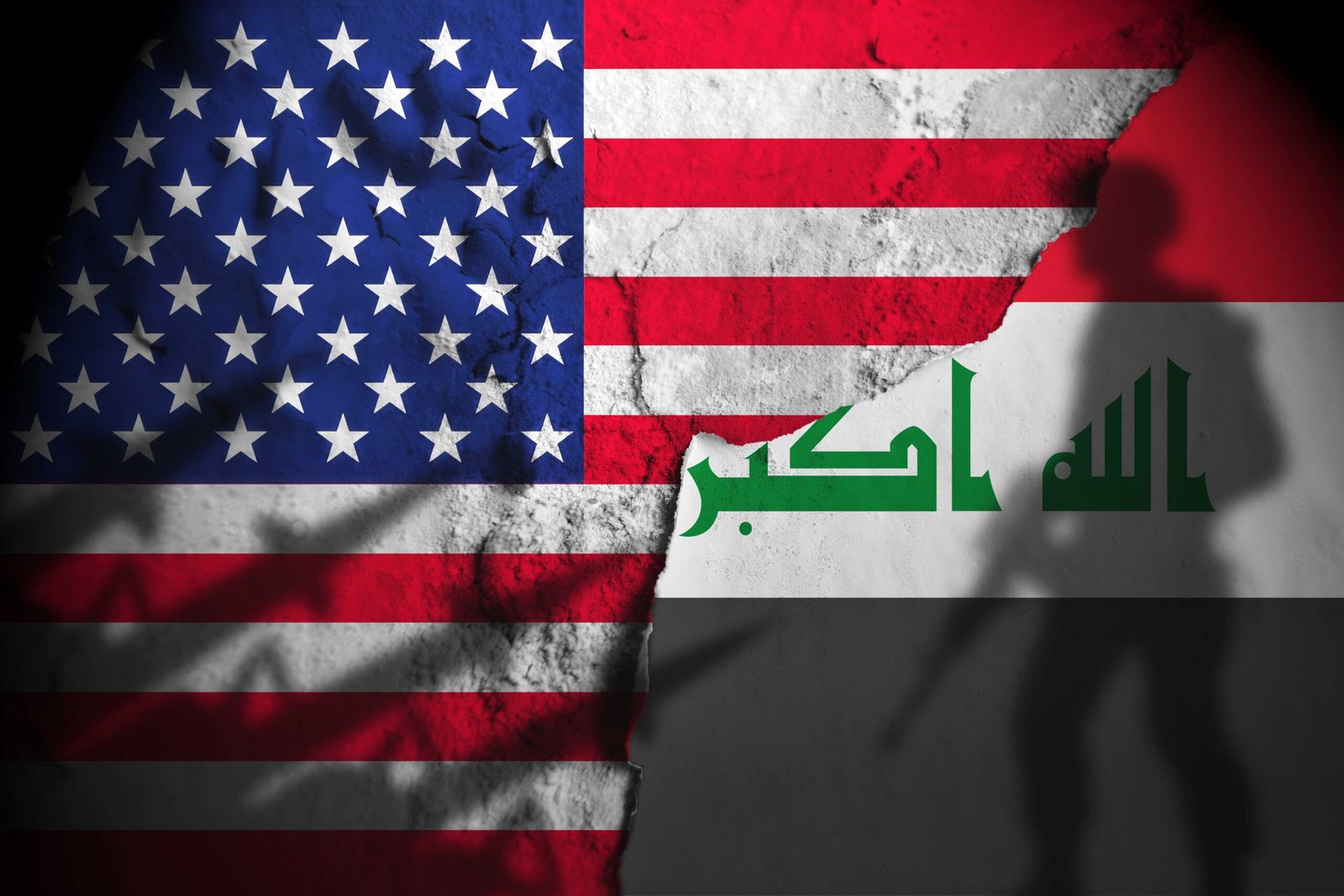
On 30th September, the United States is due to complete the withdrawal of its remaining coalition forces from Iraq, while the Pentagon’s memorandum of understanding with the Kurdistan Region’s Peshmerga (MoU) is set to expire.[i] The deadline marks another step in Washington’s effort to reduce its military footprint in the Middle East and shift security responsibilities to regional partners. Iraq’s withdrawal deadline has been confirmed.[ii] According to Prime Minister Ali al-Zaidi, Baghdad aims to complete the disarmament of Iran-aligned militias by 30 June 2027. The change separates the coalition’s departure from Baghdad’s effort to establish full state control over armed groups.
The timing is striking. On 25th August, Mazloum Abdi, commander of the Kurdish-led Syrian Democratic Forces, announced the group’s dissolution and the integration of its forces[iii] — the mainstay of the U.S.-backed anti-ISIS campaign — into the Syrian army. Two days later, Ahmed al-Sharaa appointed Abdi as a presidential adviser.[iv] In Iraq, meanwhile, the Peshmerga partnership is approaching its formal endpoint. The MOU’s expiration has been reported.
Taken together, these developments point toward a regional strategy that Washington appears to be trying to build around economic integration, energy corridors and regional connectivity, with Turkey, Iraq and Syria assuming greater security responsibilities. The architecture remains embryonic and its premises are being tested under exceptionally difficult conditions. The US-Iran war continues to generate volatility across the region, including the disruption of the very trade and energy networks Washington hopes will underpin its emerging order.
That tension offers a better way to understand what is happening to America’s Kurdish partnerships. The question is less whether Washington is “abandoning” the Kurds than how it is changing the basis on which regional actors retain American attention. The emerging hierarchy increasingly rewards control over energy, infrastructure and connectivity. Military utility remains important, yet its value appears to be declining as Washington reduces direct security commitments.
A new hierarchy of leverage
The Trump administration’s own language provides clues to this direction. U.S. officials have sketched a regional order built around Turkey as an energy and trade gateway, Iraq as a resource hub and Syria as a transit corridor to the Mediterranean, with security increasingly devolved to Ankara, Baghdad and Damascus. Washington signalled the economic side of this approach last December when it opened an $800 million consulate in Erbil[v] its largest anywhere in the world, while preparing to close its last remaining military base in the same city.
The extension of the disarmament timetable in Iraq means that U.S. forces are due to leave before the Iraqi government expects to complete its effort to bring armed factions under state control. The resulting gap illustrates one of the risks inherent in Washington’s approach.
The juxtaposition captures the direction of travel. Diplomatic and economic infrastructure is gaining importance as the U.S. military footprint contracts. The objective appears to be a system in which American influence flows increasingly through trade, energy, investment and regional partners.
For Kurdish actors, that shift creates a new hierarchy of leverage. The Kurdistan Democratic Party (KDP) retains importance to Washington because it controls the Ibrahim Khalil border crossing and much of the pipeline infrastructure running to the Turkish port of Ceyhan. Washington actively pushed to restart those oil exports[vi] after a two-and-a-half-year halt, restoring Kurdish crude to international markets.
The Patriotic Union of Kurdistan (PUK) has likewise acquired greater strategic relevance through the resources under its control. The Khor Mor field’s expansion is positioning Iraq to reduce its reliance on Iranian gas[vii], making the field an asset in Washington’s effort to reduce Iranian influence. That relevance has political value. PUK President Bafel Talabani met with Special Presidential Envoy to Syria and Iraq Tom Barrack and Mazloum Abdi[viii] in March to discuss constitutional protections for Syria’s communities, despite the PUK having no governing role in Syria.
The Peshmerga and SDF occupy a different position. Their principal strategic asset was manpower and military capability. The SDF’s territory and U.S. backing diminished sharply after January’s clashes, and the force has now been integrated into Syrian army brigades. The SDF’s dissolution followed that integration[ix] Kurdish rights, including language instruction, restored citizenship and a national holiday, currently rest on presidential decrees, while the constitutional settlement remains unfinished. Abdi has acknowledged that constitutional guarantees remain unresolved.[x] The Peshmerga faces a parallel decline[xi] in U.S. military support.
The emerging pattern is revealing. Actors with commodities, infrastructure or strategic access retain bargaining power. Actors whose principal contribution has been military manpower have less leverage as Washington reduces the role of U.S. forces. The shift is therefore more than a change in troop levels. It is a change in the currency of regional partnership.
The limits of commodity leverage
The clearest stress test is the Kurdish region itself. Washington’s emerging strategy places considerable faith in corridors, pipelines and energy infrastructure. Those assets can generate economic interdependence and give Washington new channels of influence. They also require a reasonably stable regional environment.
The U.S.-Iran war has exposed that vulnerability. The Kurdistan Region has lost roughly 70 percent of its trade amid the conflict.[xii] Regional reporting has detailed the scale of the disruption.[xiii] Iranian strikes forced the Khor Mor field offline in July[xiv], cutting gas production and thousands of megawatts from the regional grid. HKN Energy subsequently shut down its Kurdistan operations[xv] despite a freshly signed agreement to develop another field.
The significance lies in the contradiction. The pipelines and gas fields continue to perform the function Washington wants from them. They create leverage, support regional connectivity and give the United States an economic stake in local stability. But the surrounding security environment can simultaneously undermine their value.
That creates a difficult situation for the nascent architecture Washington appears to be constructing. Washington is seeking to substitute economic connectivity for some of the stabilizing effects once provided by American military presence, even as its confrontation with Iran contributes to the volatility that puts regional connectivity at risk. The result is an unresolved relationship between the economic and security sides of the equation.
Kurdish civilians are absorbing part of that tension through salary disputes with Baghdad[xvi] that predate the war and have intensified since it began. The episode illustrates a broader point. Economic infrastructure can create strategic leverage, but leverage becomes fragile when the security environment surrounding that infrastructure remains unsettled.
Turkey as security provider
Turkey illustrates another challenge. Ankara has been the most direct beneficiary of the SDF’s dissolution, which it had long regarded as removing a PKK-linked force from its southern border. Turkey has now moved from adversary to security provider for the new Syrian order. Defence Minister Yaşar Güler has confirmed that more than 20,000 Turkish troops have no immediate plans to leave Syria and are training Damascus’s forces.[xvii]
This represents continuity through a change in purpose. A Turkish military presence justified for years by the need to contain Kurdish autonomy is now helping support the Syrian government into which the SDF has been absorbed.
For Washington, this is precisely the kind of burden sharing that a smaller U.S. military footprint requires. It also creates a new dependency. Washington can influence regional security through Turkey, yet Turkey retains its own priorities toward the Kurds, Syria and the PKK. Outsourcing security therefore changes the source of risk as well as the distribution of responsibility.
The same problem appears in the unresolved question of Kurdish rights. Damascus has incorporated the SDF into the state, while the durability of the political guarantees offered to Syria’s Kurds remains uncertain. The emerging order has a stronger state at its centre, but the institutions capable of protecting minority rights are still developing.
The Women’s Protection Units (YPJ) offers the sharpest test. Kurdish negotiators have sought to integrate the YPJ, the all-female wing of the former SDF, into the Defence Ministry as an intact formation. Damascus has refused that arrangement[xviii] and instead offered individual absorption into the Interior Ministry. Women in Kobani have said plainly that they would not trust a Syrian army without an intact YPJ.[xix]
The YPJ matters analytically because it has little commodity leverage to offer. Its importance rests on political representation, social legitimacy and the role its members played in defeating ISIS. Those assets are harder to translate into bargaining power in an architecture increasingly organized around infrastructure and economic connectivity.
The case therefore exposes a limit to the new sorting logic. An order built around actors who possess resources and strategic infrastructure has fewer tools for protecting actors whose claims are primarily political, institutional or normative.
Israel and the problem of divergent interests
Israel adds another complication. Washington’s emerging architecture depends on a sufficiently unified Syria capable of supporting stable trade and energy corridors. Israeli officials have expressed a preference for a more fragmented Syrian landscape. Researchers at the Belfer Center have reported that Israel’s foreign minister favoured fragmentation into statelets[xx], while New Lines Magazine has separately documented an Israeli preference for weak and internally divided neighbours.[xxi]
That creates a second-order problem for Washington. The United States is trying to assemble an integrated regional economic system through partnerships with governments whose strategic preferences can diverge from the conditions that system requires.
The emerging architecture therefore depends on alignment among several moving parts. Turkey must provide security, Damascus must consolidate authority while accommodating minorities, Iraq must support energy and trade links, and regional conflict must remain sufficiently contained for infrastructure to function. The U.S.-Iran war has shown how quickly those assumptions can be disrupted.
September 30 and what comes next
The 30th will mark the beginning rather than the conclusion of an important test of how this new arrangement works in practice. The Peshmerga MOU’s expiration[xxii] will help determine who inherits the American bases being vacated in Erbil and how much of the security relationship survives after the formal U.S. military presence recedes. Iraqi and Kurdish officials are already watching the transition closely.
The SDF’s integration provides another test. Abdi’s appointment as presidential adviser gives Washington and the Kurds a channel into the new Syrian political structure, but the durability of Kurdish rights will depend on whether guarantees move from presidential decrees into constitutional and institutional protections.
The YPJ will offer an especially revealing test because it lacks the commodity leverage that has preserved the relevance of other Kurdish actors. Its treatment will show how much room the emerging order has for actors whose value cannot readily be measured in barrels, cubic feet, trade routes or border crossings.
The broader experiment remains in its early stages. Washington appears to be moving toward a Middle Eastern order in which economic integration, regional partners and local security providers carry more of the burden once assumed by American forces. That direction is visible in the treatment of the SDF, the Peshmerga, the KDP and PUK, as well as in the growing emphasis on Turkey, Iraq and Syria as components of a connected regional economy.
The first war of this emerging order is already testing its premises. The Iran conflict has disrupted trade, threatened energy infrastructure and exposed the security dependence embedded in economic corridors. That does not invalidate the strategy. It shows the conditions it requires.
Washington can gain influence at lower military cost by trading presence for leverage. The harder task is ensuring that the infrastructure, partners and political arrangements carrying that leverage remain resilient when regional volatility rises. For the Kurds, 30th September will mark another step in that transition. For Washington, the period that follows – including Iraq’s attempt to bring armed factions under state control by June 2027 – will provide an early indication of whether its new hierarchy of leverage can produce the stability that the strategy itself requires.
[i] Ozdemir, M. (2026). “The US-KRG Memorandum of Understanding (2016): The First Formal Military Pact Between America and the Kurds”, Kurdish History, 24 May 2026, retrieved from: https://www.kurdish-history.com/post/us-krg-memorandum-of-understanding-2016.
[ii] Al Jazeera (2026). “Iraq says September 30 withdrawal deadline for US-led coalition ‘final’”, 12 August 2026, retrieved from: https://www.aljazeera.com/news/2026/8/12/iraq-says-sept-30-deadline-to-end-us-led-military-coalition-final.
[iii] Al Jazeera (2026). “Kurdish-led SDF announces dissolution after merging with Syria’s military”, 26 August 2026, retrieved from: https://www.aljazeera.com/news/2026/8/25/kurdish-led-forces-in-syria-dissolve-after-merging-with-the-army.
[iv] Al Jazeera (2026). “Syria’s president appoints ex-commander of Kurdish-led SDF as advisor”, 27 August 2026, retrieved from: https://www.aljazeera.com/news/2026/8/27/syrias-president-appoints-ex-commander-of-kurdish-led-sdf-as-advisor.
[v] Raouf, S. (2026). “Iraq’s semi-autonomous Kurdish region suffers as US-Iran war drags on”, Al Jazeera, 11 August 2026, retrieved from: https://www.aljazeera.com/news/2026/8/11/iraqs-semi-autonomous-kurdish-region-suffers-as-us-iran-war-drags-on.
[vi] Al Jazeera (2025). “Iraq resumes Kurdish oil exports to Turkiye after two-and-a-half-year halt”, 27 September 2025, retrieved from: https://www.aljazeera.com/news/2025/9/27/iraq-resumes-kurdish-oil-exports-to-turkiye-after-two-and-a-half-year-halt.
[vii] Saeed, Y. (2025). “The Kurdish Gas Gambit”, New Lines Institute, 8 July 2025, retrieved from: https://newlinesinstitute.org/middle-east-center/the-kurdish-gas-gambit/.
[viii] PUK Media (2026). “Statement from the PUK Political Bureau”, 3 March 2026, retrieved from: https://pukmedia.com/EN/Details/80681.
[ix] Al Jazeera (2026). “Syria’s president appoints ex-commander of Kurdish-led SDF as advisor”, 27 August 2026, retrieved from: https://www.aljazeera.com/news/2026/8/27/syrias-president-appoints-ex-commander-of-kurdish-led-sdf-as-advisor.
[x] Turkish Minute (2026). “Syrian president appoints former SDF commander Mazloum Abdi as adviser”, 28 August 2026, retrieved from: https://turkishminute.com/2026/08/28/syrian-president-appoints-former-sdf-commander-mazloum-abdi-as-adviser/.
[xi] Aydogan, B. and Solmaz, Z. (2026). “Potential end of US aid to Peshmerga could mark ‘transitional phase’ in US-KRG relations, experts say”, AA, 7 September 2026, retrieved from: https://www.aa.com.tr/en/middle-east/potential-end-of-us-aid-to-peshmerga-could-mark-transitional-phase-in-us-krg-relations-experts-say/4049782.
[xii] Raouf, S. (2026). “Iraq’s semi-autonomous Kurdish region suffers as US-Iran war drags on”, Yahoo News, 11 August 2026, retrieved from: https://www.yahoo.com/news/world/articles/iraq-semi-autonomous-kurdish-region-094753807.html.
[xiii] Raouf (2026). “Iraq’s semi-autonomous Kurdish region suffers as US-Iran war drags on”.
[xiv] Frantzman, S.J. (2026). “Iran targets Kurdistan in regional escalation, spiking gas prices and tensions”, The Jerusalem Post, 19 July 2026, retrieved from: https://www.jpost.com/middle-east/iran-news/article-902917.
[xv] Ibid.
[xvi] The Arab Weekly (2026). “Fresh tension as Iraq’s new government faces old Kurdistan salary crisis”, 10 June 2026, retrieved from: https://thearabweekly.com/fresh-tension-iraqs-new-government-faces-old-kurdistan-salary-crisis.
[xvii] Gumrukcu, T. (2025). “Exclusive-Turkey backing Syria’s military and has no immediate withdrawal, defence minister says”, Yahoo News, 4 June 2025, retrieved from: https://www.yahoo.com/news/exclusive-turkey-backing-syrias-military-102449524.html.
[xviii] Salhani, J. (2026). “Kurdish-led SDF has dissolved, but has Syria really unified its military”, Al Jazeera, 26 August 2026, retrieved from: https://www.aljazeera.com/news/2026/8/26/kurdish-led-sdf-has-dissolved-but-has-syria-really-unified-its-military.
[xix] Abdi, N. (2026). “Women of Kobani: The Women’s Protection Units Are Our Primary Defensive Force”, Jinha Agency, 12 March 2026, retrieved from: https://jinhaagency.com/en/actual/s-38753.
[xx] Djerejian, E. (2025). “External States and Syria’s Challenge of Reunification under Transitional President Ahmed al-Sharaa”, Belfer Center, 29 October 2025, retrieved from: https://www.belfercenter.org/research-analysis/external-states-and-syrias-challenge-reunification-under-transitional-president.
[xxi] Scheindlin, D. (2026). “Does Israel Prefer Weak Neighbours?”, New Lines Magazine, 10 April 2026, retrieved from: https://newlinesmag.com/argument/does-israel-prefer-weak-neighbors/.
[xxii] Bush, D. (2026). “US plans to cut off military aid to key Middle East ally, BBC told”, BBC News, 28 August 2026, retrieved from: https://www.bbc.co.uk/news/articles/cn74m8e5rleo.