Dismissing October 2026 attacks by the Houthi movement against Riyadh’s airport and other civilian infrastructure[i] as a manifestation of a proxy war between Saudi Arabia and Iran ultimately fails to acknowledge the underlying factors that gave rise to Ansar Allah. Iran’s military, financial and diplomatic support has certainly been critical to developing drone and ballistic missile capabilities[ii] and to providing a regional context conducive to Houthi ideology and legitimacy. Iranian support reinforced an already existing northern alliance[iii] committed to destabilizing existing political structures and hegemony in the region. This reality, which conveniently served Tehran’s efforts to buttress destabilizing regional forces, was brought about not solely by the machinations of the Islamic Revolutionary Guard Corps but by the combination of Saudi policies towards Yemen over a century, misguided UN diplomatic efforts since 2011, and southern Red Sea geography. Understanding this historical, diplomatic, and geographic context both allows the formulation of a more nuanced view of the Houthi-Saudi conflict and allows for the disaggregation of the Yemen conflict from the far more intractable war with Iran – allowing one to be solved even as the other continues unabated.
The origins of Yemen’s fragmentation
At its core, the Ansar Allah movement, led by the northern Houthi tribal family, emerged in opposition to the Yemeni state in Sana’a – a state that has been weakened as a consequence, in part, of Saudi policies towards South Arabia. Since the first conflict between the nascent Saudi monarchy and the centuries-old North Yemeni imamate[iv], there remains a deep-seated cultural conflict between the settled Bedouin of Yemeni highlands and the emerging Saudi state under Ibn Saud.
The 1934 Taif Agreement, which marked the end of the first Saudi-Yemen conflict, both documented the annexation of three Yemeni provinces by Saudi Arabia[v] and served as a perpetual source of resentment among Yemeni nationalists who were forced not only to endure an embarrassing military defeat but also to cede territory that was culturally, tribally, and linguistically Yemeni. Adding further insult to injury, the three provinces – Asir, Najran, and Jizan – have continued to receive a proportionally smaller percentage of state investment and development funding.[vi] [vii] As the most impoverished Saudi citizens, the residents of this southern border region have been susceptible to extremist tendencies and radicalization.[viii]
A weakened Yemeni state was ultimately more susceptible to populist opposition parties united around existing regional and political grievances.
Almost uniformly, Yemeni politicians have repeatedly called for returning these three provinces to Yemen. With the exception of a few moments in Yemen’s history, Yemeni leaders had neither the popular support nor the political and military power to challenge Saudi regional hegemony. This was entirely by design. Fearing a Yemeni challenge to the monarchy along these border regions, Saudi Arabia strategically supported opposition groups[ix], thereby maintaining a weakened state in South Arabia and disunity among its political regions. This also meant that the Saudi monarchy might ultimately have found itself supporting and countering the same loose coalitions at different periods in Yemen’s history.
When Egyptian President Gamal Abdel Nasser, for example, sent 70,000 Egyptian soldiers to support a Yemeni republic in 1962, the Saudi monarchy granted territorial refuge, material support, and diplomatic cover for the deposed Yemeni Imam Muhammad al-Badr and his royalist northern tribal opposition.[x] Those same tribes, which would later constitute the most vocal supporters of the Houthi movement, were allies of necessity for Saudi Arabia, out of concern for Egyptian expansionism and the emergence of a strong North Yemeni republican state. Once Egypt was forced to withdraw in 1967[xi] and an independent post-colonial Arab Communist state emerged in South Yemen following the dissolution of the British Empire colonial outpost in Aden, the Saudis were sufficiently placated with South Arabian disunity to relinquish their own support for the Imam’s opposition party.
When unification between north and south Yemen came about in 1990, the Saudi monarchy was again alarmed by the emergence of a strong enemy state south of its border. These concerns were reinforced when Yemen, then occupying one of the Arab seats on the United Nations Security Council, failed to condemn Saddam Hussein’s August 1990 invasion of Kuwait.[xii] Saudi Arabia’s immediate response, aimed at the economic prosperity of Yemen, was to expel over 1 million Yemeni migrant workers[xiii] whose remittances were a key source of investment financing, and whose return to Yemen set off a decades-long economic crisis. Aiming at a long-term challenge to a united Yemen, Saudi Arabia again turned to the southern separatist movement to undermine a strong unified state.[xiv] The 1994 Civil War between Sana’a and Aden highlighted the regional and political fissures in the imperfect Yemeni unity.
These same regional fissures contributed to the northern grievances against the Sana’a-based government, which, as a matter of state policy, exercised economic, religious, political, and developmental marginalization.[xv] The Houthi family took advantage of those grievances, encouraging anti-Saudi tendencies like the “Asir Movement”[xvi] and leveraging the growing popularity of slogans like “Death to America! Death to Israel!” to solidify the foundations of their own movement. In the short term, Saudi policy might have served as an unbalanced security measure. In the long term, however, a weakened Yemeni state was ultimately more susceptible to populist opposition parties united around existing regional and political grievances.
The unintended consequences of UN diplomacy
Saudi Arabia’s approach to Yemen was complicated by regional events and global responses that failed to fully account for the complexities of Yemen’s political landscape and unintentionally supported the growth and development of the Houthi movement. In a now well-documented scholarly critique of international response to the 2011 Arab Spring[xvii], the downfall of Arab presidential states paved the way for extremist and militant organizations to exert a destabilizing influence on national politics. Yemen was no exception to the civil wars and renewed authoritarianism that emerged in the subsequent decade.
Failing to appreciate the broader impact of Yemen’s state collapse, UN Special Envoy Jamal Benomar oversaw a National Dialogue Conference[xviii], the resolutions of which served to further enflame regional tensions in the country. Southern and northern autonomy and political power were sacrificed in the name of Yemeni unity and modernist development. Less than two years after the end of the much celebrated, UN-financed NDC, Houthi tribal militias had already arrived in Sana’a, seizing control of state institutions.[xix]
An equal seat at the negotiating table offered the Houthi movement international political legitimacy.
Through a policy consistent with its decades-long practice of supporting opposition groups within Yemen, Saudi Arabia, along with the United Arab Emirates, gave financial and military support to a loose coalition of anti-Houthi groups.[xx] Coupled with Saudi and Emirati airstrikes, this coalition fought the Houthi militias, pushing back their territorial advance, which had already reached the eastern oil-rich city of Marib and the southern port city of Aden in March 2015. When it seemed that Saudi Arabia’s policy of Yemeni-disunity was, once again, serving to weaken a Yemeni state with disparate parties, UN diplomatic interventions were launched, constituting an unanticipated challenge to Saudi policy. In response to Yemen’s devastating humanitarian crisis, international actors intensified diplomatic efforts and expanded humanitarian assistance. However, these interventions also produced unintended political and economic consequences that benefited the Houthi movement. An equal seat at the negotiating table offered the Houthi movement international political legitimacy[xxi], while ballooning foreign aid unintentionally enriched Houthi militias[xxii] who benefitted from transit fees and the black market.
After two years of predictably failed negotiations, the Saudi-led coalition launched a renewed offensive against the Houthi-controlled port of Hodeidah[xxiii], the gateway for both humanitarian aid and clandestine munitions from Iran. As it appeared the coalition was on the verge of victory, once again validating Saudi regional policy; UN Envoy Martin Griffiths brokered an agreement that, critics argue, ultimately benefited the Houthi movement. He invited warring parties to another negotiating table, crafting the Stockholm Agreement in December 2018[xxiv] as a limited ceasefire and troop withdrawal from Hodeidah. Houthi forces went on to consolidate control of the port city two years later, forcing the military withdrawal of Saudi coalition forces.
Riding early gains in 2021 Hodeidah, Houthi militants launched a second major offensive against Marib.[xxv] Rather than condemning the renewed violence, the Biden Administration removed the movement’s Foreign Terrorist Organization designation[xxvi], while rescinding its support for the Saudi coalition. A renewed round of UN-brokered talks in March 2023[xxvii] arguably strengthened the Houthis’ negotiating position as the UN further called for an end to Saudi Arabia’s military operations in Yemen.
The Red Sea and the geography of Houthi influence
Its alliance with Iran is hardly the principal foundation of Houthi power, nor is it vital for the movement’s identity.
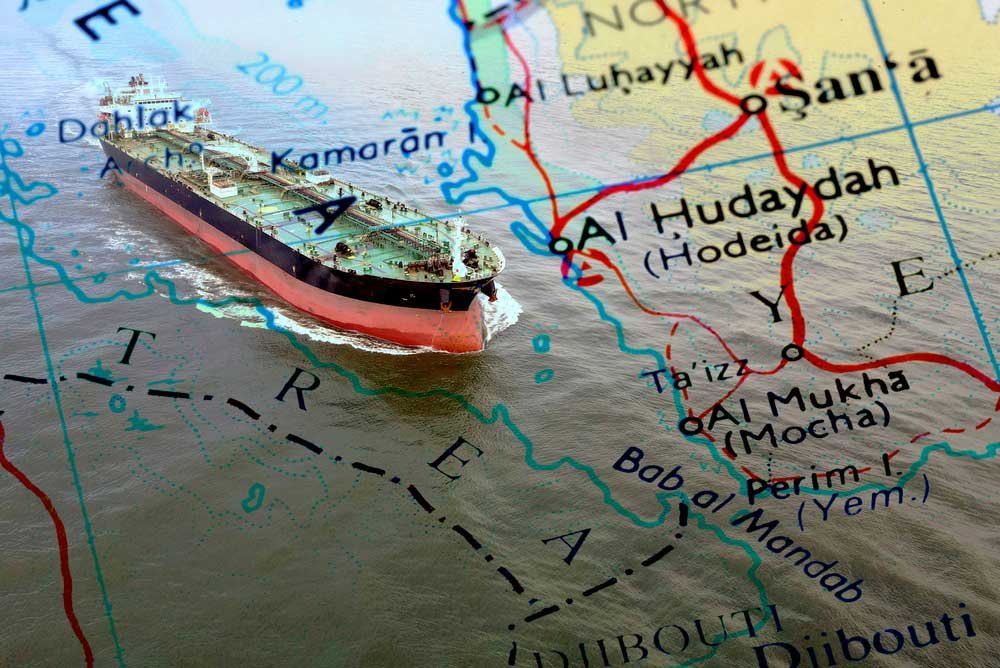
Although UN and other international diplomatic maneuvers may have surprised Saudi policy makers in Yemen, the strategic implications of Houthi territorial expansion should have been more readily apparent. Bab al-Mandeb, the southern gateway to the Red Sea, has been a strategically important economic asset for regional trade, especially for Suez Canal shipping. When Egypt completed its 2015 expansion of the Suez Canal[xxviii], adding a parallel channel to allow two-way traffic through its central section, Bab al-Mandeb became even more important. While international attention understandably focused on Yemen’s deepening humanitarian crisis, the strategic implications of emerging Houthi threats to Red Sea shipping received comparatively limited attention.
By the time of October 7, 2023, the Houthi movement was in an advantageous territorial position for two main reasons. Located just 1,200 miles from Tel Aviv, the Houthis could launch ballistic missiles towards Israeli territory, albeit with limited effectiveness, thereby acting on the movement’s slogan calling for “Death to Israel!”[xxix] and solidifying its popular legitimacy in Yemen and across the Arab world. While Sana’a was not within striking distance of American territory, Houthi leadership appreciated the economic harm that could be brought about by threatening Bab al-Mandeb traffic.
And thus, geographic realities and regional developments provided the Houthi movement with the position to challenge decades of Saudi policy towards Yemen. Compounded by the unintended consequences of international diplomatic intervention, Saudi Arabia’s strategy of weakening the Yemeni state has finally met an insurmountable obstacle.
Of important note is that its alliance with Iran is hardly the principal foundation of Houthi power, nor is it vital for the movement’s identity. Separating these two aspects will ultimately allow both Saudi Arabia and the international community, to address the Yemen crisis independently of the broader confrontation with Iran. It might also behoove the UN to accept short-term responsibility for allowing the Houthi movement to metastasize into an internationally sanctioned entity, or Saudi Arabia to admit to a failed policy of Yemeni disunity, perhaps considering a more long-term alternative that focuses on unifying Yemen, rather than dividing the country and hoping for weakness.
[i] Choukeir, J. et al. (2026). “One dead in new attack on Saudi airport, a day after Houthi strike kills 13”, Reuters, 11 October 2026, retrieved from: https://www.reuters.com/world/middle-east/yemens-houthis-renew-warning-over-saudi-airports-after-deadly-riyadh-attack-2026-10-11/.
[ii] Hafezi, P., Ghobari, M. and Azhari, T. (2026). “Iranian arms and advice helped Yemen’s Houthis seize key Red Sea city, sources say”, Reuters, 10 September 2026, retrieved retrieved from: https://www.reuters.com/world/middle-east/iranian-arms-advice-helped-yemens-houthis-seize-key-red-sea-city-sources-say-2026-09-10/.
[iii] International Crisis Group (2014). “The Houthis: From Saada to Sanaa”, 10 June 2014, retrieved from: https://www.jstor.org/stable/resrep32000.
[iv] Brandt, M. (2017). “Sects and Politics” in Tribes and Politics in Yemen: A History of the Houthi Conflict, 15 November 2017, Oxford: Oxford University Press.
[v] Orkaby, A. (2015). “Saudi Arabia’s War with the Houthis: Old Borders, New Lines”, WINEP, 9 April 2015, retrieved from: https://www.washingtoninstitute.org/policy-analysis/saudi-arabias-war-houthis-old-borders-new-lines.
[vi] Leber, A. (2020). “Saudi Arabia: How Yemen War Weighs on South’s Economy”, Italian Institute for International Political Studies, 9 September 2020, retrieved from: https://www.ispionline.it/en/publication/saudi-arabia-how-yemen-war-weighs-souths-economy-27325.
[vii] Roelants, C. (2016). “Poverty in the Land of Black Gold”, New Internationalist, 1 March 2016, retrieved from: https://newint.org/features/2016/03/01/poverty-in-the-land-of-black-gold.
[viii] Orkaby, A. (2026). “How Saudi Arabia Created the Yemen It Fears”, The National Interest, 19 October 2026, retrieved from: https://nationalinterest.org/blog/middle-east-watch/how-saudi-arabia-created-the-yemen-it-fears.
[ix] Johnsen, G.D. (2021). “Foreign Actors in Yemen: The History, the Politics and the Future”, Sana’a Center, 31 January 2021, retrieved from: https://sanaacenter.org/publications/policy-research/13042.
[x] Ibid.
[xi] Wearing, D. (2018). “Britain’s War in Yemen”, New Socialist, 19 October 2018, retrieved from: https://newsocialist.org.uk/britains-war-in-yemen/.
[xii] Repertoire of the Practice of the Security Council (1990). “Items relating to the situation between Iraq and Kuwait”, retrieved from: https://main.un.org/securitycouncil/sites/default/files/en/sc/repertoire/89-92/Chapter%208/MIDDLE%20EAST/item%2022_Iraq-Kuwait_.pdf.
[xiii] Sana’a Center (2019). “Saudi Arabia’s ‘Deportation Storm’”, 9 April 2019, retrieved from: https://sanaacenter.org/publications/editorials/7303.
[xiv] Al-Muslimi, F. (2015). “The Southern Question: Yemen’s War Inside the War”, Carnegie Endowment, 8 July 2015, retrieved from: https://carnegieendowment.org/middle-east/diwan/2015/07/the-southern-question-yemens-war-inside-the-war.
[xv] Brandt (2017). Tribes and Politics in Yemen.
[xvi] Nagi, A. (2022). “The Pitfalls of Saudi Arabia’s Security-Centric Strategy in Yemen”, Carnegie Endowment, 12 October 2022, retrieved from: https://carnegieendowment.org/middle-east/research/2022/10/the-pitfalls-of-saudi-arabias-security-centric-strategy-in-yemen.
[xvii] Al-Madhaji, M. (2016). “How Yemen’s post-2011 transitional phase ended in war”, Sana’a Center, 19 May 2016, retrieved from: https://sanaacenter.org/publications/policy-research/39.
[xviii] Schmitz, C. (2014). “Yemen’s National Dialogue”, Middle East Institute, 10 March 2014, retrieved from: https://mei.edu/publication/yemens-national-dialogue/.
[xix] BBC News (2014). “How Yemen’s capital Sanaa was seized by Houthi rebels”, 27 September 2014, retrieved from: https://www.bbc.co.uk/news/world-29380668.
[xx] Middle East Eye (2015). “Who has joined the Saudi-led anti-Houthi coalition and why?”, 31 March 2015, retrieved from: https://www.middleeasteye.net/news/who-has-joined-saudi-led-anti-houthi-coalition-and-why.
[xxi] Alasrar, F.A. (2025). “The legitimacy trap: How international institutions sustain the Houthis’ hold on Yemen”, Middle East Institute, 3 November 2025, retrieved from: https://mei.edu/publication/legitimacy-trap-how-international-institutions-sustain-houthis-hold-yemen/.
[xxii] Schmitz (2014). “Yemen’s National Dialogue”.
[xxiii] BBC News (2018). “Yemen war: Why the battle for Hudaydah matters”, 13 June 2018, retrieved from: https://www.bbc.co.uk/news/world-middle-east-44471977.
[xxiv] United Nations (2018). “Full text of the Stockholm Agreement”, 13 December 2018, retrieved from: https://osesgy.unmissions.org/en/node/15464.
[xxv] “The Marib front in Yemen’s Civil War””, Strategic Comments, 27(8), 2021, retrieved from: https://www.tandfonline.com/doi/full/10.1080/13567888.2021.2003083.
[xxvi] Schifrin, N. and Rogin, A. (2021). “In foreign policy shift, Biden lifts terrorist designation for Houthis in Yemen”, PBS News, 16 February 2021, retrieved from: https://www.pbs.org/newshour/show/in-foreign-policy-shift-biden-lifts-terrorist-designation-for-houthis-in-yemen.
[xxvii] UK Parliament (2023). “Yemen in 2023: Conflict and status of peace talks”, 27 November 2023, retrieved from: https://commonslibrary.parliament.uk/research-briefings/cbp-9327/.
[xxviii] BBC News (2015). “Egypt launches Suez Canal expansion”, 6 August 2015, retrieved from: https://www.bbc.co.uk/news/world-middle-east-33800076.
[xxix] Phillips, S.G. (2024). “’America is the mother of terrorism’: why the Houthis’ new slogan is important for understanding the Middle East”, The Conversation, 11 February 2024, retrieved from: https://theconversation.com/america-is-the-mother-of-terrorism-why-the-houthis-new-slogan-is-important-for-understanding-the-middle-east-222865.