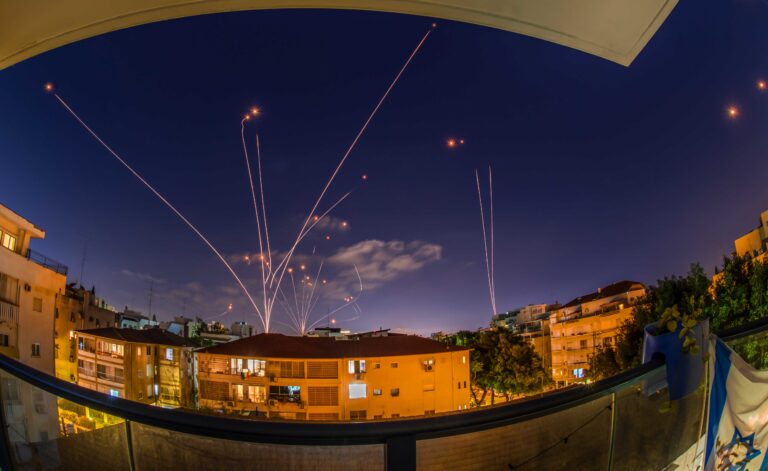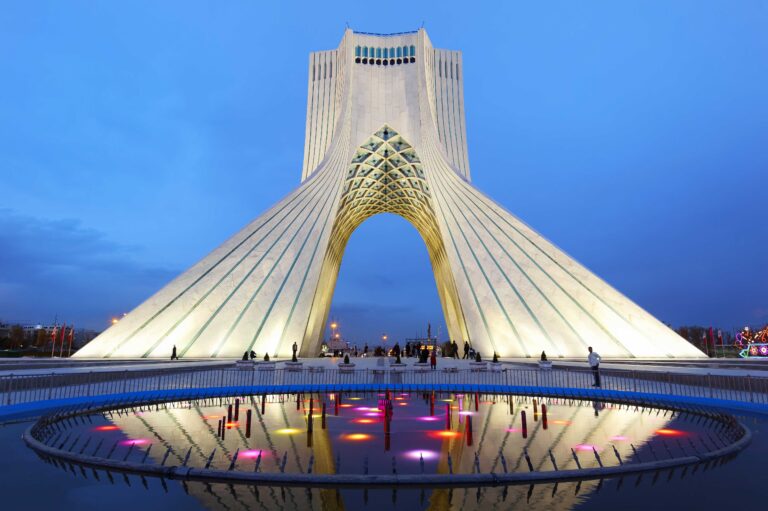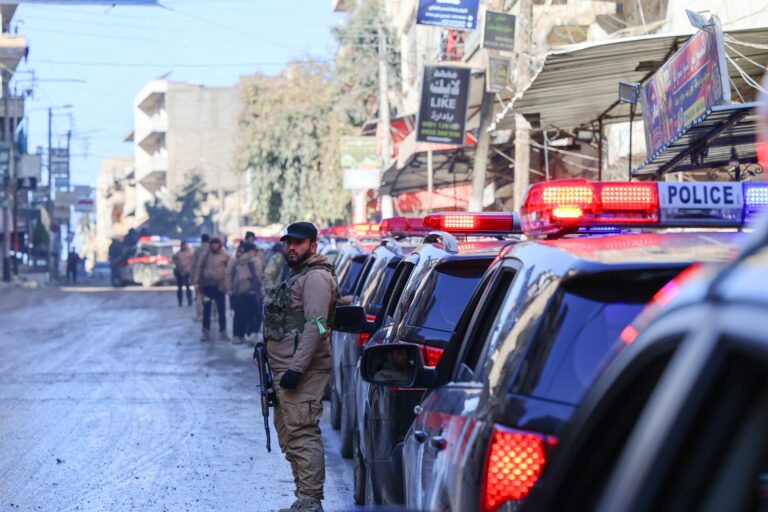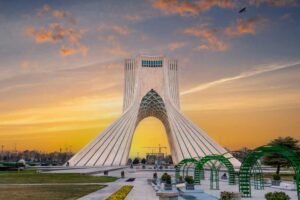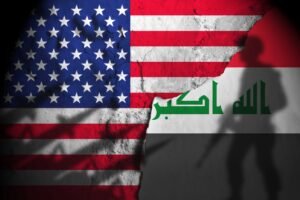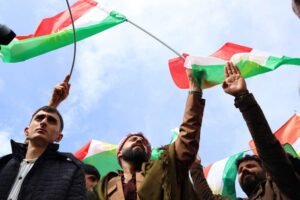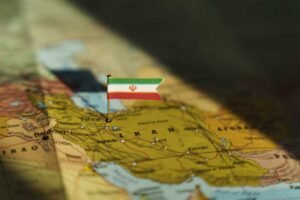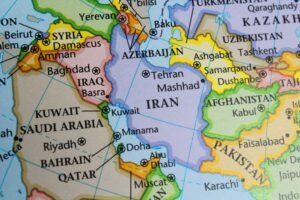
On a military map, the strategy looks simple: support armed Kurdish, Baluchi or Azeri groups, add American and Israeli air power and intelligence, and force Tehran to fight on several fronts. Inside Iran, however, the same strategy could divide the opposition, frighten the wider public and allow the Islamic Republic to present itself as the defender of the country.
This creates a difficult question for Iran’s opposition. Can armed ethnic organisations help remove an authoritarian government, or will they make democratic change harder? These groups are very different from one another. Some campaign peacefully for minority rights, federalism or greater local power. Others are armed and seek separation. Some present themselves as defenders of oppressed communities. This article focuses on armed groups that seek to change Iran’s borders, as well as the risks associated with foreign support for armed ethnic organisations. Yet there is little reliable evidence that the armed organisations discussed here have received a democratic mandate to speak for the wider Kurdish, Baluchi, Azeri or Arab populations of Iran. Their uncertain public support, armed methods and reliance on foreign patrons could weaken the democratic opposition and give the Islamic Republic another reason to suppress it.
Iran’s political system has clearly lost much of its public support. A GAMAAN survey[i], conducted in June 2026, used a weighted sample of 31,450 respondents inside Iran. Its findings were calibrated to represent literate residents aged 15 and above. Around 47 per cent identified with regime change and another 23 per cent supported structural transformation and transition from the Islamic Republic. Only about 9 per cent identified with the principles of the 1979 Revolution and the Supreme Leader. These figures suggest that demands for fundamental political change have moved into the mainstream of Iranian society, although the groups seeking change do not necessarily support the same alternative.
Yet opposition to the Islamic Republic should never be confused with opposition to Iran’s territorial integrity. This distinction is missing from many discussions about fragmentation. Iran is a multilingual and multi-ethnic country. Kurds, Azeris, Baluchis, Arabs, Turkmen, Lurs and Persians have distinct languages, identities and political grievances. Minority regions have faced discrimination, economic neglect and harsh security policies. These problems are real. A democratic Iran must address them through equal citizenship, cultural rights, fair development and meaningful decentralisation. Recognising these injustices, however, does not require accepting the claims of armed organisations that say they represent entire communities. The case for political reform is therefore strong. The case for breaking the country apart is far weaker.
Iran’s ethnic and national landscape
Iran is not a state created by the Sykes–Picot agreement.[ii] That agreement dealt with the Arab provinces of the Ottoman Empire, and its role in drawing the present borders of the Middle East is itself often exaggerated. Iran has a far longer history of statehood. Its national identity has survived foreign occupations, revolutions, dynastic changes and the eight-year war with Iraq.
Iran’s ethnic map is also very different from the simple coloured maps sometimes circulated online. Its communities do not live in completely separate territories. Large cities and many provinces have mixed populations. Decades of migration, bilingualism, shared institutions and intermarriage have created strong links between them. Research on Iranian ethnic politics describes the country’s national identity[iii] as comparatively coherent and stable despite repeated local uprisings.[iv] This social reality also limits what armed organisations could achieve through territorial control.
The problem of representation
Armed organisations operate particularly in some Kurdish and Baluchi border areas, although their strength is difficult to measure independently. Several Iranian Kurdish parties have long maintained bases or camps in northern Iraq[v], where they have faced pressure to disarm and move away from the Iranian border. Such groups could create instability in border regions if central authority weakened, but their ability to exercise control across a large, urbanised and socially connected country would be far more limited.
Armed separatist groups may also speak in the name of Iran’s Kurds, Azeris, Baluchis and Arabs. Yet no reliable election or representative institution shows that these organisations have been authorised to decide the political future of entire communities. Many operate partly or mainly from exile, with little demonstrated support inside Iran, although their actual level of support is difficult to measure independently.
Kurdish armed parties have developed more durable political and military structures through their long presence across the Iraqi border and, in some cases, outside assistance by foreign funding. Where it exists, external support can provide visibility and military capacity, but it cannot create a democratic mandate. Even the wider ethnic opposition remains divided, poorly coordinated and weakly connected to communities inside Iran.[vi] The language of national liberation cannot replace public consent.
Armed separatism can also obstruct democratic change. It moves attention away from accountable government, civil rights and free elections towards borders, territory and military control. It can divide opposition groups and encourage people to view political change as a threat to the country’s survival. It also harms peaceful minority activists. Once an armed organisation attacks in the name of an ethnic community, Tehran can more easily accuse teachers, journalists, students and cultural campaigners from that community of separatism.
The problem goes beyond democratic legitimacy. Dependence on foreign money, protection, intelligence or military access can tie an armed group to the priorities of its sponsor. It may gain weapons without gaining legitimacy and international attention without building trust at home.
Israel, the Kurds and the politics of perception
The recent Jewish–Kurdish conference in London shows why careful language matters.[vii] The event, held on 6–7 September 2026, brought together Kurdish and Jewish scholars, activists and civil-society representatives. Israeli Foreign Minister Gideon Sa’ar addressed[viii] the conference by video, praised Jewish–Kurdish relations and noted that the Kurdish people had not achieved political independence. His remarks were a public statement by a senior Israeli official, but they did not announce a formal Israeli policy on Iran’s borders or support for Kurdish armed action.
The conference itself does not prove the existence of an Israeli plan to create a “Greater Kurdistan”. Cultural cooperation between Jews and Kurds should not automatically be described as a conspiracy. In the present climate, however, support from an Israeli minister for Kurdish political aspirations can easily be interpreted inside Iran and Turkey as part of a wider regional strategy. This is especially sensitive while Israeli–Turkish competition is growing and speculation continues about using Kurdish forces against Tehran.
Inside Iran, the distinction between formal policy and political perception can easily disappear, making any perceived foreign support for ethnic fragmentation politically explosive.[ix]
Media reports have described American and Israeli efforts to mobilise Iranian Kurdish fighters against Tehran.[x] Such reporting is different from a publicly declared government policy, and Israel has not formally announced such a plan. The political consequences, however, do not depend entirely on whether such a policy exists. Reports of foreign contact with armed ethnic groups can strengthen the belief that outside powers may use Iran’s internal divisions for their own strategic purposes.
Israel conducts digital diplomacy aimed at regional audiences in several languages, including Persian, Arabic, Kurdish and Turkish, using language-specific pages and social-media accounts.[xi] Its Persian-language campaign presents Israel as an opponent of the Islamic Republic and a friend of the Iranian people, while in Kurdish it portrays itself as a supporter of Kurdish rights and political aspirations. Similar messages are directed at Arabic- and Turkish-speaking audiences. This allows Israel to appeal to different communities, even when their political interests may conflict. This message appears to have found a receptive audience among some Iranians, although public attitudes towards Israel remain divided. A 2026 survey found that 51 per cent held a positive view of Benjamin Netanyahu and 38 per cent a negative one.[xii] This does not amount to general support for Israeli policy, but it shows that Israel has attracted some public sympathy inside Iran. Any suggestion that Israel also seeks to weaken or fragment Iran could damage that support, increase public suspicion and help Tehran portray its opponents as partners in a foreign project.
It could also reinforce a longstanding government narrative. The Islamic Republic has long tried to portray democratic activists, journalists and minority-rights campaigners as foreign agents. A real or perceived threat to Iran’s borders allows the authorities to transform a debate about freedom into a struggle for national survival.
The risks of fragmentation
The costs would not stop at Iran’s borders. Fragmentation could spread instability across the region. Kurdish armed mobilisation could pull in Turkey and factions based in Iraqi Kurdistan. Attempts to mobilise Iranian Azeris could create a dangerous contest involving Azerbaijan, Turkey and Iran. A Baluchi conflict could cross into Pakistan. The result could be rival authorities[xiii], local militias and a regional struggle without a clear end. Air strikes can create a political vacuum; they cannot control what fills it.
The risks would also extend to Iran’s nuclear calculations. If Tehran became convinced that foreign powers intended to destroy Iran as a state, nuclear weapons could begin to appear less like an ideological project and more like protection against national collapse. Such a perception could strengthen voices within Iran’s nuclear debate[xiv] that present weaponisation as a final form of deterrence. A threat to the country’s territorial integrity could therefore increase pressure for the very nuclear outcome that Israel and the United States seek to prevent.
Using Iran’s ethnic communities as instruments of a wider regional conflict would cross a dangerous line. It is also unlikely to produce a controlled outcome in which Iran is weakened by internal ethnic conflict and becomes less able to project power across the region. Instead, it could turn a campaign against the Islamic Republic into a perceived threat against Iran itself, alienate Iranians who once viewed Israel positively and give Tehran a powerful excuse to present every opponent as a foreign-backed separatist.
Iran’s democratic future depends on a movement able to cross ethnic, linguistic and regional divisions. Armed separatist parties or Foreign-backed ethnic groups cannot offer that common ground. Their lack of a proven public mandate, reliance on outside support and military approach may weaken the national opposition, endanger minority communities and help the Islamic Republic survive. Iran needs equal citizenship, cultural rights and meaningful decentralisation, but these goals will not be achieved by turning ethnic communities into tools of proxy war. The Islamic Republic may eventually fall or give way to a different political system, but Iran will almost certainly outlive it. A strategy that appears to force Iranians to choose between political freedom and the survival of their country could lead many to place territorial security first.
[i] The Group for Analyzing and Measuring Attitudes in Iran (GAMAAN) (2026). “Iranians’ Attitudes Toward the 2026 Protests and War”, 27 July 2026, retrieved from: https://gamaan.org/2026/07/27/iranians-attitudes-toward-the-2026-protests-and-war/.
[ii] Ottaway, M. (2015). “Learning from Sykes-Picot”, Wilson Center, 19 November 2015, retrieved from: https://www.wilsoncenter.org/publication/learning-sykes-picot.
[iii] Beidollahkhani, A. (2024). “Myth and epic as a non-religious revival of national identity…”, National Identities, 24 July 2024, retrieved from: https://www.tandfonline.com/doi/full/10.1080/14608944.2024.2372597#d1e122.
[iv] Bayat, K. (2005). “The Ethnic Question in Iran”, Middle East Research and Information Project, 31 December 2005, retrieved from: https://www.merip.org/2005/12/the-ethnic-question-in-iran/.
[v] Abdul-Zahra, Q. (2023). “Tehran and Baghdad reach a deal to disarm and relocate Iranian dissident groups based in north Iraq”, AP, 28 August 2023, retrieved from: https://apnews.com/article/iraq-iran-dissidents-kurds-4de08f7aab08bae540f9c45a718bad8c.
[vi] Vaziri, N. (2026). “Fissures Among Iran’s Ethnic Minority Groups Are Poised To Break Open”, New Lines Institute, 28 February 2026, retrieved from: https://newlinesinstitute.org/middle-east-center/fissures-among-irans-ethnic-minority-groups-are-poised-to-break-open/.
[vii] UA News (2026). “Conference on Jewish-Kurdish relations opens in London”, 7 September 2026, retrieved from: https://ua.news/en/world/u-londoni-vidkrilasia-konferentsiia-pro-ievreisko-kurdski-vidnosini.
[viii] Carson, A. (2026). “International Jewish-Kurdish conference kicks off in London”, The Jerusalem Post¸7 September 2026, retrieved from: https://www.jpost.com/diaspora/article-907858.
[ix] Zimmt, R. (2025). “The Iran-Israel war and the stability of the Islamic Regime”, INSS, 28 July 2025, retrieved from: https://www.inss.org.il/publication/iran-regime-stablity/.
[x] Burke, J. and Roth, A. (2026). “Airstrikes hit Iran-Iraq border as US and Israeli plan to mobilise Kurds gathers pace”, The Guardian, 5 March 2026, retrieved from: https://www.theguardian.com/world/2026/mar/04/airstrikes-hit-iran-iraq-border-as-us-and-israeli-plan-to-mobilise-kurds-gathers-pace.
[xi] Barel, O. (2024). “Artificial Intelligence in the Service of Israel’s Public Diplomacy”, INSS, retrieved from: https://www.inss.org.il/strategic_assessment/artificial-intelligence/.
[xii] The Group for Analyzing and Measuring Attitudes in Iran (GAMAAN) (2026). “Iranians’ Attitudes Toward the 2026 Protests and War.”
[xiii] Roush, J. (2026). “Balkanizing Iran? US Strategy Risks Protracted Ethnic Conflict”, Geopolitical Monitor, 9 March 2026, retrieved from: https://www.geopoliticalmonitor.com/balkanizing-iran-us-strategy-risks-protracted-ethnic-conflict/.
[xiv] Azizi, H. (2024). “Iran’s Shifting Discourse on Nuclear Weaponisation: Bargaining Tactic or Doctrine Change?”, Middle East Council on Global Affairs, 6 November 2024, retrieved from: https://mecouncil.org/publication/irans-shifting-discourse-on-nuclear-weaponization-bargaining-tactic-or-doctrine-change/.