“It would be best for Erdoğan to continue making empty, delusional speeches against Israel in the Turkish Parliament, rather to attempt to test Israel’s resolve to defend itself,” warned Israel’s Defense Minister, Israel Katz, in a post on X in late August.[i]
Katz’s warning reflects the growing regional rivalry between Turkey and Israel, in which the two countries increasingly find themselves pursuing competing strategic objectives. The two states now engage with one another not simply as diplomatic antagonists over Palestine, but as competing regional powers whose strategic ambitions overlap across the eastern Mediterranean and, in particular, in Syria.
Alongside this political transformation has come an apparently dramatic economic break. Turkey first restricted exports to Israel in April 2024 and suspended all direct imports and exports the following month after Israel’s war in the Gaza Strip began in the autumn of 2023. But the relationship was already less balanced and less expansive than this suggests. Open-source trade data reveal a striking asymmetry. Even accounting for country size and weight in global trade, Turkey was a substantially more important trading partner for Israel than Israel was for Turkey.
Turkey-Israel trade in historical and global perspective
Western media outlets often portrayed Turkey and Israel as natural allies in the Middle East: two states with strong ties to the United States and Europe, broadly aligned with the Western security order, and both presented as exceptional regional ‘success stories’–Turkey as a model of secular modernization and Israel as a beacon of liberal democracy. Yet these labels can be misleading: there was nothing inevitable about Turkey and Israel becoming close partners, despite their shared place in the Western geopolitical imagination. The two economies were barely linked through most of the Cold War, only integrating amid the much broader expansion of global trade after 1990. Nor did integration mean the same for each side. Turkey and Israel entered the relationship with distinct economic needs and strategic objectives, reflected in the very different goods they came to import from one another.
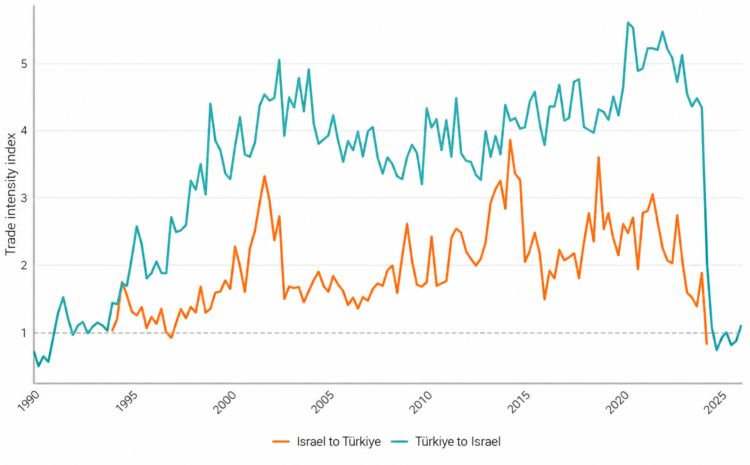
Figure 1: Turkey–Israel Bilateral Trade Intensity
Source: IMF Direction of Trade Statistics (DOTS).
Figure 1 measures bilateral trade using a trade intensity index, which compares each country’s share of its partner’s imports with its share of world exports. Grounded in the same basic logic as gravity models used by trade economists, this normalization accounts for countries’ differing weight in global trade when evaluating the intensity of trade between them. This normalization captures the intensity of the bilateral relationship relative to each country’s broader importance in global trade (an intensity of 1, for instance, means that Turkey supplies the same share of Israeli imports as it does of world exports). After remaining marginal through the 1980s, the two countries expanded bilateral trade rapidly during the 1990s, as the end of the Cold War and a broader expansion of global trade created new opportunities for economic and strategic cooperation (note that some Turkish data is missing from 1990-1993, as well as for 2025-26).
The trade intensity index immediately reveals a key asymmetry in the Israel-Turkey trade relationship over the course of the pre-rupture period: trade intensity from Turkey to Israel was, on average, nearly twice that in the opposite direction. But what was the prevailing trend in this relationship, and was it continuing to intensify in both directions? Headline numbers taken out of context might lead us to believe that the trade relationship had been deepening since the 1990s, before suddenly collapsing in 2024. Indeed, by 2022, Turkey had become one of Israel’s five largest sources of merchandise imports, behind only the United States, China, and Germany, and Switzerland. Turkish-origin goods accounted for 6.3% of Israeli merchandise imports.[ii]
To systematically analyze the series and unearth the more complex story of the shifting trends preceding the 2024 collapse, structural-break analysis was used here. This is a statistical method for identifying points at which the trajectory of trade changed significantly. Combined with the observed trajectories, the results suggest that the pre-rupture years can plausibly be divided into three broad periods: expansion (1990–2002), stabilization and convergence (2003–2013), and divergence (2014–2023). In the final period, the asymmetry that had narrowed during the second period once again became more pronounced, foreshadowing the eventual rupture.[iii]
Expansion of relations, 1990-2002
The expansionary story of the first period, from roughly 1990 to 2002, is well known. Bilateral trade grew rapidly throughout the 1990s, with both Israeli exports to Turkey and Turkish exports to Israel rising. The relationship was also becoming more important relative to each country’s overall trade, and relative to their overall trade activity, pointing to genuine economic integration rather than simply rising nominal trade volumes. Still, the relationship was asymmetric from the beginning, as trade from Turkey to Israel was far more intensive than it was in the opposite direction.
The integration of the 1990s was also asymmetric in terms of the character of goods exchanged. Turkey imported a relatively strategic basket of goods from Israel, including energy, chemicals and industrial inputs alongside intermittent but significant purchases of aircraft components, turbines and ammunition – as one study has documented, such strategic products dominated the Turkish import basket throughout this period.[iv] Israel’s imports from Turkey, by contrast, increasingly shifted from food and textiles toward a broad range of steel, cement, ceramics and other industrial and construction inputs. The two countries were therefore integrating in distinct ways: Israel increasingly incorporated Turkey into its industrial supply chain, while Turkey relied on Israel for a narrower and more strategically oriented set of goods.
|
Year |
Turkey’s imports from Israel |
Israel’s imports from Turkey |
|
1990 |
Cyclic hydrocarbons ($12.0m) |
Petroleum products ($10.9m) |
|
2002 |
Petroleum products ($74.4m) |
Primary iron and steel ($42.6m) |
Top Five Imports by Value in Turkey–Israel Bilateral Trade, 1990 and 2002
Note: Israel does not report bilateral commodity-level imports from Turkey in UN Comtrade for 1990. The 1990 figures in the right-hand column therefore use Turkey-reported exports to Israel; subsequent figures use importer-reported data. Values are nominal US dollars.
Stabilization and brief convergence, 2003-2013
The second period, beginning in approximately 2003 and lasting until 2013, was one of relative stability in the relationship despite occasional political conflicts, and represented the continuation of the new status quo reached at the end of the expansion period. The pronounced asymmetry inherited from the expansion period persisted through much of this second period. Toward its end, however, the two trajectories began to converge: trade intensity from Turkey to Israel declined, while intensity in the opposite direction increased. By 2013, the asymmetry remained substantial, but the gap between the two had narrowed considerably – although this would prove to be a temporary convergence. Meanwhile, the broad composition of trade inherited from the 1990s remained consistent.
Divergence in intensity, 2014-2023
After 2014, the relationship began to diverge again. Trade intensity from Turkey to Israel increased significantly between 2014 and 2023, rising by approximately 0.13 intensity points per year. Trade intensity in the opposite direction showed no statistically significant trend over the same period, with a slightly negative point estimate. By the end of the period, the asymmetry that had briefly narrowed around 2013–14 had therefore become pronounced once again. The relationship was therefore deepening from Israel’s perspective at the same time that its relative importance to Turkey had plateaued.
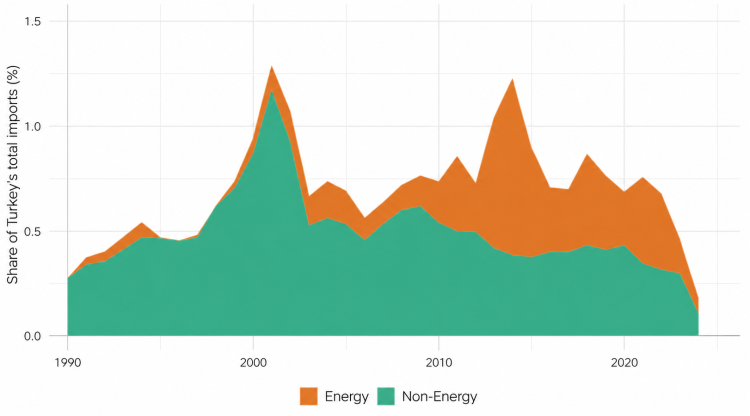
Composition of Turkey’s Imports from Israel
Another trend during this period stands out as well: non-energy imports – the bulk of the bilateral relationship in dollar terms – essentially stopped growing in the early 2000s, even as Turkey’s total imports from the rest of the world continued to expand. As a result, these goods became steadily less significant to the Turkish economy: their share of Turkey’s total imports fell by nearly two-thirds between the early 2000s and the early 2020s, even before the formal embargo. What had briefly been a substantial and diversified import relationship became, in relative terms, a marginal one.
Energy was the exception. Refined petroleum from Israel grew steadily more important to Turkey, at one point accounting for more than half of Turkish imports from Israel, and substantial, if volatile, energy trade continued through 2023. This divergence was also visible in the composition of trade: As Israel increasingly treated Turkey as a broad industrial supplier, energy had become the principal remaining area of substantial Turkish imports from Israel.
Post-2023 rupture and decoupling
This brings us to the final rupture, which followed the Gaza war and Turkey’s 2024 trade embargo. Whereas previous diplomatic crises had left surprisingly little lasting imprint on bilateral commerce, the 2023–24 rupture brought direct, officially recorded bilateral trade in Turkish statistics to a virtual standstill, even as Israeli data continued to record Turkish-origin goods entering through direct and indirect channels. Crucially, though, the embargo did not interrupt a continuously deepening economic partnership: it interrupted a relationship that had always been asymmetric and in which that asymmetry had become more pronounced again after 2014.
The nature of the period of divergence (2014-2023) may also have made decoupling easier for Turkey. The most important remaining area of substantial imports from Israel – refined petroleum – proved relatively easy to substitute. Turkey already sourced petroleum products on a much larger scale from Russia, Azerbaijan, Iraq, Egypt and other suppliers, making the Israeli component relatively straightforward to substitute. The picture on Turkish exports is somewhat murkier. Israeli statistics continued to record Turkish goods after the embargo, even as Turkish statistics recorded direct trade at zero. Israeli data still recorded $2.87 billion in imports from Turkey in 2024. Of this amount, the Bank of Israel estimates that roughly $2.02 billion was purchased directly from Turkey. Journalistic investigations have traced this discrepancy partly to goods routed indirectly through third economies and, in particular, through the Palestinian Authority’s customs area. A separate issue concerns Azerbaijani crude oil shipped to Israel from the Turkish port of Ceyhan. These flows continued despite the embargo, but constitute third-country oil transiting Turkish infrastructure rather than Turkish-origin exports. Yet this ambiguity was concentrated in the initial period of the embargo: Turkey subsequently tightened the system, requiring Palestinian authorities to certify that goods were destined for Palestinian importers and actually reached the Palestinian market, after which these flows declined substantially.[v]
Taken together, these patterns suggest that the economic costs of severing the relationship, at least from Turkey’s side, were more manageable than the raw scale of bilateral trade might suggest. The late divergence in trade intensity could naturally be read as one dimension of a wider geopolitical realignment – the same realignment reflected in Israel Katz’s warning on X – but it also underscores the contingency of the earlier partnership.[vi] The shared place of Turkey and Israel within the Western security order never made them natural allies, and their post-Cold War economic relationship was asymmetric from its inception. The temporary convergence of the early 2010s did little to alter that underlying structure, and by 2023 the asymmetry had again become more pronounced. Whether economic decoupling proves permanent remains uncertain, but the broader geopolitical alignment of the current moment suggests that the economic relationship is unlikely, on its own, to drive an imminent reconciliation.
[i] Katz, I. (2026). X post, August 2026, retrieved from: https://x.com/Israel_katz/status/2090304513278111989.
[ii] Bank of Israel (2025). “Box from the forthcoming Bank of Israel Annual Report for 2024: The Impact of the Turkish Embargo on Israel’s Economy”, 19 March 2025, retrieved from: https://www.boi.org.il/en/communication-and-publications/press-releases/box-from-the-forthcoming-bank-of-israel-annual-report-for-2024-the-impact-of-the-turkish-embargo-on-israels-economy/.
[iii] The structural-break analysis identifies four breaks in the Israel-to-Turkey series. One, around 2012, appears to capture the onset of a short-lived spike rather than a persistent change in trajectory, and is therefore not treated as a separate historical period.
[iv] Zoumpoulidis, V., Karasavvoglou, I.A. and Chrysopoulos, D.N. (2022). “Turkish Imports of Strategic Products from Israel: Strategic Bonds amongst Turbulent Relations,” European Journal of Inter-disciplinary Studies, 14(1), retrieved from: https://www.researchgate.net/publication/362502318.
[v] Bank of Israel (2025). “Box from the forthcoming Bank of Israel Annual Report for 2024.
[vi] Khan, A. (2026). “Israel and Turkey’s Emerging Cold War in the Mediterranean,” Manara Magazine, 23 July 2026, retrieved from: https://manaramagazine.org/2026/07/israel-and-turkeys-emerging-cold-war/.