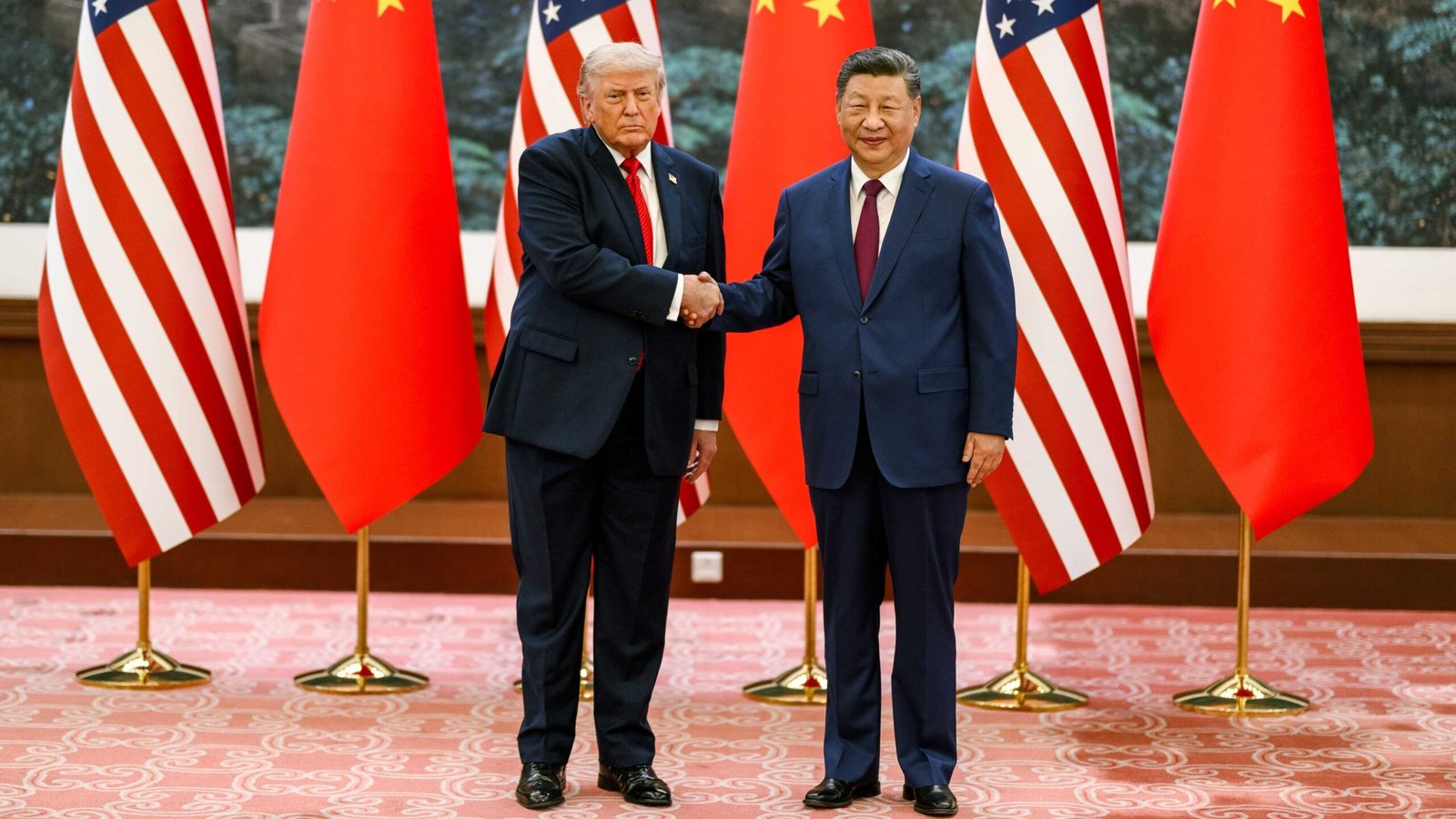
U.S. President Donald Trump’s visit to Beijing in May offers a revealing glimpse into a changing international order after a unipolar moment. The visit highlights a transition from uncontested American predominance to a more fragmented system of great-power management. The United States remains militarily preeminent, but it faces growing difficulty translating strategic superiority into durable political outcomes, particularly in its relationship with China.
The significance of the visit becomes clearer when viewed alongside two related developments that expose the limits of American predominance. Christopher Layne argues that unipolar systems generate countervailing pressures because “the threat inheres in the very fact that hard-power capabilities are overconcentrated in the hegemon’s favour.”[i] Trump’s visit demonstrated that relations with Beijing could no longer be managed through the strategic assumptions that shaped American predominance after the Cold War. Bargaining shaped the relationship because China had the economic scale and geopolitical weight necessary to resist unilateral American pressure. The war on Iran demonstrated that overwhelming military superiority no longer automatically produces decisive political outcomes or durable strategic compliance. These developments point to an international environment in which assumptions formed during the unipolar era no longer align with contemporary political and economic realities. Trump’s recurring complaints about the burden and cost of maintaining international security reflect this reality.
The persistence of expansive international commitments generates pressures and perceptions of threat that accompany the exercise of unipolar power. Layne maintains that “the U.S.’ expansionist grand strategy reinforces other states’ perceptions that U.S. unipolar power is threatening.”[ii] However, American power has increasingly been tested. The wars in Iraq and Afghanistan, the 2008 financial crisis, intensifying rivalry with China, and the war on Iran have gradually narrowed the strategic flexibility that accompanied the U.S.’ post-Cold War dominance. These developments increased the costs of sustaining predominance while reducing Washington’s ability to organise international support behind its strategic objectives.
The concept of the “reluctant merchant” rests on the relationship between bargaining and constraint. Merchant diplomacy does not emerge because a state abandons power, nor because it prefers accommodation to coercion. It emerges when the exercise of power encounters growing political, economic, and strategic costs. The merchant seeks agreements because they are cheaper and more sustainable than prolonged confrontation. The reluctance arises because bargaining is no longer one option among many but becomes the most practical means of securing outcomes. A power operating under such conditions continues to possess substantial military and economic resources, yet finds that command alone no longer guarantees compliance. Negotiation becomes not a sign of weakness but a response to a more demanding international environment.
China, Iran, and the new limits of power
Post-summit statements revealed different priorities in Beijing and Washington. The Trump administration emphasised trade and commercial ties, while Chinese leaders focused on a broader framework of bilateral relations. This divergence has characterised Sino-American relations for much of the post-Cold War era. Beijing expanded its position within an American dominated order without accepting permanent hierarchy. China’s rise proceeded largely through “acceptance of the prevailing rules, norms, and institutions of the international system.”[iii] Economic integration enabled China’s rise while limiting direct confrontation with the U.S., allowing Beijing to expand its influence without directly challenging American primacy.[iv]
The U.S., particularly under President Trump, viewed military superiority and economic strength as the foundations of its relationship with China and the wider international order. China expanded its influence primarily through trade and economic integration, while the U.S. continued to rely heavily on military commitments and security guarantees. Trump’s visit to Beijing highlighted a central change. China is one of the few powers capable of resisting sustained American pressure. Layne notes that the “the United States acts multilaterally when it can (i.e., when others support U.S. policies), and unilaterally when it decides that it must, which is much of the time.[v]
The gap between Washington’s treatment of China and its treatment of allies risks generating the uncertainty that weakened earlier hegemonic orders.
Washington must therefore negotiate with Beijing rather than simply issue demands. Yet it continues to approach much of the rest of the international system differently. The U.S. negotiates with Beijing as a rival power while continuing to demand deference from allies. Trump’s criticism of European partners over defence spending, trade disputes, and strategic dependence shows this contrast. Kissinger argued that stable orders require accepted limits and recognised rules among major powers, [vi]while Stephen M. Walt noted that alliances depend upon perceptions of reliability as much as power.[vii] Several European governments also resisted participation in the war on Iran and instead favoured diplomacy and regional containment. The gap between Washington’s treatment of China and its treatment of allies risks generating the uncertainty that weakened earlier hegemonic orders.
History suggests that dominant powers face difficulties when they adopt different approaches toward major actors within the same international order. During the nineteenth century, Britain gradually accommodated the growing power of the United States while preserving a wider imperial and maritime order. That selective accommodation reduced tensions in Anglo-American relations but left other powers uncertain about the limits of British authority. The Concert of Europe offers a similar example. Cooperation among the major powers depended upon a shared acceptance of limits, yet recurring disputes over the ‘Eastern Question’ and the balance of power repeatedly exposed tensions between shared management and unilateral ambition. The Sino-Soviet split provides a more recent example. Once China openly challenged the Soviet leadership of the communist world, Moscow could no longer exercise unquestioned authority across its wider bloc. The dispute exposed the limits to Soviet influence and encouraged greater autonomy among other communist states. Those divisions became increasingly visible during the final decades of Soviet power.
Beijing and the geography of diplomacy
The United States negotiated with a Beijing, a rival power not because competition had ended, but because competition itself required continued engagement.
The return of bargaining
One consequence is that coercion has become less reliable as an instrument of statecraft. China and Iran represent very different cases, yet both demonstrated the growing difficulty of bringing superior capabilities into political compliance. Furthermore, negotiation occupies a larger role in relations among major powers as rivalry unfolds between states capable of resisting unilateral pressure and imposing costs on their competitors. Diplomatic engagement therefore becomes a practical requirement of international politics rather than a voluntary alternative to power. The United States negotiated with a Beijing, a rival power not because competition had ended, but because competition itself required continued engagement.
The implications extend beyond relations among major powers. Military capabilities alone do not sustain alliances. Confidence in the reliability and effectiveness of the leading state is equally important. European reluctance to participate in the war on Iran reflected concerns about the costs and consequences of continued escalation rather than opposition to the United States itself. The broader result is a more flexible international environment in which states possess greater room for diplomatic manoeuvre without abandoning existing relationships. Rivalry persists, yet it no longer organises the international system into rigid blocs. States continue to cooperate even while competing across multiple domains. Beijing’s simultaneous engagement with Washington and Moscow illustrates this condition. The management of competition increasingly occurs through overlapping relationships rather than through clear geopolitical division.
This is the wider significance of the reluctant merchant. The concept does not describe a power in decline. Rather, it describes a powerful state operating in circumstances where command has become more costly and bargaining more necessary. Kissinger noted that international orders weaken when legitimacy fragments faster than dominant powers adapt to changing distributions of power and authority.[viii] The merchant emerges because the returns from coercion have weakened, while the reluctance reflects the constraints that make negotiation unavoidable. The result is an international order in which power remains highly concentrated, yet its exercise produces fewer automatic outcomes than in the decades immediately following the Cold War.
Conclusion
The Beijing summits and the war on Iran exposed the same structural challenge from different directions. The U.S. remains the most powerful military actor in the international system, yet military superiority no longer guarantees political compliance or durable settlement. China compels negotiation through its economic scale and geopolitical weight. Iran has resisted coercion through endurance and strategic adaptation. Traditional allies continued depending upon American protection while simultaneously questioning the reliability and direction of American leadership. These pressures do not signify the collapse of American power. They instead reflect a growing gap between the capacity to project power and the ability to secure desired political outcomes.
The “reluctant merchant” emerges from this environment. Washington now negotiates with rival powers through bargaining and symbolic parity while continuing to manage much of the international order through hierarchy and military dependence. These approaches no longer fit together comfortably. The result is a more fragmented and constrained form of predominance operating within an international system that no longer responds uniformly to American power. Over the long term, these developments may contribute to a more fragmented pattern of American statecraft within an increasingly fragmented international system. Maintaining a coherent and consistent foreign policy becomes more difficult when different actors are approached through distinctly different strategies. To some extent, this condition may already be emerging. The issue is not accommodation with China itself. Rather, it is the contrast between Washington’s willingness to negotiate with Beijing as a strategic rival while simultaneously managing allies through demands and pressure. Such inconsistencies can weaken confidence in American leadership – and may already be doing so – while encouraging allies to pursue greater diplomatic autonomy. Over time, this may reduce Washington’s ability to coordinate collective action and sustain the political foundations of its global influence.
[i]Layne, C. (2006). “The Unipolar Illusion Revisited: The Coming End of the United States’ Unipolar Moment”, International Security, 31(2), 7-41, retrieved from: https://doi.org/10.1162/isec.2006.31.2.7.
[ii] Layne (2006). “The Unipolar Illusion Revisited”, p.9.
[iii] Fravel, M. T. (2008). Strong borders, secure nation: Cooperation and conflict in China’s territorial disputes, Princeton University Press.
[iv] Simón, L. (2026). “Strategy without hubris: How China rose by managing America’s reaction”, War on the Rocks, 14 April 2026, retrieved from: https://warontherocks.com/strategy-without-hubris-how-china-rose-by-managing-americas-reaction/?utm_source=chatgpt.com.
[v] Layne (2006). “The Unipolar Illusion Revisited”, pp. 24-25.
[vi] Kissinger, H. (2014). World order: Reflections on the character of nations and the course of history, Penguin Press, pp. 9-10.
[vii] Walt, S.M. (1987). The origins of alliances, Cornell University Press.
[viii] Kissinger, H. (2014). World order, pp. 9-13.