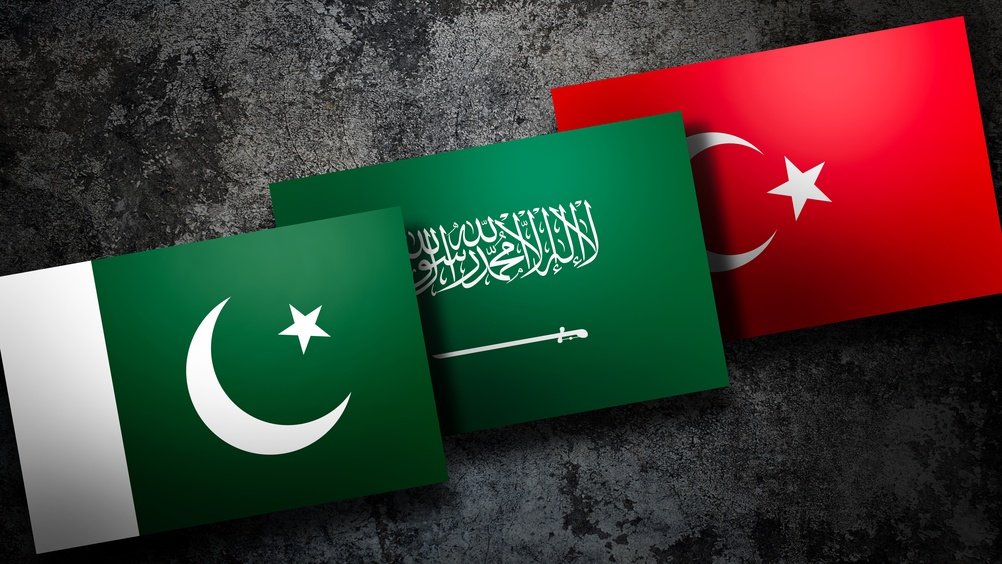
Saudi Arabia, Türkiye and Pakistan are not abandoning Washington or aligning with Beijing. They are trying to make sure that neither power becomes indispensable to their security.
On 7th August, at Al-Safa Palace in Mecca, Saudi Crown Prince Mohammed bin Salman, Turkish President Recep Tayyip Erdoğan and Pakistani Prime Minister Shehbaz Sharif signed the Mecca Joint Defence Agreement.[i] Its central clause is unambiguous: an armed attack on any one of the three states will be regarded as an attack on all three.[ii]
In the days since, the picture has grown more instructive. Pakistan’s foreign minister has publicly described the pact as purely defensive and open to other states, stressing that it does not override existing bilateral or multilateral commitments, a notable softening of the more assertive framing that dominated the first days of coverage.[iii] Turkey’s foreign minister, Hakan Fidan, has since signalled that Egypt could join once technical matters are resolved, raising the possibility that what looked like a fixed trilateral arrangement may become something more open-ended.[iv] Neither development changes the pact’s core logic; both reinforce it. This was never designed as an exclusive bloc.
The comparison to NATO’s Article 5 was immediate, and not unreasonable: Fidan himself has described the arrangement as modelled on the principle that an attack on one member is considered an attack on all, complete with a planned ministerial committee and permanent secretariat.[v] Here are three states, a major oil exporter, NATO’s second-largest military, and the only nuclear-armed country in the Muslim world, binding themselves to each other’s defence in explicit, mutual language, in the holiest city in Islam, while war continues next door in Iran.
But the “Islamic NATO” label, however tempting, obscures more than it reveals. It assumes ideological solidarity where the more plausible driver is strategic calculation. And it assumes these three states are converging toward a single alliance identity, when in fact they have quite different relationships with Washington, Beijing, Tehran, Israel and each other. Riyadh has spent months absorbing strikes from Iran and its allies since the 2026 Iran war began, while watching American reassurances lose their weight.[vi] Ankara is a NATO member pursuing an increasingly independent foreign policy, and reporting suggests Türkiye’s own calculus involves growing unease over Israel’s regional military conduct as much as Iran’s.[vii] Islamabad’s defence posture remains fixed, above all, on India. A former Turkish diplomat has argued Türkiye itself is unlikely to be drawn into conflicts with Iran or India unless the pact develops a genuine joint command structure.[viii] Why would three states with such different threat perceptions choose this moment to bind themselves together?
The answer is not solidarity. It is insurance: an attempt by each state to reduce how dependent it is on any single outside power, without cutting itself off from any of them.
A pact built for overlap, not exclusivity
The joint defence agreement represents security pluralisation, not an initiative aimed at replacing American primacy in this field. This reading differs from an earlier assessment that the region was drifting toward rival, calcifying blocs.[ix] The evidence since Mecca points the other way: rather than hardening into a closed axis, the pact has moved toward openness, with Egypt in active discussions to join[x] and Turkish officials publicly framing the initiative as something that should “grow” beyond its founding members[xi], a posture more consistent with layered, overlapping partnerships than with rival bloc formation.
The logic differs with each signature. For Saudi Arabia, the agreement offers a layer of deterrent at a time when trust in Washington’s security umbrella has visibly deteriorated, without requiring Riyadh to cut the commercial and military ties that still connect it to the US. For Turkey, the agreement is not a substitute for NATO, but rather an extra instrument alongside it. For Pakistan, the agreement offers something more particular: deeper strategic relevance to two wealthy, influential states, achieved without altering a defence posture still oriented primarily toward India, and it builds directly on the Strategic Mutual Defence Agreement Riyadh and Islamabad signed in September 2025.[xii] These are not identical interests dressed up as unity. They are three separate calculations that happen, for now, to point in the same direction.
That is also why, while the NATO analogy is not entirely inaccurate, it is incomplete. NATO lacked an integrated command structure when it was created; instead, the Alliance quickly developed one in response to the security challenges of the early 1950s. Its members transitioned from somewhat restricted planning arrangements to an integrated military command, with SHAPE and the Supreme Allied Commander created within the first two years of the Korean War.[xiii] For the time being, the Mecca agreement provides a proposed committee structure and secretariat but lacks institutional integration.[xiv] It is unclear whether it will establish the mechanism required to make its Article 5-style clause credible during a crisis.
The nuclear question is treated carefully
Much of the early commentary asked whether the pact extends Pakistan’s nuclear deterrent to Saudi Arabia. Saudi officials have explicitly denied any nuclear dimension. Deputy public diplomacy minister Rayed Krimly stated the agreement “does not represent any intention to build a military axis or a sectarian/religious bloc” and is “not linked to nuclear ambitions or an arms race, but rather to building sustainable, self-reliant capabilities.”[xv] Analysts who study Pakistan’s nuclear posture note that it remains oriented primarily toward India.[xvi] Pakistan’s status as the only nuclear power in the arrangement still gives the pact a strategic weight the other two cannot replicate, but that ambiguity should not crowd out the more verifiable, and more consequential, story underneath it.
Where China fits, and where it does not
Beijing’s reaction is genuinely revealing, even in its restraint. Weeks after the signing, China’s foreign ministry has still not issued a formal position, a silence attributed partly to the summer recess.[xvii] Its state media and scholars have not stayed quiet, however. Guangming Daily commentator Wang Yuxinhong has argued that Riyadh’s real achievement is preserving its American relationship while adding Türkiye and Pakistan as additional partners – a more convincing reading than talk of a post-American Middle East.[xviii] Wen Jing of Tsinghua University has gone a step further, noting that all three signatories continue to rely heavily on American-linked military systems and intelligence capabilities that they cannot soon replace, a stark reminder that professing strategic autonomy is easier than realizing it.[xix] That framing should not be dismissed as mere propaganda; it reflects something genuine about China’s own preferences.
Beijing’s interest rests on a paradox: China can benefit from the erosion of American security exclusivity without wanting to inherit America’s role as the region’s security guarantor. Being the indispensable power in the Gulf is enormously costly: it means military bases, crisis management, deterrence commitments, and the risk of being pulled into conflicts that serve no Chinese interest. A cheaper, more durable form of influence is available if regional states become more capable of managing their own security while growing less exclusively tied to Washington. That opens space for Chinese defence exports, military training, and technological cooperation, particularly through Pakistan, without requiring Beijing to promise anyone protection. China may prefer influence without responsibility to influence backed by formal guarantees.
That preference has limits, and they matter. Beijing has its own relationships with Iran, Saudi Arabia and Pakistan, and no interest in seeing one deepen at the expense of the others.[xx] It would be considerably less comfortable if the Mecca framework hardened into an explicitly anti-Iran coalition or acquired any nuclear dimension serious enough to invite proliferation pressure elsewhere. Notably, Iran’s own public response has been genuinely mixed rather than uniformly hostile: its foreign ministry spokesman has publicly said Tehran has “no reason to fear” the pact, framing it instead as a response to Israeli ambitions,[xxi] even as hardline commentators and lawmakers have dismissed it as an empty “paper agreement” and warned of retaliation against signatory territory in the event of an attack.[xxii] That split complicates any simple reading of the pact as a settled anti-Iran project. China’s ideal outcome is not a stronger trilateral alliance, but a more fragmented and capable regional security landscape, in which no single outside power, American or Chinese, holds an unquestioned monopoly on strategic relevance. Beijing is a beneficiary of this moment, not its architect.
A more difficult question for Washington
The temptation in Washington will be to read Mecca as evidence of abandonment. That reading would miss the point. Saudi Arabia, Türkiye and Pakistan are not choosing to leave the America’s orbit; they are declining to remain exclusively inside it. Alliance loss can be countered with reassurance and renewed commitments. Declining exclusivity cannot, because the states in question no longer see exclusivity itself as desirable, regardless of how reliable any single partner proves to be. The real question facing U.S. policymakers is not whether this arrangement can be undone, but whether Washington can remain each state’s preferred partner without insisting on being their only one.
What could go wrong
None of this guarantees the pact will succeed on its own terms. Collective defence is easy to declare and hard to operationalise among states with genuinely different threat perceptions: what looks like an attack requiring a united response to Riyadh may look very different from Ankara or Islamabad. Would Türkiye’s forces actually be committed if Saudi Arabia and Iran moved from proxy skirmishing to direct war? Would Saudi Arabia and Türkiye feel bound by a clause originally aimed at deterring aggression against them if Pakistan’s own conflict with India escalated instead? The agreement’s text does not answer these questions, and the states that signed it may prefer to keep it that way.
That ambiguity points to a deeper tension in the whole project. Diversifying security relationships is supposed to reduce risk by spreading it across more partners. But overlapping commitments among states with genuinely divergent rivalries can just as easily multiply the number of conflicts any one member might be drawn into, trading dependence on a single, distant power for entanglement with two nearer ones, each carrying its own quarrels. Strategic autonomy and strategic entanglement are not always easy to tell apart in advance. A pact designed to give each signatory more room to manoeuvre could, under the wrong circumstances, do the opposite: narrow it, by tying each state’s fate more tightly to disputes that were never originally its own.
The Mecca Pact should not be judged solely by whether it hardens into a formal alliance, or whether Beijing eventually offers it explicit endorsement. Its deeper significance lies in what it reveals about how middle powers are beginning to think about dependence itself. Saudi Arabia, Türkiye and Pakistan are not selecting a new patron to replace an old one. They are constructing overlapping relationships precisely so that no single power, present or future, becomes indispensable again.
The Middle East may not be choosing between Washington and Beijing. It may be learning how to rely less on either.
[i] Saudi Press Agency (2026). “Saudi Arabia, Türkiye, and Pakistan Issue Joint Statement of the Makkah Al-Mukarramah Summit for Joint Defence”, 7 August 2026, retrieved from: https://www.spa.gov.sa/en/N2649227.
[ii] Shankar, P. (2026). “Turkiye, Saudi Arabia, Pakistan sign joint defence agreement: What’s in it?”, Al Jazeera, 7 August 2026, retrieved from: https://www.aljazeera.com/news/2026/8/7/turkiye-saudi-arabi-pakistan-sign-joint-defence-agreement-whats-in-it.
[iii] Ahmed, M. (2026). “Pakistan says new defence pact with Saudi Arabia and Turkey is ‘purely defensive’ and open to others”, PBS, retrieved from: https://www.pbs.org/newshour/world/pakistan-says-new-defence-pact-with-saudi-arabia-and-turkey-is-purely-defensive-and-open-to-others.
[iv] Türkiye Today (2026). “Turkish FM signals Egypt could join Mecca defense pact”, 9 August 2026, retrieved from: https://www.turkiyetoday.com/nation/turkish-fm-signals-egypt-could-join-mecca-defense-pact-3225669.
[v] Ari, L.B. (2026). “Egypt could join new Saudi-Turkey-Pakistan defense alliance, Turkish FM says”, retrieved from: https://www.ynetnews.com/article/rkhkzlhize; Semafor (2026). “Egypt could be the latest addition to the Mecca defense pact”, 10 August 2026, retrieved from: https://www.semafor.com/article/08/10/2026/egypt-could-be-the-latest-addition-to-the-mecca-defense-pact.
[vi] Al Jazeera (2026). “Saudi Arabia, Pakistan and Turkiye sign defence deal amid regional turmoil”, 7 August 2026, retrieved from: https://www.aljazeera.com/news/2026/8/7/saudi-arabia-pakistan-and-turkiye-sign-defence-deal-amid-regional-turmoil.
[vii] Lior Ben Ari (2026). “Egypt could join new Saudi-Turkey-Pakistan defense alliance, Turkish FM says”, Ynet News, retrieved from: https://www.ynetnews.com/article/rkhkzlhize.
[viii] Azhari, T. et al. (2026). ” Saudi Arabia, Turkey, Pakistan pledge mutual defence as Middle East turmoil escalates” retrieved 18 August 2026 from: https://www.reuters.com/world/asia-pacific/saudi-arabia-turkey-pakistan-sign-joint-defence-deal-amid-regional-turmoil-2026-08-07/.
[ix] Azam, A. (2026). “The Middle East is drifting toward rival security blocs”, Manara Magazine, 9 February 2026, retrieved from: https://manaramagazine.org/2026/02/middle-east-drifting-rival-security/.
[x] Türkiye Today (2026). “Turkish FM signals Egypt could join Mecca defense pact”.
[xi] Ibid.
[xii] Saudi Press Agency (2025). “Joint Statement Issued Following Pakistan Prime Minister State Visit to Saudi Arabia”, 17 September 2025, retrieved from: https://www.spa.gov.sa/en/w2399706.
[xiii] NATO (n.d.). “NATO’s Integrated Military Command Structure”, retrieved from: https://shape.nato.int/page14612223.
[xiv] Ari, L.B. (2026). “Egypt could join new Saudi-Turkey-Pakistan defense alliance, Turkish FM says”.
[xv] Al Jazeera (2026). “Saudi Arabia, Pakistan and Turkiye sign defence deal amid regional turmoil”, 7 August 2026, retrieved from: https://www.aljazeera.com/news/2026/8/7/saudi-arabia-pakistan-and-turkiye-sign-defence-deal-amid-regional-turmoil.
[xvi] Azhari, T. et al. (2026). ” Saudi Arabia, Turkey, Pakistan pledge mutual defence as Middle East turmoil escalates”.
[xvii] Karakullukcu, D. (2026). “China is watching Mecca agreement very closely, and staying very quiet”, Turkiye Today, retrieved from: https://www.turkiyetoday.com/opinion/china-is-watching-mecca-agreement-very-closelyand-staying-very-quiet-3226002.
[xviii] Ibid.
[xix] Ibid.
[xx] Hass, R. et al. (2026). “Beijing’s approach to the conflict in Iran and its implications for China”, Brookings, 5 May 2026, retrieved from: https://www.brookings.edu/articles/beijings-approach-to-the-conflict-in-iran-and-its-implications-for-china/.
[xxi] Sinaiee, M. (2026). “Iran plays down Mecca Pact as regional security order shifts”, Iran International, retrieved from: https://www.iranintl.com/en/202608106405.
[xxii] Sohrabi, A. (2026). “Mecca pact ties three Sunni powers together as Iran-backed attacks loom”, Iran International, retrieved from: https://www.iranintl.com/en/202608073701.