An early and widely circulated narrative held that the U.S. had been pulled into the Iran war by Israel[i]. This provides too simplistic a reading. The U.S.’ Gulf allies have also had strong incentives to welcome military action against Iran. In addition to this, U.S. President Donald Trump himself rejected the idea that Israel pressured him[ii]. More importantly, this framing misses the very strategic logic of the war, which, in fact, serves American interests by preventing Iran from maturing into a more formidable China-aligned node of regional coercion, by reducing pressures that push Gulf states to hedge away from Washington, by taking advantage of a military window opened by Israel’s earlier actions, and by revealing the shallow commitments offered by Russia and China to their partners.
For decades, Iran posed a regional threat that Israel thought it could more or less contain, the Gulf could hedge against, and the U.S. could manage at arm’s length. What changed was not only Iran’s nuclear programme or its missile arsenal, but also the regime’s growing value to China and, to a lesser extent, Russia. Iran was becoming entangled in a wider anti-U.S. network, setting off alarm bells in Washington.
The China problem
Iran appears to have been moving toward a model of external backing that, in functional terms, bore some resemblance to the U.S.-Israel relationship: a frontline regional state supported by larger powers with economic, military, and diplomatic reasons to sustain its strength. In this emerging arrangement, China offered substantial economic support and potential access to advanced capabilities, while Russia provided military cooperation and political backing. Iran, in turn, offered strategic geography, energy relevance, regional pressure points, and a demonstrated willingness to confront the West directly.
China buys the overwhelming majority of Iranian oil exports. That means Beijing is not just a customer but also directly funds the regime while gaining significant leverage over it. The U.S. Energy Information Administration says China took nearly 90 per cent of Iran’s crude oil and condensate exports in 2023[iii], while Reuters, citing Kpler, reports that China bought more than 80 per cent of Iran’s shipped oil in 2025[iv]. Iran matters to China because the country cannot produce enough energy at home to sustain its enormous demand. Reliable external supply is critical. Influence over the routes that move global energy and trade is equally significant. ‘Testimony to the U.S.-China Commission’ notes that Iranian firms are often paid in renminbi through small Chinese banks and sanctioned institutions, leaving them with earnings that are difficult to use outside Chinese financial channels and often pushing them back into buying Chinese goods. Donovan adds that because these firms often cannot spend renminbi freely outside China, they are pushed into purchasing Chinese goods instead; in 2023, Iran imported $10 billion worth of goods from China, and Donovan suggests that roughly that amount of Iran’s oil earnings may have been recycled in this way.[v] China is therefore helping shape the financial terms on which Iran can convert that oil into usable economic power: That economic asymmetry has at times carried political weight too. Reuters reported in 2024 that Chinese officials warned Iran that Houthi attacks in the Red Sea could damage business ties with Beijing[vi]. Also, after the China-brokered Saudi-Iran rapprochement, a Saudi official told Reuters that “China has leverage on Iran” and that Tehran would “find it difficult to explain” reneging on a deal signed in Beijing, since China’s central trading position gave it unusual influence over Iranian compliance.[vii] Economic dependence is clearly a source of Chinese leverage.
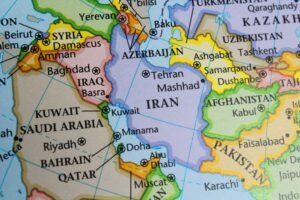
This is where Iran becomes so important. Iran and its proxy – the Houthis – sit beside two of the most important maritime chokepoints on earth: the Strait of Hormuz and the Bab el-Mandeb Strait leading to the Red Sea. If a state with that geography is armed, entrenched, and increasingly tied to Chinese interests, the problem is no longer just Israeli or even regional – it becomes global and directly American.
That is why this war makes more sense when viewed as part of the U.S.’ wider contest with China. Washington is not only monitoring centrifuges and proxy militias but also the possibility of Iran becoming a more capable, China-aligned pressure platform on the edge of the global energy system.
Why the military build-up mattered
Iran was not only signing symbolic partnership agreements. It was pursuing advanced military capabilities that would make future American and Israeli action far harder and costlier. Its ballistic missile programme was rapidly growing in size, range, and sophistication. It has benefited from decades of Chinese assistance, from early direct transfers to more recent joint military drills[viii] and China-based procurement networks supplying dual-use components and propellant ingredients. The reported Diego Garcia strike on 21 March is significant because it suggests Tehran may be moving beyond its self-declared 2,000 km ceiling and into a range relevant to a future U.S. homeland threat. Publicly available U.S. intelligence does not assess that Iran has fielded such a missile, but it now judges that Iran’s space-launch vehicles could support a militarily viable ICBM before 2035 if Tehran chose to pursue one.[ix] The rapid growth of the Iranian missile arsenal is nearly impossible to counter with interceptors alone. Moreover, Iran operates a mix of domestically produced and Russian-made advanced air-defence systems, and claims to have received delivery of more capable platforms. Some analysts believe this includes the S-400 system.[x] Its Air Force also had serious ambitions, having recently purchased the Su-35[xi]. Clearly, Iran had been strengthening the capabilities most likely to complicate external intervention and enhance regional coercion. Yet, the subsequent destruction of much of its visible air-defence network by Israeli and U.S. strikes has altered that picture, leaving the surviving strength of its dispersed and better-protected IRGC infrastructure uncertain.
That matters enormously. Once a state like Iran becomes significantly harder to penetrate, effective deterrence emerges. The longer you wait, the worse the problem becomes. America then faces an unattractive choice: strike sooner while Israel has opened the window and Iran’s capabilities are not yet fully advanced – or accept a future in which Iran becomes vastly more difficult to handle, due to the enhanced deterrence resulting from military deals with Russia and China[xii].
A China that can rely on aligned disruption in the Middle East has a way of stretching American focus, resources, and response capacity across multiple theatres at once.
The maritime dimension is also central and often underplayed. If Iran acquires more advanced anti-ship capabilities – whether for itself or its proxies – the consequences would extend far beyond the Gulf. Reuters reported in February 2026 that Iran was nearing a deal to buy Chinese CM-302 supersonic anti-ship missiles[xiii], a system designed to evade ship defences and pose a serious challenge to nearby U.S. naval forces.[xiv] A stronger Iranian coastal and naval denial network would threaten shipping through Hormuz and beyond, and complicate American and European naval freedom of movement in any wider crisis. In a Taiwan scenario, this seriously matters. A China that can rely on aligned disruption in the Middle East has a way of stretching American focus, resources, and response capacity across multiple theatres at once.
That is a cost-effective way of tying down America, strengthening Iran, and raising the military and economic cost of confronting it. It forces Washington to expend attention, ships, munitions, and political capital in the Gulf, making it harder to concentrate fully on East Asia. From an American perspective, that cannot be allowed.
The Gulf dimension
A more militarily dominant Iran does not only threaten Israel or American bases; it changes the political psychology of the Gulf. This dynamic was already taking shape before the current war. As Iran grew stronger and harder to deter, Gulf states had stronger incentives to hedge, diversify, and reduce exclusive reliance on Washington.
The result is not the replacement of the U.S., but a regional environment in which Gulf states have more room to diversify, bargain, and resist full dependence on Washington.
If Iran grows more coercive, better armed, and better protected, Gulf states are likely to hedge more aggressively. That does not mean a decisive Gulf pivot to China. The U.S. remains the region’s primary security guarantor, but it does mean greater space for Beijing to embed itself in the Gulf’s diplomatic and security landscape, although it brokered the Saudi-Iran rapprochement[xv], has built dense partnership networks across the Gulf, and now features in parts of the region’s infrastructure, digital ecosystem, and even arms market[xvi]. For instance, Saudi Arabia and the UAE have worked with Chinese firms Huawei and Alibaba on parts of their digital infrastructure, including 5G networks, and large data centres. Saudi government services operate on Chinese-developed digital platforms.[xvii][xviii] Additionally, it is notable that China has developed “Comprehensive Strategic Partnership” agreements with Saudi and the UAE between 2016-18, and a “Strategic Partnership” with Qatar, Bahrain and Oman between 2014-18. [xix] These partnership arrangements with Gulf states are not alliances, but they do institutionalise privileged political access and broad cooperation across energy, infrastructure, technology, and diplomacy. The result is not the replacement of the U.S., but a regional environment in which Gulf states have more room to diversify, bargain, and resist full dependence on Washington.
That is how Chinese influence expands into the heart of global energy production without the need for outright military control – through fear, hedging, and the gradual reshaping of regional incentives. A stronger Iran would create precisely such an environment in which the seeds that China has already sewn in the Gulf could develop into much more substantial relationships.
By contrast, weakening Iran’s coercive arsenal can reverse this trend. When the U.S. targets Iranian naval assets, coastal defences, and missile infrastructure, it is also weakening the very pressure that drives Gulf hedging in the first place.
Netanyahu has also stated that he plans to soon announce that additional Arab states are entering alliances with Israel, after the war[xx]. If that materialises, it would reinforce the same logic: states that now feel that Israel and the U.S. are reliable partners for security, or who no longer feel a need to balance themselves between spheres of influence due to a now weakened Iranian threat, are likely to align themselves more firmly with the American-backed regional order, narrowing the space for deeper Chinese influence.
Israel opened the door
Another reason this war benefits the U.S. is that Israel has already done much of the hardest work. Israel spent years penetrating Iranian military networks, disrupting the nuclear programme, and exposing the depth of Iran’s internal vulnerabilities. Then it degraded Iranian air defences in October 2024, and June 2025 during the 12-day war, making the battlespace dramatically easier for future strikes[xxi].
That changed the equation in Washington. Acting directly against Iran is one thing when its advanced defensive systems are intact; it is another when Israel has already punched major holes. The U.S. did not create the opening, but once it existed, exploiting it became strategically easier.
Even if Israel had acted alone in this round of fighting, which it is rumoured that it was willing to do[xxii], American assets in the region could still be targeted in retaliation. If the risk of escalation partly falls on Washington anyway, it has a strong incentive to shape the conflict toward its own goals rather than merely absorb the consequences of another country’s campaign.
Russia and the lesson of abandonment
There is also a fascinating signalling effect. The January 2025 Russia-Iran treaty is not a mutual-defence pact[xxiii]. It does not bind Moscow to come to Iran’s rescue in the way NATO’s Article 5 binds Allies to assist one another after an armed attack. Russia may coordinate with Iran, arm it, and benefit from it, but it has not offered Tehran anything close to a Western-style security guarantee. Iran aligned more closely with Russia and China in hopes that great power partnership would raise the cost of Western action and create strategic insurance. But when tested, neither patron protected Tehran as it would have liked, or in any way even close to how the U.S. has protected its Gulf allies, as I will demonstrate. This sends a message to any state tempted by this model of alignment.
On another note, Russia’s behaviour is especially telling. Moscow benefited from Iranian support in Ukraine, particularly through drones and other systems central to its war effort. A weakened Iran, unable to supply these resources, forces concessions to Ukraine in ceasefire negotiations. This is a win for the U.S.
Alignment with China and Russia may provide arms, intelligence, and diplomatic backing, yet still leave a partner fundamentally alone when the real test comes.
As Iran faces immense pressure from this war, Russia and China help, but stop well short of rescue. Recent reporting indicates covert Russian assistance, including satellite imagery and cyber support that may have helped Iran target U.S. and regional assets more effectively. China allegedly plans on making an arms shipment[xxiv]. But that is precisely the point – Beijing and Moscow appear willing to raise the cost for Washington, not to stake their own personnel and most expensive and valuable assets on Iran’s defence. This is not Article 5-style solidarity. Russia and China have deliberately avoided making any comparable commitment to Iran. It is only deniable support from powers that want America distracted and weakened, but does not want a direct war for Iran. They seem happy to profit from a relationship with Iran, but not yet meaningfully protect it. Russia did not save Assad in the end, and it has not saved Tehran now. That undermines the prestige of the anti-Western axis and fosters mistrust. Alignment with China and Russia may provide arms, intelligence, and diplomatic backing, yet still leave a partner fundamentally alone when the real test comes. Iran is discovering that Moscow and Beijing can function as an accomplice, but not as a guarantor. Tehran’s biggest mistake may have been pursuing tighter cooperation with China, which alarmed Washington, pushing the U.S. to war.
In contrast, in the Gulf, U.S. assets are on the ground, in the air, and at sea defending allied states, and British and French fighter jets are defending their skies. Washington will want that lesson of Russian and Chinese neglect to spread.
The nuclear issue
None of this diminishes the nuclear concern. Iran’s efforts to rebuild, harden, and protect nuclear infrastructure are alarming. Any American administration would worry about facilities that are more buried, resilient, and harder to destroy, such as “Pick Axe Mountain”, which could withstand the best bunker-busting bombs in the Western arsenal[xxv].
But the nuclear issue is not the whole story. This war is also about preventing Iran from becoming a far more formidable, China-aligned outpost whose nuclear progress is shielded by missile power, maritime disruption, proxy warfare, and great power backing. Alternatively, an equally compelling way of understanding this war is preventing an increasingly China-aligned outpost from being shielded by nuclear progress.
What America wants
Trump will not publicly articulate this strategy. He is unlikely to announce that America is using the war with Iran to break a growing web of Chinese coercive potential in the Middle East.
Yet the logic is visible in the actions: what is being targeted and what messages Washington seeks to leave behind. Even without regime change, Iran will be weakened and isolated. It will become less trusted by allies and less useful to them. Its failure will make Beijing and Moscow appear less reliable to other states – a significant strategic outcome. The whole world; the entire Belt and Road Initiative, the entire BRICS Alliance, every piece and part of the Chinese attempt to build an anti-American world order or a non-aligned world order, is now noticing this.
Regime change would be a bonus but is not the main objective. The immediate goal is to prevent Iran from maturing into a state capable of more substantial deterrence against American power than the version seen in recent years.
Too much discussion has focused on the cost of confronting Iran, and too little on the cost of allowing it to mature unchecked. A more heavily armed Iran, protected by missiles, air defences, anti-ship capabilities, proxy networks, and potentially a nuclear deterrent, would be far harder and far more expensive to contain later. It would sit astride vital shipping lanes, with the capacity to disrupt global trade and oil flows, which Beijing could seek to shape or exploit, given that Iran’s sanctions-era economy now depends so heavily on Chinese demand, Chinese financial channels, and Chinese commercial tolerance. Iran would constrain allied naval freedom of manoeuvre, and impose costs far beyond the Middle East. In a wider crisis, including one over Taiwan, it could also help stretch American assets across multiple regions at once. The real issue is that delay does not buy stability. It buys a stronger Iran, a wider strategic problem, and a much higher price when the reckoning finally comes.
This is why the idea that the U.S. is being pulled along by Israel misses the bigger picture, and the strategic logic of the war: Israel created the opportunity; the U.S. decided it would be foolish not to use it. The strategy aims to break an emerging structure of pressure before it hardens, prevent the Gulf from becoming more entangled in China’s sphere, weaken Russia’s network, and demonstrate that states betting on Chinese and Russian backing may end up devastated and alone.
[i] Associated Press (2026). ‘The Latest: Pakistan prepares for upcoming peace talks despite US seizure of Iranian cargo ship’, The Washington Post, 20 April 2026, retrieved from: https://www.washingtonpost.com/business/2026/04/20/iran-israel-us-lebanon-latest-april-20-2026/6ee76bda-3c84-11f1-bb46-ed564688d953_story.html.
Reuters (2026). ‘Trump: Israel never talked me into war with Iran’, Reuters, 20 April 2026, retrieved from: https://www.reuters.com/world/asia-pacific/trump-israel-never-talked-me-into-war-with-iran-2026-04-20/.
[ii] Magid, J. (2026). ‘Trump says he may have forced Israel’s hand into war with Iranian “lunatics”’, The Times of Israel, 3 March 2026, retrieved from: https://www.timesofisrael.com/trump-says-he-may-have-forced-israels-hand-into-war-with-iranian-lunatics/.
[iii] U.S. Energy Information Administration (2024). “Country Analysis Brief: Iran”, retrieved from: https://www.eia.gov/international/content/analysis/countries_long/Iran/pdf/Iran%20CAB%202024.pdf.
[iv] Reuters (2026). ‘China’s heavy reliance on Iranian oil imports’, 21 March 2026, retrieved from: https://www.reuters.com/business/energy/chinas-heavy-reliance-iranian-oil-imports-2026-03-21/.
[v] Donovan, K. (2025). “Testimony before the US-China Economic and Security Review Commission hearing on ‘An Axis of Autocracy? China’s Relations with Russia, Iran, and North Korea’, Panel II: Economic Linkages and Sanctions Evasion”, 20 February 2025, retrieved from: https://www.uscc.gov/sites/default/files/2025-02/Kimberly_Donovan_Testimony.pdf.
Reuters (2025). ‘Iran pushes China to let it sell $1.7 billion worth of stranded oil, sources say’, 8 January 2025, retrieved from: https://www.reuters.com/business/energy/iran-pushes-china-let-it-sell-17-billion-worth-stranded-oil-sources-say-2025-01-08/.
[vi] Reuters (2024). ‘Exclusive: China presses Iran to rein in Houthi attacks in Red Sea, sources say’, 26 January 2024, retrieved from: https://www.reuters.com/world/middle-east/china-presses-iran-rein-houthi-attacks-red-sea-sources-say-2024-01-26/.
[vii] Reuters (2023). ‘Saudi Arabia could invest in Iran “very quickly” after agreement – minister’, 15 March 2023, retrieved from: https://www.reuters.com/world/middle-east/saudi-investment-iran-could-happen-very-quickly-after-agreement-minister-2023-03-15/.
[viii] The Iran Primer (2023). ‘Iran & China: Military Ties’. 28 June 2023, retrieved from: https://iranprimer.usip.org/blog/2023/jun/28/iran-china-military-ties.
[ix] Office of the Director of National Intelligence (2026). “2026 Annual Threat Assessment of the U.S. Intelligence Community”, retrieved from: https://www.dni.gov/files/ODNI/documents/assessments/ATA-2026-Unclassified-Report.pdf.
[x] Daftari, A. (2025). ‘Russia Delivers MiG-29 Jets to Iran Air Force’, Newsweek, 24 September 2025, retrieved from: https://www.newsweek.com/russia-delivers-mig-29-jets-iran-air-force-10479982.
[xi] Reuters (2025). ‘Iran’s Revolutionary Guards commander says Iran purchased Russian-made Sukhoi 35 fighter jets’, 27 January 2025, retrieved from: https://www.reuters.com/business/aerospace-defense/irans-revolutionary-guards-commander-says-iran-purchased-russian-made-sukhoi-35-2025-01-27/.
Rettig Gur (2026). ‘Ask Haviv Anything: Episode 94: America’s war, not Israel’s’, 2 March 2026, retrieved from: https://podcasts.apple.com/gb/podcast/ask-haviv-anything/id1794590850?i=1000752614732&r=1150.
[xii] The Iran Primer (2023). ‘Iran & Russia: Burgeoning Military Ties’, 5 September 2023, retrieved from: https://iranprimer.usip.org/blog/2023/may/18/iran-russia-burgeoning-military-ties; Reuters (2025). ‘Key provisions of Russia-Iran strategic cooperation treaty’, 17 January 2025, retrieved from: https://www.reuters.com/world/key-provisions-russia-iran-strategic-cooperation-treaty-2025-01-17/; The Iran Primer (2023). ‘Iran & China: Military Ties’, 28 June 2023, retrieved from: https://iranprimer.usip.org/blog/2023/jun/28/iran-china-military-ties; U.S.-China Economic and Security Review Commission (2026). “China-Iran Fact Sheet: A Short Primer on the Relationship”, 16 March 2026, retrieved from: https://www.uscc.gov/sites/default/files/2026-03/China-Iran_Fact_Sheet_A_Short_Primer_on_the_Relationship.pdf.
[xiii] Irish, J., Hafezi, P. and Finch, G. (2026). ‘Exclusive: Iran nears deal to buy supersonic anti-ship missiles from China’, Reuters, 24 February 2026, retrieved from: https://www.reuters.com/world/china/iran-nears-deal-buy-supersonic-anti-ship-missiles-china-2026-02-24/.
[xiv] U.S. Government Accountability Office (2022). “Missile Defense: Better Oversight and Coordination Needed for Counter-Hypersonic Development”, retrieved from: https://www.gao.gov/assets/gao-22-105075.pdf; Vergun, D. (2023). ‘General Says Countering Hypersonic Weapons Is Imperative’, U.S. Department of War, 10 May 2023, retrieved from: https://www.war.gov/News/News-Stories/Article/Article/3391322/general-says-countering-hypersonic-weapons-is-imperative/.
[xv] Hafezi, P., Abdallah, N. and El Yaakoubi, A. (2023). ‘Iran and Saudi Arabia agree to resume ties in talks brokered by China’. Reuters, 10 March 2023. Retrieved from: https://www.reuters.com/world/middle-east/iran-saudi-arabia-agree-resume-ties-re-open-embassies-iranian-state-media-2023-03-10/.
[xvi] Lons, C. (2024). “East meets middle: China’s blossoming relationship with Saudi Arabia and the UAE”, European Council on Foreign Relations, 20 May 2024, retrieved from: https://ecfr.eu/publication/east-meets-middle-chinas-blossoming-relationship-with-saudi-arabia-and-the-uae/.
[xvii] Lons, C. (2024). “East meets middle: China’s blossoming relationship with Saudi Arabia and the UAE”, European Council on Foreign Relations, 20 May 2024, retrived from: https://ecfr.eu/publication/east-meets-middle-chinas-blossoming-relationship-with-saudi-arabia-and-the-uae/.
[xviii] Reuters (2023) ‘China’s Huawei opens cloud data centre in Saudi Arabia in regional push’, 4 September 2023, retrieved from: https://www.reuters.com/technology/chinas-huawei-opens-cloud-data-centre-saudi-arabia-regional-push-2023-09-04/.
[xix] Green, W. and Roth, T. (2021). “China-Iran Relations: A Limited but Enduring Strategic Partnership”, U.S.-China Economic and Security Review Commission, 28 June 2021, retrieved from: https://www.uscc.gov/sites/default/files/2021-06/China-Iran_Relations.pdf.
[xx] Government of Israel (2026). “Statement by PM Netanyahu”, 7 March 2026, retrieved from: https://www.gov.il/en/pages/statement-by-pm-netanyahu-7-mar-2026.
Segal, A. (2026). Telegram post, 31 March 2026, retrieved from: https://t.me/amitseg/20953. Note: Segal is respected journalist in Israel.
[xxi] Lair, S. (2025). ‘Shallow Ramparts: Air and Missile Defenses in the June 2025 Israel-Iran War’, Foreign Policy Research Institute, 17 October 2025, retrieved from: https://www.fpri.org/article/2025/10/shallow-ramparts-air-and-missile-defenses-in-the-june-2025-israel-iran-war/.
[xxii] Ashkenazi, A. (2026). ‘Israel warns Trump: We may act alone if Iran crosses ballistic missile red line’, The Jerusalem Post, 8 February, retrieved from: https://www.jpost.com/israel-news/defense-news/article-885948; Asharq Al-Awsat (2026). ‘Israel Threatens to Hit Iran’s Ballistic Missiles, Questions “Value” of Deal’, 9 February 2026, retrieved from: https://english.aawsat.com/world/5238713-israel-threatens-hit-iran%E2%80%99s-ballistic-missiles-questions-%E2%80%98value%E2%80%99-deal.
[xxiii] Reuters (2025). ‘Key provisions of Russia-Iran strategic cooperation treaty’, 17 January 2025, retrieved from: https://www.reuters.com/world/key-provisions-russia-iran-strategic-cooperation-treaty-2025-01-17/.
[xxiv] Reuters (2026). ‘US intelligence indicates China preparing weapons shipment to Iran, CNN reports’, 11 April 2026, retrieved from: https://www.reuters.com/world/china/us-intelligence-indicates-china-preparing-weapons-shipment-iran-cnn-reports-2026-04-11/.
[xxv] The Associated Press (2023). ‘An Iranian nuclear facility is so deep underground that US airstrikes likely couldn’t reach it’, 22 May 2023, retrieved from: https://apnews.com/article/iran-nuclear-natanz-uranium-enrichment-underground-project-04dae673fc937af04e62b65dd78db2e0.