In under seven weeks during the autumn of 2024, Hezbollah suffered the most concentrated loss of senior leadership in its four-decade history. Israel assassinated its secretary-general, Hassan Nasrallah, his presumed successor Hashem Safieddine, and at least five other senior commanders, while simultaneously incapacitating more than 1,500 Hezbollah personnel through a coordinated strike on its communications infrastructure.[i]
At the centre of this crisis was the killing of Nasrallah. His death struck at the foundation of Hezbollah’s legitimacy. For decades, Nasrallah had embodied the movement’s identity, its past victories, and its political narrative. Without him, Hezbollah faced not just a leadership vacuum, but a crisis of meaning. And yet, the organisation did not collapse. In the weeks that followed, Hezbollah moved quickly to stabilise itself through a carefully constructed public narrative.
Today, it faces a different kind of crisis. As the US–Israeli war on Iran approaches its third month, the pressure on Hezbollah is growing: a ground invasion of southern Lebanon and sustained airstrikes bear down on an organisation still heavily weakened from 2024, while the assassination of Khamenei and pressure on Iran threatens to sever the ideological and material lifelines on which it has long depended.
The question, then, is not only how Hezbollah survived the shock of 2024. It is whether the same strategies can sustain it now.
From his appointment as its Secretary-General in 1992, to his death in 2024, Nasrallah was the symbolic core of Hezbollah. His leadership was populist and charismatic, rooted in past victories and in a persona that, over three decades, became inseparable from Hezbollah itself.
His assassination, accordingly, did not simply decapitate the organisation, but threatened to decapitate its legitimacy as well. What Hezbollah did next, with striking speed and coherence, was refuse that logic. Rather than centring its narrative on loss, it emphasised continuity. Rather than replacing Nasrallah as a leader, it enshrined him as a martyr. And rather than defending its position, it projected its strength. In the two months that followed his death, three interlocking moves defined Hezbollah’s response: it moralised his martyrdom, asserted organisational continuity, and demonstrated its operational capacity. Together, these strategies amounted to the argument that Hezbollah’s legitimacy had never truly resided in one man, and that his death only proved it.
The first move was to transform death into meaning. In the immediate aftermath, Hezbollah saturated its media output with the language of martyrdom. In his death Nasrallah transitioned from a leader into a divine figure and martyr within the broader Islamic tradition of sacrifice. At the same time, its messaging sharpened into stark moral contrasts: Hezbollah and its allies as righteous and pure; Israel and the United States as brutal and corrupt. By framing his assassination in this way, Hezbollah turned death into martyrdom and placed an assassination into a broader narrative of a timeless moral struggle.
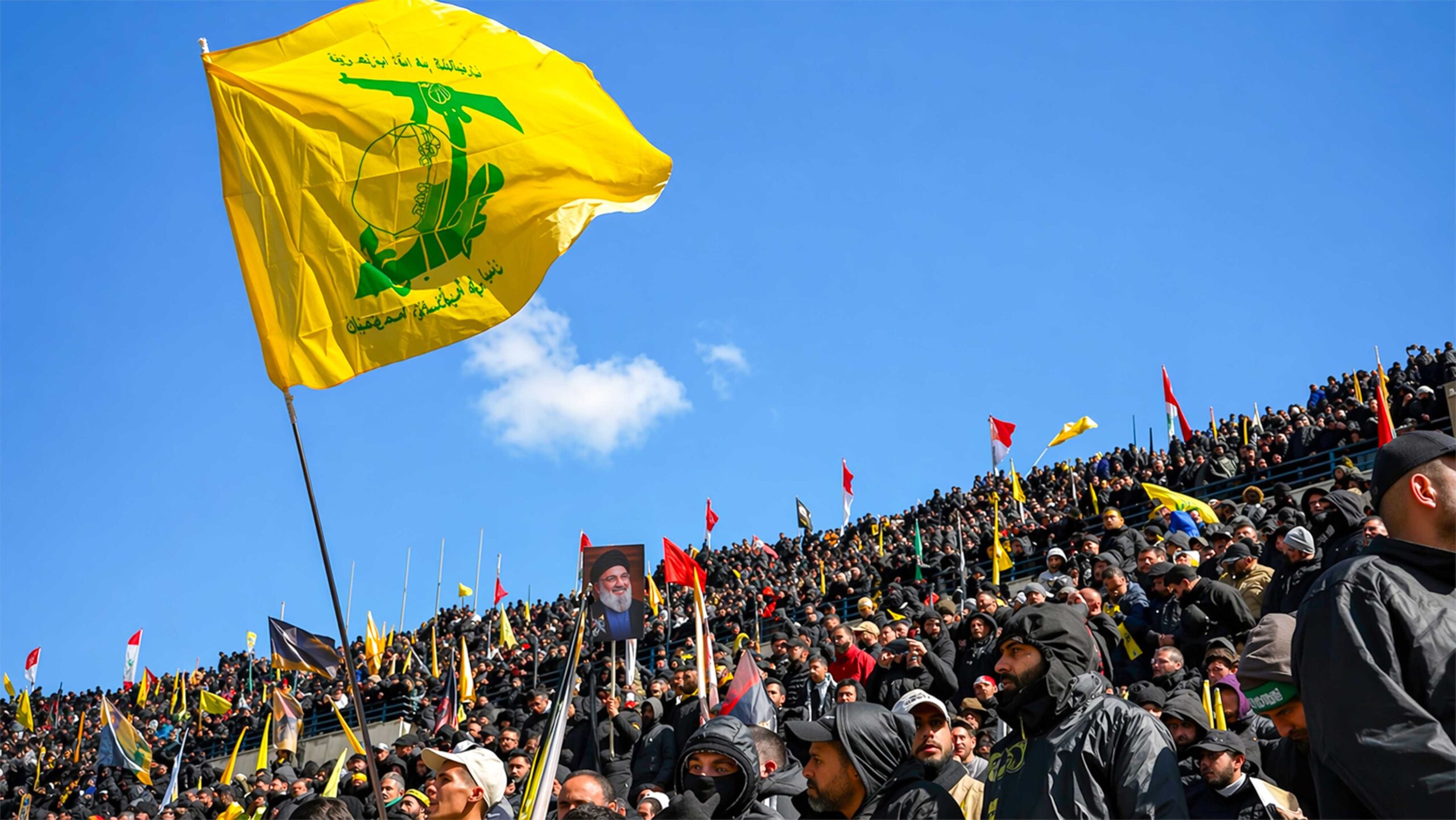
The second move was to deny any sense of rupture. Across speeches, broadcasts, and official messaging, Hezbollah emphasised continuity at every turn. Any mention of loss was instrumentalised to justify promises of future resistance and victory. Nasrallah himself was preserved as a permanent presence within this narrative. In televised addresses by his successor, Naim Qassem, his portrait loomed in the background. His voice, his principles, his legacy were presented as ongoing forces guiding the organisation. By constantly invoking past victories under his leadership, Hezbollah folded the present into a longer story of success, effectively transferring his authority from the individual to the collective.
The final move was to show, not just tell. Hezbollah leaned heavily on discursive performance of its own continued military relevance. Its portrayal of the conflict with Israel diverged sharply from mainstream accounts, casting itself as the active, dominant force while depicting Israel as reactive and exposed. This was more than propaganda. It was a claim to agency, a claim that Hezbollah was capable, unbroken, and in control of the terms of engagement.
The period following the ceasefire revealed the extent to which these strategies were effective. Hezbollah emerged from its 2024 conflict with Israel greatly weakened, with no opportunity to rest and regain its strength. More than a quarter of the Lebanese population had been displaced during the war[ii], and satellite damage modelling indicated that over 40% of buildings in parts of the south had been destroyed or damaged. Most of the burden of reconstruction fell upon the shoulders of Hezbollah.[iii]
In the year following the ceasefire, the IDF conducted 669 airstrikes throughout Lebanon, averaging 51 per month[iv] — targeting not only fighters but the physical infrastructure of recovery itself. Financially, U.S. Treasury actions and a Lebanese central bank directive constraining Al-Qard al-Hassan explicitly targeted Hezbollah’s reconstitution capacity.[v]
Yet the May 2025 Lebanese municipal elections showed that the Hezbollah-Amal alliance had largely maintained its support among core Shiite constituencies, with no “dramatic erosion” in terms of popularity having taken place. Hezbollah emerged from the conflict materially weakened, but internally unified, maintaining its strong support base.[vi]
The conditions Hezbollah currently faces are structurally more complex than those faced in 2024. Hezbollah’s decision to strike Israel following Khamenei’s assassination has reinserted it into a war whose costs, once again, fall on Lebanese civilians. A ground invasion and sustained airstrikes continue to pummel an organisation that never fully recovered from the previous conflict. Finally, proposed diplomatic settlements to the US/Israeli war on Iran raise the prospect of a deal that would sever the financial pipeline underpinning Hezbollah’s entire resistance model.
The question, then, is whether the narrative that held in 2024 can hold in 2026.
In 2023–2024, Hezbollah could credibly cast its intervention as solidarity with Gaza, a cause with genuine resonance among its Shia constituency and the broader Arab world. Striking Israel in response to Khamenei’s assassination is harder to present in the same light. It is more transparently Iran’s war than Lebanon’s, and Hezbollah’s audiences experiencing the consequences are not blind to that distinction. The language of righteous resistance persists, but the gap between the frame and the reality it is meant to describe has widened considerably.
Whatever claim Hezbollah could make to continuity in 2024 is even harder to sustain now. Hezbollah could assert that its command structure remained intact and its strategic direction unchanged, but those claims were made against the backdrop of visible, undeniable losses — a decapitated leadership, a disrupted communications network, a successor in Naim Qassem widely regarded as lacking Nasrallah’s authority and presence.[vii] [viii] In 2026, that claim is weaker still. Compounding losses continued strikes on senior figures, the potential loss of Hezbollah’s operational heartland in the south, and the prospect of Iran’s withdrawal as a patron increasingly undermine the long-term viability of the resistance project.
The same logic applies to Hezbollah’s claim to operational strength. The projection of strength that followed Nasrallah’s death held because Hezbollah controlled the narrative frame and because the ceasefire arrived before the gap between image and reality became impossible to manage. That gap is now harder to close. How can an organisation that is dragged into a second major conflict before it has recovered from the first, which operates under airstrikes and a ground invasion it cannot repel, credibly claim dominance?
All in all, the current conflict between Israel and Hezbollah in 2026 goes further than a military escalation. It is a stress test of the very logic that kept Hezbollah standing in 2024. The narrative has not fundamentally changed, yet the distance between material reality and discourse is now proving untenable. There is a limit to how long audiences can be asked to subscribe to a narrative they are living inside the contradiction of.
[i] Reuters, and TOI Staff. (2024). ‘Pager, Walkie-Talkie Explosions Took 1,500 Fighters out of Action – Hezbollah Source’, The Times of Israel, retrieved from: https://www.timesofisrael.com/pager-walkie-talkie-explosions- took-1500-fighters-out-of-action-hezbollah-source/.
[ii] Salhani, J. (2025). ‘A Year after Hezbollah-Israel Ceasefire, over 64,000 Lebanese Displaced | Israel Attacks Lebanon | Al Jazeera’. Al Jazeera, retrieved from: https://www.aljazeera.com/features/2026/2/2/a-year-after- hezbollah-israel-ceasefire-over-64000-lebanese-displaced.
[iii] Mercy Corps Lebanon Crisis Analytics Team. (2024). Thematic Report: Assessment of Damages in the South, Beirut: Mercy Corps, retrieved from: https://reliefweb.int/report/lebanon/thematic-report-assessment-damages- south-december-2024.
[iv] Alma Research and Education Center. (2025). Special Report: One Year Since the Ceasefire in Lebanon – The Israeli Thwarting Effort Against Hezbollah’s Reconstruction Effort, Israel: Alma Research and Education Center, retrieved from: https://israel-alma.org/special-report-one-year-since-the-ceasefire-in-lebanon-the- israeli-thwarting-effort-against-hezbollahs-reconstruction-effort/.
[v] Department of the Treasury. (2025). ‘Treasury Sanctions Hizballah Financial Officials’, U.S. Department of the Treasury, retrieved from: https://home.treasury.gov/news/press-releases/sb018.
[vi] Salhani, J. (2025). ‘Hezbollah Holds Firm in Lebanon’s Municipal Elections’, Al Jazeera, retrieved from: https://www.aljazeera.com/features/2025/5/26/hezbollah-holds-firm-in-lebanons-municipal-elections.
[vii] Mizhari, O. (2025). ‘Hezbollah 2.0—One Year After Nasrallah’s Elimination’, INSS Insight (2043), retrieved from: https://www.inss.org.il/publication/one-year-nasrallah/.
[viii] Fahs, B. (2024). ‘Naim Qassem: The Austere Ex-Chemist Now Leading Hezbollah’, Al Majalla, retrieved from: https://en.majalla.com/node/322902.