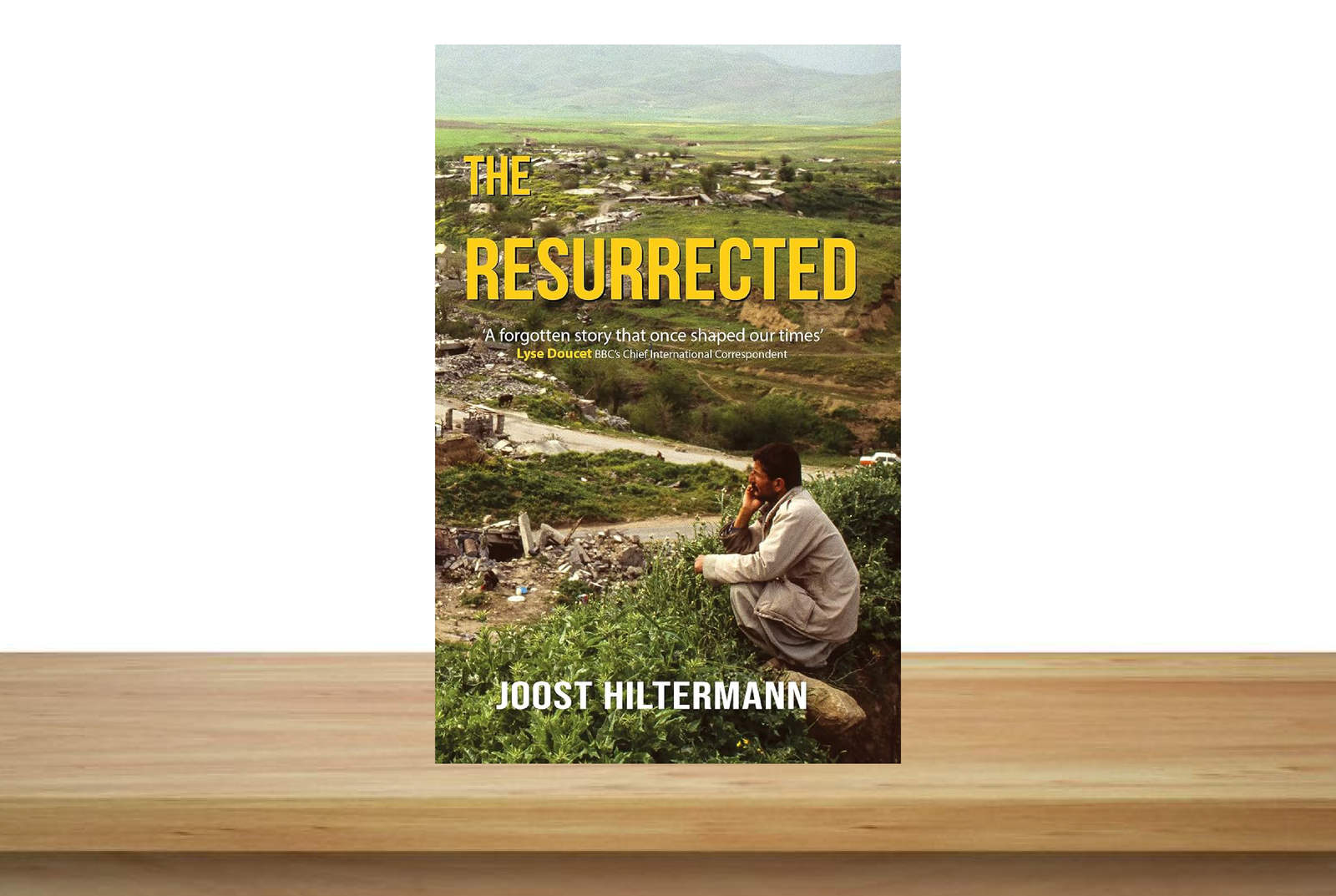
Dr. Joost Hiltermann is a Dutch researcher, writer, academic and sociologist. He was the Programme Director for MENA at the International Crisis Group and was previously a main investigator for Human Rights Watch into the Anfal genocide (1988) against the Iraqi Kurds, which may have caused 100,000 deaths. This led to his monograph, A Poisonous Affair: America, Iraq, and the Gassing of Halabja (Cambridge U.P., 2007) and many articles. The Resurrected (Afsana Press, 2026), his debut novel, tells the story of two young Kurdish survivors of Anfal.
First, thanks you very much for agreeing to do this interview for Manara Magazine.
ALAN SAEED: The Anfal is often referred to as one of the “forgotten genocides” in Middle Eastern history and Iraqi-Kurds certainly feel that to be true. Why has the public in the West forgotten about this?
JOOST HILTERMANN: There a several reasons for this. One is that the genocide of rural Kurds during the Anfal campaign came at the very end of the Cold War. The Berlin War fell one year later, and the world changed dramatically. Global attention shifted to the termination of Cold War-era conflicts, the breakup of the Soviet Union and Yugoslavia, the eruption of new conflicts and mass killings in Rwanda and Bosnia. The containment – rather than defeat – of Saddam Hussein’s Iraq following the liberation of Kuwait, as well as of Iran, was another significant development, which for the U.S. and Israel came to loom as the new threat in the Middle East. The U.S. needed Saddam’s Iraq as a bulwark against a revolutionary Iran that emerged more cohesive from the Iran-Iraq war. By the time the U.S. and its allies came to see Iraqi Kurds as a potential asset rather than as Iranian proxies after 9/11, the Anfal campaign was forgotten and not needed for political purposes, except for putting Saddam on trial. The irony, of course, is that he was convicted of, and hanged for, a different crime.
A second reason is the nature of both Iraq and Iran in the 1980s. The two countries were tightly ruled authoritarian security states, closed to independent outside scrutiny. Western intelligence agencies had information about Iraq’s use of poison gas and military operations in the north, but I have seen no evidence that they were aware of what happened to Kurds captured during the Anfal campaign. Western visitors to the north from their base in Baghdad came back with only fragmentary and anecdotal information about these military operations that might have raised alarm bells in home capitals. The only exception was perhaps that Iraq was fighting an existential war against Islamist revolutionary Iran, and Iraqi Kurds were perceived as Iran’s allies. Kurdish voices abroad that tried to draw public and governmental attention to what was happening in Kurdistan were disbelieved due to alleged political bias, and ignored.
A third reason is that, apart from Human Rights Watch’s research, the production of knowledge about the Anfal campaign was extremely limited for many years. This meant that there was no informed public that could have supported the pursuit of justice against the regime, only political steps that served Western strategic interests. Thus, HRW’s efforts to bring a case of genocide before the International Court of Justice in The Hague failed for lack of international political support. By the time Ali Hassan al-Majid was convicted by an Iraqi tribunal for his role in the Anfal campaign, it barely made the headlines.
AS: You are a prominent scholar of the Anfal but what impelled you to turn this expertise into a novel, particularly as it has taken you some twenty years to write? Can fiction do things that academic work cannot achieve?
JH: The idea of writing a novel about Anfal grew out of frustration that Human Rights Watch’s efforts – and my own in A Poisonous Affair – to bring the genocidal nature of the campaign to public attention had largely failed. I thought that if a non-fiction treatment through reports, books, and essays did not produce the results I sought, maybe I could reach a wider public through a novel. And in any case, I was keen to bring out the astonishing stories of the handful of survivors of the execution sites, and knew there was potential there for stirring public interest.
AS: The Resurrected is an unusual book, somewhere between a novel and creative non-fiction. There is the touching, fictionalised treatment of the two Kurdish survivors, your own memoir, testimony and oral history, analyses of reports and documents: to name but a few of its modes. How and why did this unusual mix come about?
JH: It is not how it started! My original idea was to use my notes from the interviews I had conducted for HRW to let two or three of the survivors tell their stories in their own words, and to shape them into more readable non-fiction accounts as opposed to their original treatment focusing on the technicalities of human rights. But once I started to write, I realized that I could make the points I wanted to make better – and expose a deeper truth – by veering from a mere recounting of the facts. Things then started to develop rapidly. Using all the sources available to me – handwritten notes of interviews I had conducted, transcripts of audiotapes and interrogations, and Iraqi Security Police documents – I decided to expand the circle of narrators to include not just the victims of Anfal but also the perpetrators, important bystanders, and even myself as chronicler. Where necessary, I filled in the blanks in my documented sources, for example people’s inner thoughts, and invented a couple of characters to get at this deeper truth. I had to cut several of these characters and their perspectives from the final draft as it was published due to length constraints, but I think the book is better – more focused – for it.
AS: Why did you include the figure of the Human Rights investigator? Is it to help the western reader have someone to identify with, or do you feel it is just an honest way to present the story?
JH: I included it the moment I moved away from just offering the stories of what happened to the execution survivors during Anfal and decided to also recount of what happened to them afterwards. I was an integral part of that chapter in their lives – their move to the U.S. And then the idea emerged to provide the reader with a more well-rounded picture of not just the events in question but also of the research that went into it, and how I found out about and located these survivors in the first place.
AS: While the Anfal is a defining part of Iraqi-Kurdish identity, it is often approached obliquely by Kurdish writers, as if language can barely delineate the enormity of the horror. In The Resurrected, in contrast, we hear the voices not just of victims and survivors but also the perpetrators. You say in the Preface: “there is no single way to tell this tale”, and you will instead “allow a throng of actors — perpetrators, victims, bystanders, and chroniclers – to interact”. Did your position as a non-Kurdish expert allow a beneficial kind of distance as a writer in terms of bringing the horrors of the Anfal to life?
JH: That is a bit of a leading question. The answer is “Yes.” But it deserves further explanation. Having worked as a human rights investigator in Palestine, Israel, Iraq, and Lebanon in the 1990s, my approach to the suffering I documented was invariably rather clinical. I am not saying I did my work without empathy; to the contrary, I could not have done it without feeling deeply for the people affected. But it is somewhat like a doctor in an emergency room who has to operate on patients suffering indescribable pain from injuries. You have to delink your emotional being from your professional skills if you want to do your job. As a chronicler, I have to maintain a certain distance – both to ensure that I portray all characters, including the truly evil ones, fairly, and to protect myself. Also, which reader could move even five pages into a book that relentlessly treats you to a sob story with another 200 pages offering more of the same? As an avid reader of fiction, I respect the reading public!
AS: What kind of models of writing lay behind the Resurrected? At times it reminded of the literary journalism pioneered by Orwell, with an emphasis on the characters lived experience of the Anfal and emotional resonance achieved through direct, on-the-ground reporting?
JH: I wish I could tell you that one particular literary work inspired me. My friend Eugene Rogan at Oxford told me the book’s form reminded him of What Is the What by Dave Eggers, but I had not read it. I am somewhat embarrassed to admit that the idea of allowing the characters in the book to express their own perspectives in their own words may have come from the Game of Thrones books, where I thought it worked really well. Of course, I may have academic training and work as an analyst, but I have been writing mainly as an investigative journalist from the moment I put finger to keyboard (actually, “pen to paper,” because believe it or not I often start my work on a piece that way). I am happy with some of the writing of this kind I have done over the years in and on Palestine, Iraq, and Iraqi Kurdistan, in particular.
AS: I thought one of the strengths of The Resurrected lay in its depiction of the wide scale effects of the Anfal on Iraqi-Kurdish society. It is not a case of something that only affected those who were murdered and their loved ones. Could you say a bit more about this?
JH: The impact of mass atrocities is never confined to the “mass.” It is in their nature to affect the entire group within which the atrocities occur. The larger the massacre, the broader the impact. The Anfal genocide was relatively limited in size, and therefore impact. It directly affected only rural families, and depending on the area only adult males. It was worst in the districts around Kirkuk because of the regime’s determination to tighten its control over the oil fields there at a time when it had no access to the much larger southern oil fields due to the war with Iran. This intensified the struggle over Kirkuk in subsequent years, with passions set alight not only over oil income but also the lives lost during Anfal and the forced displacement of Kurds as part of the regime’s Arabization campaign there more generally.
AS: The Resurrected is surprisingly experimental, rather than simply realist. It deploys a fragmented narrative (you have said something about using card indexing to facilitate this). It shifts between third- and first-person narration, sometimes we see characters from their point of view and at others from a more objective narrative point of view. There are a wide range of characters some real, some imagined, some fictionalised. What was the reason for all this experimentation?
JH: No specific reason. Once I went the way of fiction, I felt liberated from the constraints within which I had been working until then. I then thought, if I can do “A,” I could do “B” all the way to “Z” as well, especially if this helped in conveying the story digestibly to a wider reading audience. I hope I was right in making this calculation, which sort of grew on me along the way.
AS: The Anfal genocide was a trauma for all Kurds and yet the two central characters, Karwan and Kawa, find safety and a hard-won kind of personal redemption in America. Why did you feel following these characters to America mattered?
JH: Precisely because the night of their supposed execution was only a brief moment in their lives. The story could have ended there, at the climax of their wondrous escape. But their subsequent story is poignant as well, as they somehow found their way back to Kurdistan, in one instance ended up with the Iraqi army in Kuwait, then got the unexpected opportunity to immigrate to the United States almost overnight. The journey there, their arrival in the Washington DC area, the very difficult days finding their way while not speaking the language or knowing the culture and society as if they had landed on the moon, and finally their feelings about the pros and cons of building a new life for themselves and their children far from their homeland, relatives, and community followed. What happened that one night decisively shaped their subsequent lives. It is an arresting story from start to where they have come today.
AS: I felt the key characters developed and went on a form of journey. Karwan and Kawa certainly, but also the Human Rights Investigator who discovers he is “shaped by the burning desire to bear witness […] as best as I can”. Would you agree?
JH: I cannot say that the story has left me unaffected since the days I recorded it. After all, that is why I published a novel about Anfal decades later. I could not leave Anfal behind even if I tried; the Kurds will not let me! But also because a little bit of the trauma of that genocide transferred to me, the chronicler. How could it not? I continue to read about other genocides as well, the Holocaust first and foremost. I have devoted my professional life to the struggle for human rights and conflict prevention, and find that I must understand what brings people to commit such atrocities, and how the surviving victims cope with the trauma. Not that I have come any closer to such understanding…
AS: Lastly, what do you hope that readers (both international and Kurdish) will take away from reading The Resurrected?
JH: I hope that they come to admire the Anfal execution survivors as much as I do for their bravery and crazy luck, and remember the many who did not make it. That they help keep alive the memory of this tragic episode in history, if this could help prevent similar atrocities – in Kurdistan or elsewhere. But also, that such stories of survival help encourage them not to give up on humanity… And, finally, that they conclude that they “enjoyed” reading a book on such a heavy topic, and appreciate the tiny bits of humour I tried to sprinkle throughout. Life is not all tragedy, and good writing, which I hope this is, should reflect that.
Updated: 28 August 2026.