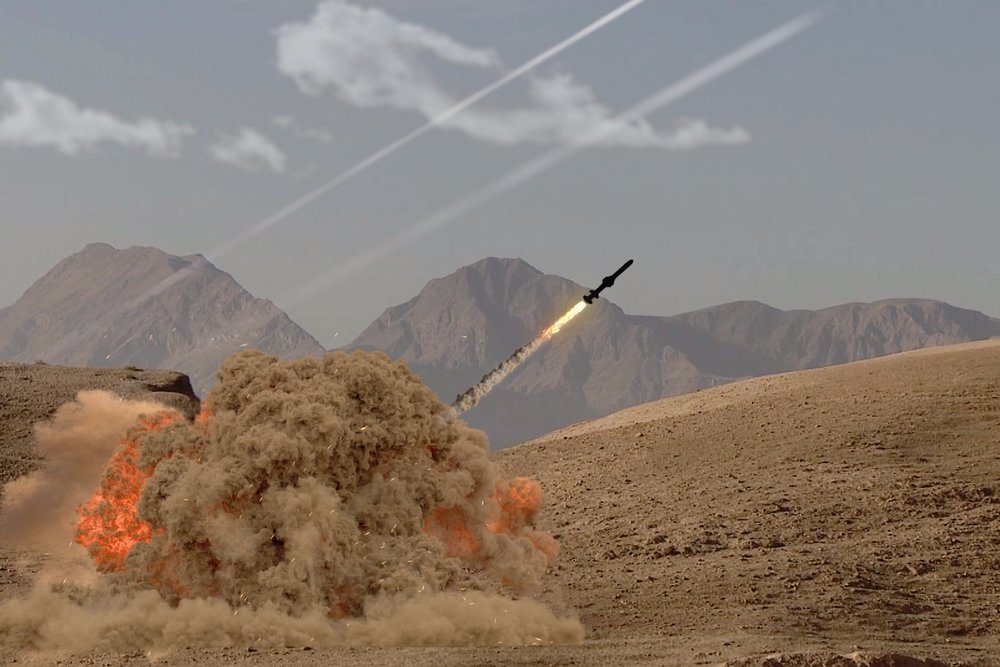
Iranian missile, drone, and mortar attacks against the positions of armed Kurdish opposition groups in the Kurdistan Region of Iraq – namely, the Kurdistan Democratic Party of Iran (KDPI), the Kurdistan Free Life Party (PJAK), the various factions of Komala, and the Kurdistan Freedom Party (PAK) – are not a new phenomenon. However, since the outbreak of the forty-day war between the United States and Israel against Iran on 28 February, Iran’s attacks on the positions of these groups have reached an unprecedented level in both scale and intensity. This trend has continued uninterrupted despite the ceasefire and memorandum of understanding between Iran and the United States.
According to figures published by KurdPress citing the media outlet “Draw”, 922 Iranian and allied drone and missile attacks were reported across the Kurdistan Region between 28 February and 20 July.[i] Erbil province accounted for 628 of the reported attacks, followed by Sulaymaniyah with 261. These figures remain unconfirmed by Iraqi, Kurdistan Regional, or Iranian authorities.
The intensity of the Iranian bombardment of these Kurdish groups is indicative of a fundamental shift in how Tehran views these groups. For decades they were treated mainly as a border-security problem – a channel for recruiting young people from Kurdish-populated areas in western and northwestern Iran, and a catalyst for ethnic nationalism and separatism in those regions. Iran now sees them as something bigger: a potential piece of a broader, foreign-backed challenge to the Iranian state. That shift in perception is what has driven the continuing campaign in Iraqi Kurdistan and Iran’s renewed pressure on Baghdad.
Heightened sensitivities in Iran
The explicit and repeated references by U.S. President Donald Trump, as well as reports by several Israeli media outlets, regarding the transfer of weapons to Kurdish groups in the Kurdistan Region of Iraq and their movement across Iran’s western borders, juxtaposed with Israeli and U.S. military attacks, have played a significant role in heightening both Iranian concern and the perceived threat posed by the armed Kurdish opposition groups based in the Kurdistan Region of Iraq.[ii] Tehran increasingly believes that these groups may serve as potential components of a scenario involving the deployment of U.S. ground forces into Iranian territory, as well as a possible regime-change project.
Recently, Iranian Foreign Minister Abbas Araghchi stated in an interview that “On the fourth day of the war, Trump personally contacted each of the leaders of the Kurdistan Region. On that same day, I called Barzani, Talabani, Sudani, and Hakan Fidan and issued a warning. The Iraqi and Kurdistan Region authorities assured me that they would never allow such a thing to happen, and Turkey also played a constructive role.”[iii]
Separate Israeli and Turkish media reports offer a glimpse of an information environment that likely reinforced Tehran’s security concerns. Israeli media reported that plans for Iranian Kurdish armed opposition groups based in the Kurdistan Region of Iraq to enter Iranian territory were part of a broader operation allegedly coordinated with Israeli involvement.[iv] Other reports claimed that Erdoğan persuaded Trump to abandon a plan to arm Iranian and Iraqi Kurdish opposition groups against Tehran, after details of the plan were leaked to Turkey by officials within the White House.[v] None of this has been independently verified, but the underlying developments appear to have reinforced Tehran’s belief that a coordinated, foreign-backed ground threat had become plausible during the war.
For its part, the Kurdistan Regional Government has repeatedly rejected accusations that it supports cross-border activities by Iranian Kurdish opposition groups and has called on Baghdad and the international community to help prevent attacks against the Kurdistan Region.[vi]
Tehran’s emphasis on the implementation of the 2023 Iran–Iraq security agreement
As Tehran’s threat perception has escalated, the 2023 Iran–Iraq Security Agreement has taken on a different character. This agreement, signed in March 2023, was originally intended to transfer responsibility for containing threats posed by armed Kurdish groups from Iran’s unilateral actions to the sovereign obligations of the Iraqi government, thereby establishing a framework for strengthening Baghdad’s authority over the border regions.[vii]
Iran now treats full implementation of that agreement as something closer to a strategic demand: a way of pressing Baghdad to address what Tehran sees as a broader threat, not merely a local security nuisance. In practice, meeting Iran’s demands for full implementation would require the Iraqi government to exercise effective control over the border areas, disarm the armed Kurdish groups, relocate them away from Iran’s borders, strengthen border security, and prevent their armed activities.
This agreement appears to remain on Baghdad’s security agenda. On 18 June 2026, Iraqi National Security Adviser Qasim al-Araji led a high-level security delegation in Sulaymaniyah to discuss the security agreement with Iran and the measures required for its implementation.[viii] Later on, during al-Zaidi’s visit to Tehran on 23 July, the two sides also discussed the security agreement and Iraq’s commitment to preventing its territory from being used to threaten Iran.[ix]
In Tehran’s security calculations, the expulsion of the Mujahedin-e Khalq Organization (MKO) from Iraq is regarded as one of the most successful examples of security cooperation between the two countries, and Iran hopes for a similar outcome with the Kurdish groups: disarmament, or at minimum, relocation away from its borders. But the analogy has clear limits: the MKO was a centralized organization with a single leadership that could be relocated abroad once it lost its state sponsor. The Kurdish groups comprise several distinct organisations with deep ethnic, linguistic, and political ties to the Kurdistan Region itself, making their disarmament or relocation considerably more difficult and politically sensitive than the MKO’s.
Baghdad’s balancing act
Baghdad is caught between two sensitive security files, each carrying real domestic and regional stakes. On the one hand, the Iraqi government faces pressure from the United States and other international partners to advance security-sector reforms, strengthen the state’s monopoly over coercive instruments, and manage the status of armed groups operating outside official structures. [x] In Iraqi political discourse, this process is primarily framed around debates concerning the future of Iran-aligned Shiite resistance groups and the extent to which their activities should be integrated into or restricted within the state framework.[xi] On the other hand, Tehran insists on the full implementation of the 2023 agreement and on containing, relocating, or expelling armed groups opposed to the Islamic Republic from Iraq’s border regions.
Both pressures, in effect, demand the same thing: that Baghdad assert a state monopoly over armed groups – Washington against Iran-aligned Shiite factions, Tehran against Kurdish opposition groups. In practice, however, Baghdad has no neutral way to apply it and thus faces a sovereignty dilemma: enforcing the principle against one set of groups and not the other inevitably serves one outside patron’s interests over the other’s. Any decisive Iraqi action against the Kurdish groups could risk backlash from the KRG and Kurdish political actors; any change in the status of the Iran-aligned groups would carry its own consequences for Iraq’s internal balance of power and its relations with Tehran. How Iraq navigates this will shape not only the future of the Iran–Iraq security agreement, but Iraq’s broader security relations with its neighbours.
[i] Kurd Press (2026). “Claims of Recording 922 Attacks on the Kurdistan Region since the Beginning of March,” 21 July 2026, retrieved from: https://en.kurdpress.com/news/161405/Claims-of-recording-922-attacks-on-the-Kurdistan-Region-since.
ii] Barin, O. (2026). “Iran War: Why Is Trump Blaming the Kurds?,” Deutsche Welle, 19 May 2026, retrieved from: https://www.dw.com/en/iran-war-us-kurds-donald-trump-iraq/a-77216394.
[iii] Daily Sabah (2026). “Iran FM Credits Türkiye with Blocking Efforts to Destabilize Iran,” 21 July 2026, retrieved from: https://www.dailysabah.com/politics/iran-fm-credits-turkiye-with-blocking-efforts-to-destabilize-iran/news.
[iv] Stein A. and Kweller, I. (2026). “Kurdish Forces Launch Ground Offensive against Iran, Officials Deny Reports,” The Jerusalem Post, 4 March 2026, retrieved from: https://www.jpost.com/middle-east/iran-news/article-888881.
[v] Daily Sabah (2026). “Erdoğan Convinced US to Halt Plan to Arm Iranian Opposition,” 6 June 2026, retrieved from: https://www.dailysabah.com/politics/erdogan-convinced-us-to-halt-plan-to-arm-iranian-opposition-report/news.
[vi] Kurdistan Regional Government, Presidency of the Council of Ministers (2026). “Statement from the Presidency of the Council of Ministers of the Kurdistan Region,” 17 July 2026, retrieved from: https://gov.krd/english/news-and-announcements/posts/2026/july/statement-from-the-presidency-of-the-council-of-ministers-of-the-kurdistan-region/.
[vii] Al Jazeera (2023). “Iraq and Iran Sign Deal to Tighten Border Security,” 19 March 2023, retrieved from: https://www.aljazeera.com/news/2023/3/19/iraq-and-iran-sign-deal-to-tighten-border-security.
[viii] Iraqi News Agency (2026). “Al-Araji Arrives in Sulaymaniyah Leading High-Level Security Delegation,” 18 June 2026, retrieved from: https://ina.iq/en/politics/49683-al-araji-arrives-in-sulaymaniyah-leading-high-level-security-delegation.html
[ix] Al Jazeera (2026). “من واشنطن إلى طهران.. ماذا حققت زيارة الزيدي إلى إيران؟” [“From Washington to Tehran: What Did al-Zaidi’s Visit to Iran Achieve?”], 24 July 2026, retrieved from: https://www.aljazeera.net/news/2026/7/24/%D9%85%D9%86-%D9%88%D8%A7%D8%B4%D9%86%D8%B7%D9%86-%D8%A5%D9%84%D9%89-%D8%B7%D9%87%D8%B1%D8%A7%D9%86-%D9%85%D8%A7%D8%B0%D8%A7-%D8%AD%D9%82%D9%82%D8%AA-%D8%B2%D9%8A%D8%A7%D8%B1%D8%A9.
[x] Salih, M.A. (2025). “Why Washington’s Anti-PMF Moves Are Testing the Iraq Partnership,” MENASource (blog), Atlantic Council, 23 October 2025, retrieved from: https://www.atlanticcouncil.org/blogs/menasource/why-washingtons-anti-pmf-moves-are-testing-the-iraq-partnership/.
[xi] Iraqi News Agency (2026). “الإطار التنسيقي: حصر السلاح بيد الدولة ركيزة أساسية لحماية الوطن وصيانة منجزاته” [“The Coordination Framework: Confining Weapons to the State Is a Fundamental Pillar for Protecting the Homeland”], 14 June 2026, retrieved from: https://ina.iq/ar/political/265834-.html.