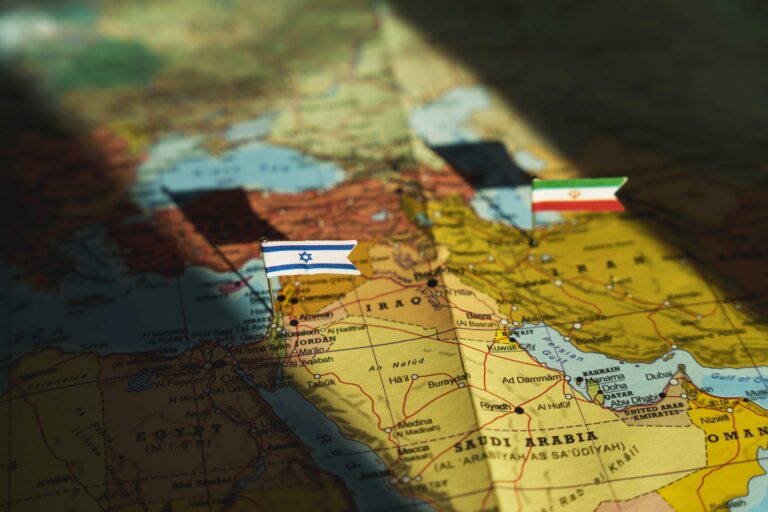
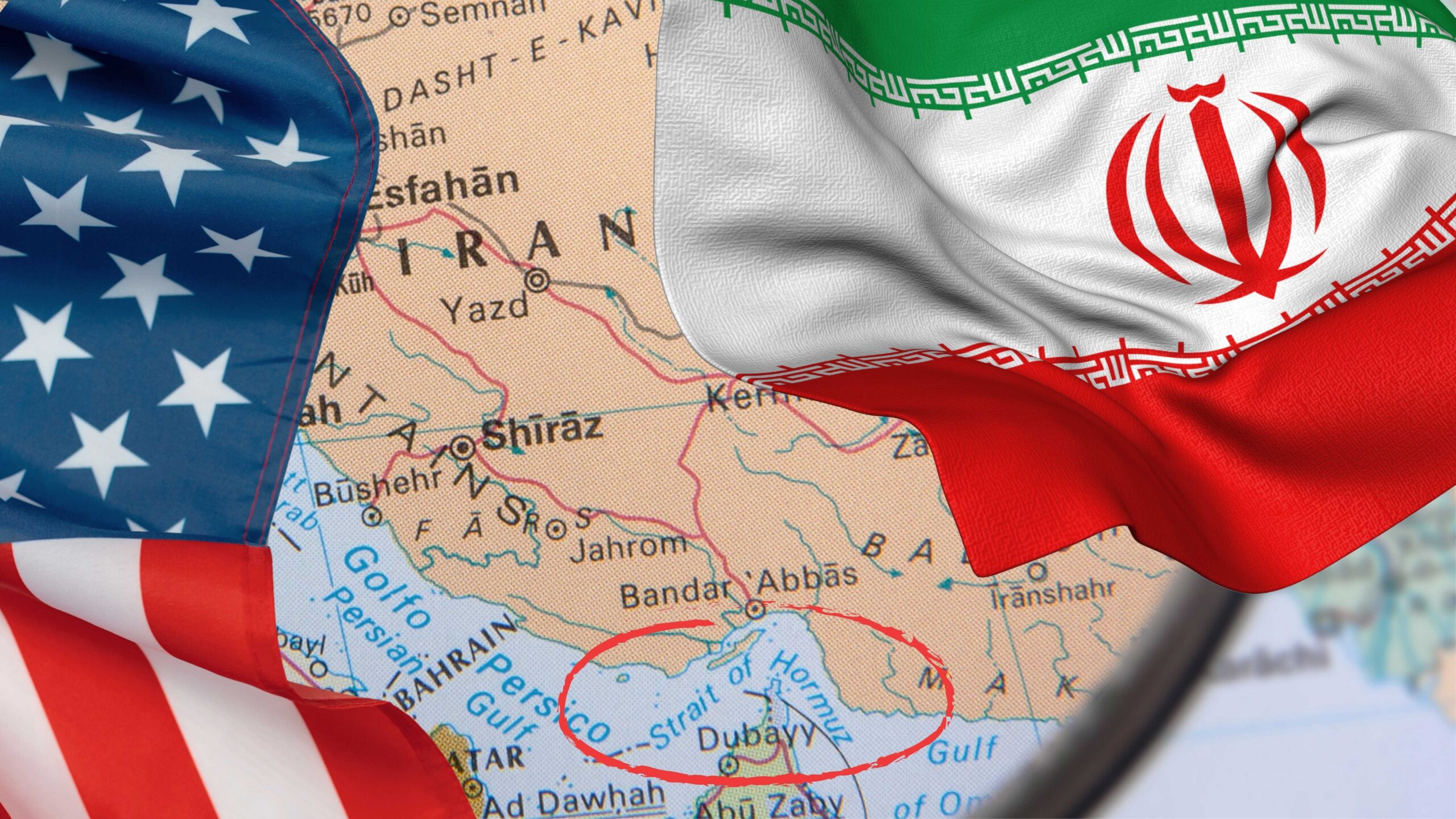
After the first four weeks of the war, a 90% drop in IRGC attacks can be observed. On the flip side, the interception rate of Gulf countries has increased to over 95%.[i] The layered UAE defence system has mitigated the threat of IRGC projectiles targeting both military and civilian infrastructure.[ii] Both U.S. and Israeli air defence systems continue to intercept threats from Iran and its proxies in Iraq, Lebanon and Yemen. Despite their ire with Iran, however, Gulf states remain reluctant to join the fight as primary participants, and the question of who will participate in opening the Strait of Hormuz remains.
De-escalation vs. escalation
On 30 March, President Trump said that the U.S. was in discussions with the Iranian regime for the urgent reopening of the strait, and threatened widespread devastation and the destruction of Iran’s power infrastructure if this goal is not reached.[iii] The Iranian response to the ultimatum – amplified by Mehr News[iv] – showed a map of power plants in Saudi Arabia, the United Arab Emirates, Qatar, and Kuwait as potential targets for retaliatory attacks.
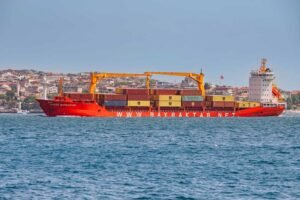
Ebrahim Azizi, the head of the Iranian parliament’s national security committee, said that the key trading route for international oil exports leading through the Strait of Hormuz would not be reopened for American vessels. The committee instead approved a toll on ships. Iran is currently charging vessels around £1.5 million to transit the strait.[v]
Most countries in the Middle East wish to resolve the conflict through negotiations.[vi] A two-week ceasefire in the war mediated by Pakistan and announced on 8 April gives some hope to this track. Nonetheless, due to persistent attacks by the IRGC, some Gulf leaders may find themselves rethinking this approach.
The conflict continues to exhibit dynamics of escalation, with both the U.S.-Israel coalition and Iran facing incentives to widen and deepen the confrontation, even though the war is increasingly costly and risks undermining their respective strategic objectives.
Iran’s adaptation and multi-domain force structure
Although the IRGC has sufficient stockpiles in its arsenal to extend the conflict further, the threat facing the establishment is significant.[vii] Built to endure, the IRGC has diversified and decentralised its administrative, military and security apparatus. Conceptualised by General Mohammad Ali Jafari, who led the IRGC between 2007 and 2019, the IRGC’s mosaic defence strategy organized the state’s defensive units “into multiple regional and semi-independent layers instead of concentrating power in a single command chain that could be paralysed by a decapitation strike.[viii] Under this model, the IRGC, the Basij, regular army units, missile control, naval and local command structures form parts of a distributed system. If one part is hit, others keep functioning. If senior leaders are killed, the chain of command does not collapse. If communications are severed, local units still retain the authority and capacity to act.
The doctrine has two central aims: to make Iran’s command system difficult to dismantle by force, and to make the battlefield more complex by turning Iran into a layered arena of regular defence, irregular warfare, local mobilisation and long-term attrition.[ix]
The regime is convinced that “it has shown that the United States is incapable of destroying Iran’s nuclear or missile programmes, even when it operates alongside Israel and with the potential financial and logistical support of its Persian Gulf partners in the future.[x]
Notwithstanding the IRGC’s mosaic defence, the U.S.-Israeli coalition’s successes in degrading it still give President Trump and Prime Minister Netanyahu an incentive to move on to the next phase of operations.
The next phase of the war
Taking control of the Strait of Hormuz and securing the Bab el-Mandeb strait are primary and urgent objectives. Recovering Iran’s enriched uranium stockpiles is an additional goal the coalition has yet to achieve. The U.S. is mobilizing significant forces to these ends.
Among Iran’s key strategic assets, Kharg Island is particularly critical. As the principal export terminal through which the vast majority of Iran’s crude oil is shipped,[xi] it underpins the state’s external revenue base and, by extension, funds a substantial proportion of IRGC activities, including the sustainment of its regional proxy network. Given its importance, Kharg has long featured in U.S. contingency planning and operational modelling, with scenario-based exercises conducted since the early 1980s.[xii] More broadly, the IRGC also maintains extensive illicit financial and commercial networks designed to circumvent international sanctions and sustain the regime’s revenues.[xiii] [xiv]
In parallel, the IRGC’s “strategic reserve” in Yemen in the form of Ansar Allah (the Houthi movement) continues to pose a credible threat to maritime security in the Bab el-Mandeb. Situated at the southern entrance to the Red Sea between Yemen and Djibouti, the strait is a vital conduit linking the Indian Ocean to the Suez Canal and, by extension, global trade between Europe and Asia. Since aligning itself with the broader anti-Israel regional axis, Ansar Allah has intermittently targeted commercial shipping in the Red Sea and Gulf of Aden using missiles, drones, and explosive-laden craft, and has already demonstrated its willingness to expand the conflict through direct attacks beyond maritime targets.[xv]
A further and more complex dimension of the conflict lies in Iran’s nuclear programme and the location and control of its highly enriched uranium stockpile. Preventing the IRGC from retaining or weaponising this material is widely regarded as a central objective of the U.S. and its partners. According to reporting based on IAEA assessments and related intelligence, Iran has accumulated a significant quantity of uranium enriched to 60% U-235 – material that remains below weapons-grade but is technically close to the threshold required for rapid breakout.[xvi]
While elements of Iran’s nuclear infrastructure have been degraded through sustained military action, assessments indicate that key components of its programme and material stockpiles remain intact and under IRGC control.[xvii] This raises the prospect that the uranium stockpile could either be converted into a pathway for weaponisation or leveraged diplomatically in any future negotiations, including those involving external actors, such as Russia and China. In this context, both Russia and China may have a strategic appetite to influence developments more actively – Russia through security guarantees, nuclear diplomacy, and leveraging its role in multilateral frameworks; and China through economic incentives, energy partnerships, and mediation efforts aimed at preserving regional stability and safeguarding its trade interests.[xviii]
The U.S. intelligence community assesses that Iran is unlikely to reopen the strait voluntarily.[xix] Tehran is expected to continue constraining maritime traffic to sustain pressure on global energy markets, prompting Washington to prepare contingency plans that include the potential use of force.
In support of sustained operations in the region, the U.S. has significantly expanded its naval and air presence[xx], with more than a third of its deployable maritime and aviation assets now concentrated in the Middle East theatre. This posture currently includes two operational aircraft carrier strike groups, with preparations underway for the deployment of a third. The arrival of the USS George H.W. Bush, which departed Naval Station Norfolk on 31 March 2026, would raise the U.S. carrier presence in the region to three. The USS Abraham Lincoln remains positioned in the Arabian Sea in support of ongoing operations, while the USS Gerald R. Ford has been temporarily withdrawn to the Mediterranean following technical damage sustained in a fire incident and is undergoing repairs in Crete.[xxi]
Taken together, the deployment of multiple carrier strike groups underscores the scale of U.S. commitment to maintaining maritime access through both the Strait of Hormuz and Bab el-Mandeb. However, given the systemic risks to global energy flows, the stabilisation of these chokepoints is increasingly framed not as a unilateral task, but as a broader international security requirement. Any durable solution would therefore require coordinated engagement among the United States, Gulf partners, European allies, and other stakeholders dependent on uninterrupted energy transit.
With Pakistani mediation, the U.S. and Iran are considering extending the current cease‑fire by another two weeks.[xxii] While Trump is focusing on recovery of the enriched uranium stockpile, imposing limits on Iran’s missile program, and dismantling its proxies, European countries and their Gulf partners are planning a post-war mission to free up shipping in the Strait of Hormuz. As part of an international defence plan, French President Emmanuel Macron is planning to send mine-clearing and other military vessels to the region, with the goal of restoring shipping companies’ confidence in using the strait after the fighting has ended.[xxiii]
Conclusion
By closing the Strait of Hormuz and signalling its capacity to threaten the Bab el-Mandeb, Iran has transformed critical maritime chokepoints into instruments of strategic coercion. The objective is not merely tactical disruption, but the deliberate use of geography to impose economic pressure on energy-dependent states and reshape the political calculus of the conflict.
At the centre of this strategy stands the Islamic Revolutionary Guard Corps (IRGC), whose decentralised force structure, missile capabilities, naval assets, and proxy networks enable Tehran to sustain calibrated pressure while avoiding immediate full-scale confrontation. Through layered deterrence and controlled escalation, Iran seeks to raise the costs of reopening the strait beyond what its adversaries may be willing to bear.
For the United States and its partners, the question is no longer solely military but systemic. Securing freedom of navigation through the Strait of Hormuz – and stabilising the Bab el-Mandeb – has become a test of coalition cohesion, burden-sharing, and credibility. A forced reopening carries risks of wider escalation, including strikes on energy infrastructure and further disruption to global markets. A negotiated reopening, meanwhile, may leave intact the underlying leverage Iran has demonstrated it can exercise.
Ultimately, who opens the Strait of Hormuz – and under what terms – will define the next phase of the war. The outcome will shape not only regional power balances, but the resilience of the global energy system and the principle that strategic waterways cannot be held hostage to political confrontation.
Continue Reading:
Muslim Brotherhood in Sudan: Genesis, Evolution and Threat
Sudan’s war is reviving Muslim Brotherhood-linked networks, exposing their influence in the military and the risks of renewed Islamist extremism.
[i] Britannica Editors (2026). “2026 Iran war”, 15 April 2026, Encyclopaedia Britannica, retrieved from: https://www.britannica.com/event/2026-Iran-war.
[ii] WION. (2026). “345 ballistic missiles intercepted, destroyed; 1,773 drones shot down: How many layers of air defence is the UAE using?”, retrieved from: https://www.wionews.com/photos/-345-ballistic-missiles-intercepted-destroyed-1-773-drones-shot-down-how-many-layers-of-air-defence-is-the-uae-using-1774266266264/1774266266265.
[iii] Johny, S. (2026). “Trump threatens to strike Iran’s civilian infrastructure if no deal is reached”, The Hindu, 30 March 2026, retrieved from: https://www.thehindu.com/news/international/iran-israel-war-donald-trump-warns-tehran/article70802880.ece.
[iv] Mehr News (2026). “Iran warns of harsh response if its power plants targeted”, 22 March 2026.
[v] Kureansiklopedi. (2026). “Strait of Hormuz crisis 2026”, retrieved from: https://kureansiklopedi.com/en/detay/strait-of-hormuz-crisis-2026-87c04.
[vi] Al Jazeera (2026). “GCC, other Middle East nations react to Iran-US ceasefire announcement”, Al Jazeera, 8 April 2026, retrieved from: https://www.aljazeera.com/news/2026/4/8/gulf-arab-nations-react-to-iran-us-ceasefire-announcement.
[vii] Kochhar, M.G.R. (2026). “Iran at an inflection point: regime stability, great power calculus, and the prospects of strategic change”, Defence Research and Studies, 17 January 2026, retrieved from: https://dras.in/iran-at-an-inflection-point-regime-stability-great-power-calculus-and-the-prospects-of-strategic-change/.
[viii] Al Jazeera (2026). “The ‘Fourth Successor’: Iran’s plan for a long war with the US and Israel”, 10 March 2026, retrieved from: https://www.aljazeera.com/features/2026/3/10/the-fourth-successor-how-iran-planned-to-fight-a-long-war-with-the-us-and-israel.
[ix] Ibrahim, S. (2026). “The ‘Fourth Successor’: Iran’s plan for a long war with the U.S. and Israel”, Al Jazeera, 10 March 2026, retrieved from: https://www.aljazeera.com/amp/features/2026/3/10/the-fourth-successor-how-iran-planned-to-fight-a-long-war-with-the-us-and-israel.
[x] Zarif, J.Z. (2026). “How Iran Should End the War; A Deal Tehran Could Take”, Foreign Affairs, 3 April 2026, retrieved from: https://www.foreignaffairs.com/middle-east/how-iran-should-end-war.
[xi] Zeidan, A. (2026). “Kharg Island”, Encyclopaedia Britannica, 12 April 2026, retrieved from: https://www.britannica.com/place/Kharg-Island.
[xii] Merrow, W., Ferragamo, M., and Roy, D. (2026). “Kharg Island: Iran’s oil lifeline and a tempting U.S. target”, Council on Foreign Relations, 7 April 2026, retrieved from: https://www.cfr.org/articles/kharg-island-irans-oil-lifeline-and-a-tempting-u-s-target.
[xiii] Hajdari, U. and Kamiar, B. (2026). “Iran’s Revolutionary Guard control the economy – here’s why the currency suffers”, Euronews, 9 January 2026, retrieved from: https://www.euronews.com/business/2026/01/09/irans-revolutionary-guard-control-the-economy-heres-why-the-currency-suffers.
[xiv] Hajdari, U. and Kamiar, B. (2026). “Iran’s Revolutionary Guard control the economy – here’s why the currency suffers”, Euronews, 9 January 2026, retrieved from: https://www.euronews.com/business/2026/01/09/irans-revolutionary-guard-control-the-economy-heres-why-the-currency-suffers.
[xv] Peoples Dispatch. (2024). “Ansar Allah attacks yet another commercial ship in the Gulf of Aden, reiterates demand for ceasefire”, 7 March 2024, retrieved from: https://peoplesdispatch.org/2024/03/07/ansar-allah-attacks-yet-another-commercial-ship-in-the-gulf-of-aden-reiterates-demand-for-ceasefire/.
[xvi] CNN (2026). “US and Israel may have set back Iran’s nuclear program—but key expertise and enriched uranium remain unclear”, 7 April 2026, retrieved from: https://edition.cnn.com/2026/04/07/middleeast/us-israel-iran-nuclear-expertise-intl.
[xvii] Solomon, C. (2026). “Iran Update Special Report”, Institute for the Study of War, 3 April 2026, retrieved from: https://understandingwar.org/research/middle-east/iran-update-special-report-april-3-2026/.
[xviii] Hughes, M., and Rajagopalan, R.P. (2026). “A coordinated Trans-Eurasian threat: the deepening China-Russia strategic partnership”, The Diplomat, 30 March 2026, retrieved from: https://thediplomat.com/2026/03/a-coordinated-trans-eurasian-threat-the-deepening-china-russia-strategic-partnership/.
[xix] Landay, J., Banco, E. and Stweart, P. (2026). “U.S. intelligence warns Iran unlikely to ease Hormuz Strait chokehold soon, sources say”, Reuters, 3 April 2026, retrieved from: https://www.reuters.com/world/middle-east/us-intelligence-warns-iran-unlikely-ease-hormuz-strait-chokehold-soon-sources-2026-04-03/.
[xx] The Economic Times (2026). “US Navy maintains 15-ship presence in Middle East, may participate Iran blockade”, 14 April 2026, retrieved from: https://economictimes.indiatimes.com/news/defence/us-navy-maintains-15-ship-presence-in-middle-east-may-participate-iran-blockade/articleshow/130249190.cms?from=mdr.
[xxi] Rawnsley, J. (2026). “US aircraft carrier to sail to Crete for repairs after fire on board”, BBC News, 19 March 2026, retrieved from: https://www.bbc.co.uk/news/articles/c0rjr28nxrwo.
[xxii] Alexander, C. (2026). “US and Iran mull another round of peace talks”, Bloomberg, 14 April 2026, retrieved from: https://www.bloomberg.com/news/newsletters/2026-04-14/us-and-iran-mull-another-round-of-peace-talks.
[xxiii] Colchester, M., Bisserbe, N., and Benoit, B. (2026). “Europe drafts postwar plan to free up Hormuz without U.S.”, The Wall Street Journal, 15 April 2026, retrieved from: https://www.wsj.com/world/europe/europe-drafts-postwar-plan-to-free-up-hormuz-without-u-s-5638f5f8.