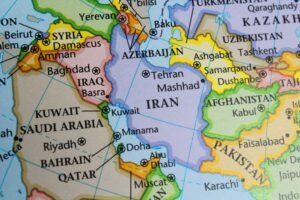
In the wake of the U.S.-Israel-Iran conflict, Pakistan emerged as a key peacemaker, engaging both Tehran and Washington, D.C.[i] The Islamabad Talks, mediated by the Pakistani government, represented a diplomatic breakthrough aimed at concluding hostilities.[ii] It involved convening a ministerial dialogue in Islamabad with the participation of the foreign ministers of Saudi Arabia, Turkey and Egypt,[iii] and engaging China immediately afterward.[iv] Though the hours-long negotiations failed to bring about a deal,[v] both parties expressed gratitude to Pakistan for its efforts.[vi] These high-stakes negotiations raise important questions about Pakistan’s diplomatic modus operandi in the conflict and what Islamabad aims to achieve through these initiatives.
The hedging strategy
A closer examination of Islamabad’s diplomatic overtures reveals a multifaceted approach. Pakistan hosts the world’s second-largest Shia population, which maintains a strong affinity with Iran and its leadership, particularly the Ayatollah. The assassination of Ayatollah Ali Khamenei triggered massive protests in Pakistan,[vii] demonstrating deep spiritual and sectarian ties. Islamabad leveraged this affinity, along with long-standing historical relations, to engage the Iranian leadership[viii] and seek support for mediation.
Simultaneously, Islamabad also capitalized on U.S. President Donald Trump’s favourable disposition toward Pakistani leadership, which developed after the May 2025 India-Pakistan conflict. Pakistan acknowledged President Trump’s role in ending the war with its neighbour and even nominated him for the Nobel Peace Prize.[ix] [x] Pakistan effectively leveraged its relations with Iran and its growing rapport with the Trump administration to position itself as a bridge for peace talks.[xi] Both Iran and the U.S. have shown trust and welcomed Islamabad’s mediation efforts.
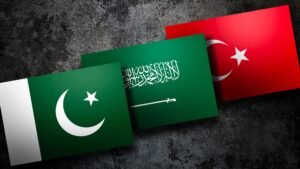
In addition, Pakistan engaged regional partners to broaden the diplomatic initiative. The government invited the foreign ministers of Saudi Arabia, Turkey and Egypt to discuss the war in Iran, Tehran’s retaliatory strikes on GCC countries, the closure of the Strait of Hormuz,[xii] the resulting economic and energy crisis, and ongoing mediation efforts. The leaders deliberated on 15 demands put forth by the Trump administration and the five counter-demands by Iran, seeking a mutually acceptable middle ground.[xiii]
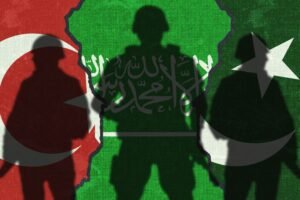
This reflects Islamabad’s use of alliance politics to lead a coordinated diplomatic effort towards de-escalation. These countries all have direct stakes in the region and are significantly affected by the prolongation of the conflict. Iranian strikes on U.S. facilities in Saudi Arabia[xiv] further heighten Riyadh’s interest in a swift resolution. Collectively, under they can exert pressure on both of the primary conflicting sides to enter into negotiations and reach a compromise. This approach underscores Pakistan’s recognition that solving the crisis requires coordinated diplomacy rather than unilateral efforts.
These initiatives remain strictly diplomatic and do not signal the formation of a security bloc[xv], an “Islamic NATO”,[xvi] or a Sunni axis.[xvii] Given the shared interests of these states in regional stability, economic continuity, and connectivity, this alignment may also help shape the post-war order and reinforce the outcomes of mediation.
Islamabad is also acting as an interlocutor with China. Following the foreign ministers’ summit, Pakistani President Asif Ali Zardari – departing from conventional diplomatic practice – visited the Chinese embassy[xviii] to convey key messages to Beijing. Shortly afterward, Pakistan’s Deputy Prime Minister and Foreign Minister Ishaq Dar travelled for Beijing to discuss the summit’s outcomes and the prospects for mediation. Pakistan brought Chinese leadership on board, resulting in a joint five-point agenda.[xix] China’s involvement adds weight to these efforts, given its immense strategic interests in Iran and the Strait of Hormuz. Its global stature and perceived neutrality also positions it as a potential guarantor in any agreement.[xx]
This multipronged diplomatic strategy – combining roles as facilitator, coalition-builder, and interlocutor – is rooted in a policy of diplomatic hedging. Islamabad refrained from taking sides, while maintaining active engagement with all parties.[xxi] Pakistan’s hedging diplomacy is both a strategic choice and a necessity. Given its geopolitical ties, sectarian dynamics, and economic constraints, Pakistan cannot remain passive or align exclusively with any one side.
Security commitments and regional threat perceptions
Pakistan signed a mutual defence agreement with Saudi Arabia in September 2025,[xxii] following Israeli strikes on Doha that heightened Saudi security concerns. This agreement came at a time when Saudi-Iranian relations had improved after the Chinese-brokered rapprochement between the two in 2023.[xxiii]
However, Iranian strikes on U.S. military targets in Saudi Arabia have placed Pakistan in a strategic dilemma. Any Saudi move to operationalize the agreement could directly implicate Pakistan, risking consequences for its security. Given geographic proximity, Iranian missile barrages would seriously damage Pakistan’s own strategic and military assets. Retaliation would risk drawing Pakistan into direct conflict with Iran, broadening the war and raising the spectre of nuclear confrontation.
Avoiding such a scenario remains a core objective for Islamabad. Pakistani leadership has reportedly urged Saudi Arabia to refrain from retaliation [xxiv] while also encouraging Iran to limit strikes on Saudi infrastructure.[xxv] Direct involvement in the conflict would not only threaten Pakistan’s security –already strained by tensions with India – but could also enflame domestic sectarian divisions.
Beyond strategic concerns, Pakistan’s energy dependence and fragile economy also necessitate a hedging diplomacy. Over 80% of Pakistan’s energy imports pass through the Strait of Hormuz, and its closure has severely disrupted supply chains.[xxvi] Pakistan’s ties with Iran allowed its shipments to continue transiting the Strait,[xxvii] while Saudi Arabia pledged government uninterrupted oil supply through the Red Sea route.[xxviii] Despite these measures, petroleum prices in Pakistan have skyrocketed, and prolonged conflict will likely deepen economic strain. This necessitates the urgency for Pakistan to play an active diplomatic role in seeking a swift resolution of the conflict in the Middle East.
Conclusion
Pakistan has long faced diplomatic isolation[xxix] and its dwindling economic situation has compounded challenges. Its current hedging strategy in the Iran conflict offers an opportunity to reposition itself on the global stage as a credible peacemaker. By leveraging alliance politics, Islamabad also seeks to establish itself as the leader of a regional diplomatic framework that could shape the post-war order. At the same time, its engagement with both the Trump administration and Beijing reflects a broader application of hedging in global power politics.
[i] Chotiner, I. (2026). “How Pakistan Became a Major Player in Peace Negotiations Between the U.S. and Iran,” The New Yorker, 30 March 2026, retrieved from: https://www.newyorker.com/news/q-and-a/how-pakistan-became-a-major-player-in-peace-negotiations-between-the-us-and-iran.
[ii] Latif, A. (2026). “Islamabad prepares to host US-Iran talks as Vance heads to Pakistan,” Anadolu Ajansı, 10 April 2026, retrieved from: https://www.aa.com.tr/en/world/islamabad-prepares-to-host-us-iran-talks-as-vance-heads-to-pakistan/3901222.
[iii] The Express Tribune (2026). “Pakistan, Turkiye, Saudi Arabia, Egypt conclude first round of talks on US-Israel-Iran war,” 29 March 2026, retrieved from: https://tribune.com.pk/story/2599919/dar-receives-egypt-turkiye-fms-as-pakistan-steps-up-us-iran-mediation.
[iv] Daily Sabah (2026). “China, Pakistan lay out 5-point Mideast plan to end Iran war,” 31 March 2026, retrieved from: https://www.dailysabah.com/business/energy/russia-bans-gasoline-exports-until-end-of-july.
[v] Al Jazeera (2026). “US and Iran fail to reach a deal after marathon talks in Pakistan,” 12 April 2026, retrieved from: https://www.aljazeera.com/news/2026/4/12/us-and-iran-fail-to-reach-peace-deal-after-marathon-talks-in-pakistan.
[vi] The Express Tribune (2026). “Trump thanks Pakistan for hosting talks, announces US Navy blockade of Hormuz,” 12 April 2026, retrieved from: https://tribune.com.pk/story/2602389/trump-thanks-pakistan-for-hosting-talks-announces-us-navy-blockade-of-hormuz.
[vii] Dawn (2026). “Protest erupts in Islamabad after Khamenei’s assassination,” 02 March 2026, retrieved from: https://www.dawn.com/news/1977231/protest-erupts-in-islamabad-after-khameneis-assassination.
[viii] Baabar, M. (2026). “Tehran appreciates Islamabad’s mediation efforts, urges trust for talks: Iran agrees to let 20 more Pakistan-flagged ships transit Hormuz strait,” The News, 29 March 2026, retrieved from: https://www.thenews.pk/print/1406991-tehran-appreciates-islamabad-s-mediation-efforts-urges-trust-for-talks-iran-agrees-to-let-20-more-pakistan-flagged-ships-transit-hormuz-strait.
[ix] Haq, S. (2025). “Pakistan nominates Trump for Nobel Peace Prize, praising ‘stellar statesmanship’,” CNN, 23 June 2025, retrieved from: https://edition.cnn.com/2025/06/21/asia/pakistan-trump-nobel-peace-prize-nomination-intl.
[x] Roth, A. (2025). “Truly, madly, deeply: Trump’s desire for a Nobel peace prize is driving diplomacy,” The Guardian, 9 October 2025, retrieved from: https://www.theguardian.com/us-news/2025/oct/09/trump-nobel-peace-prize.
[xi] Xinhua (2026). “Trump’s envoy confirms White House sent 15-point plan to Iran via Pakistan,” 27 March 2026, retrieved from: https://global.chinadaily.com.cn/a/202603/27/WS69c57a61a310d6866eb4017e.html.
[xii] Shahid, A. (2026). “Pakistan hosts regional powers for Iran talks, with focus on Hormuz proposals,” Reuters, 29 March 2026, retrieved from: https://www.reuters.com/world/asia-pacific/pakistan-hosts-regional-powers-iran-talks-with-focus-hormuz-proposals-2026-03-29/.
[xiii] Javaid, O. (2026). “Pakistan hosts four-nation bid to encourage US, Iran towards diplomacy,” Al Jazeera, 29 March 2026, retrieved from: https://www.aljazeera.com/news/2026/3/29/pakistan-hosts-four-nation-bid-to-encourage-us-iran-towards-diplomacy.
[xiv] Gambrell, J. (2026). “Iranian drones strike U.S. Embassy in Saudi Arabia as war widens,” PBS News, 03 March 2026, retrieved from: https://www.pbs.org/newshour/world/iranian-drones-strike-u-s-embassy-in-saudi-arabia-as-war-widens.
[xv] Podeh, E. (2026). “Middle East realignment: Turkey, Egypt, and Pakistan are reshaping US-Iran relations – opinion,” The Jerusalem Post, 29 March 2026, retrieved from: https://www.jpost.com/opinion/article-891245.
[xvi] Zee News (2026). “Pakistan to host ‘Islamic NATO style’ quadrilateral meeting with Saudi Arabia, Turkey and Egypt over Iran war,” 29 March 2026, retrieved from: https://zeenews.india.com/world/pakistan-to-host-islamic-nato-style-quadrilateral-meeting-with-saudi-arabia-turkey-and-egypt-over-iran-war-3031335.html.
[xvii] RT (2026). “SUNNI AXIS formed by Saudi Turkey Egypt & nuclear Pakistan — reports after top-level talks,” 30 March 2026, retrieved from: https://x.com/RT_com/status/2038528767048785955.
[xviii] Daily Times (2026). “President Zardari makes unannounced China embassy visit,” 30 March 2026, retrieved from: https://dailytimes.com.pk/1470806/president-zardari-makes-unannounced-china-embassy-visit/.
[xix] Dawn (2026). “Pakistan, China issue 5-point initiative for restoring peace in Middle East,” 31 March 2026, retrieved from: https://www.dawn.com/news/1987106.
[xx] Bicker, L. (2026). “China is trying to play peacemaker in the Iran war – will it work?,” BBC, 01 April 2026, retrieved from: https://www.bbc.com/news/articles/cze0kz7gr84o.
[xxi] Mansour, M. (2026). “Pakistan maintains ‘delicate balancing act’ as it hosts Iran talks,” Al Jazeera, 29 March 2026, retrieved from: https://www.aljazeera.com/news/2026/3/29/pakistan-maintains-delicate-balancing-act-as-it-hosts-iran-talks.
[xxii] Dahan, M. (2025). “Saudi Arabia, nuclear-armed Pakistan sign mutual defence pact,” Reuters, 18 September 2025, retrieved from: https://www.reuters.com/world/asia-pacific/saudi-arabia-nuclear-armed-pakistan-sign-mutual-defence-pact-2025-09-17/.
[xxiii] Al Jazeera (2023). “China-brokered Saudi-Iran deal driving ‘wave of reconciliation’, says Wang,” 21 August 2023, retrieved from: https://www.aljazeera.com/news/2023/8/21/china-brokered-saudi-iran-deal-driving-wave-of-reconciliation-says-wang.
[xxiv] Jamal, U. (2026). “Why Pakistan Is Desperate to Avert an Iran-Saudi Confrontation,” The Diplomat, 20 March 2026, retrieved from: https://thediplomat.com/2026/03/why-pakistan-is-desperate-to-avert-an-iran-saudi-confrontation/.
[xxv] Syed, B. (2026). “Pakistan invoked Saudi pact to ‘deter’ Iran strikes: Dar,” DAWN, 04 March 2026, retrieved from: https://www.dawn.com/news/1978079.
[xxvi] Biswas, S. (2026). “Pakistan Struggles With Oil Shock: How Islamabad is Coping with the Hormuz Energy Crisis,” Times Now News, 04 April 2026, retrieved from: https://www.timesnownews.com/business-economy/economy/pakistan-struggles-with-oil-shock-how-islamabad-is-coping-with-the-hormuz-energy-crisis-article-153995262.
[xxvii] Dawn (2026). “DPM Dar says Iran has allowed ‘20 more ships’ under Pakistan flag to cross Strait of Hormuz,” 29 March 2026, retrieved from: https://www.dawn.com/news/1986336.
[xxviii] Ansari, I. (2026). “Saudi Arabia assures Pakistan of oil supply through Port of Yanbu on Red Sea,” The Express Tribune, 04 March 2026, retrieved from: https://tribune.com.pk/story/2595785/saudi-arabia-assures-pakistan-of-oil-supply-through-port-of-yanbu-on-red-sea.
[xxix] Sayeed, S. (2026). “From international outcast to mediator in Iran war, Pakistan’s remarkable makeover,” Reuters, 02 April 2026, retrieved from: https://www.reuters.com/world/asia-pacific/international-outcast-mediator-iran-war-pakistans-remarkable-makeover-2026-04-02/.