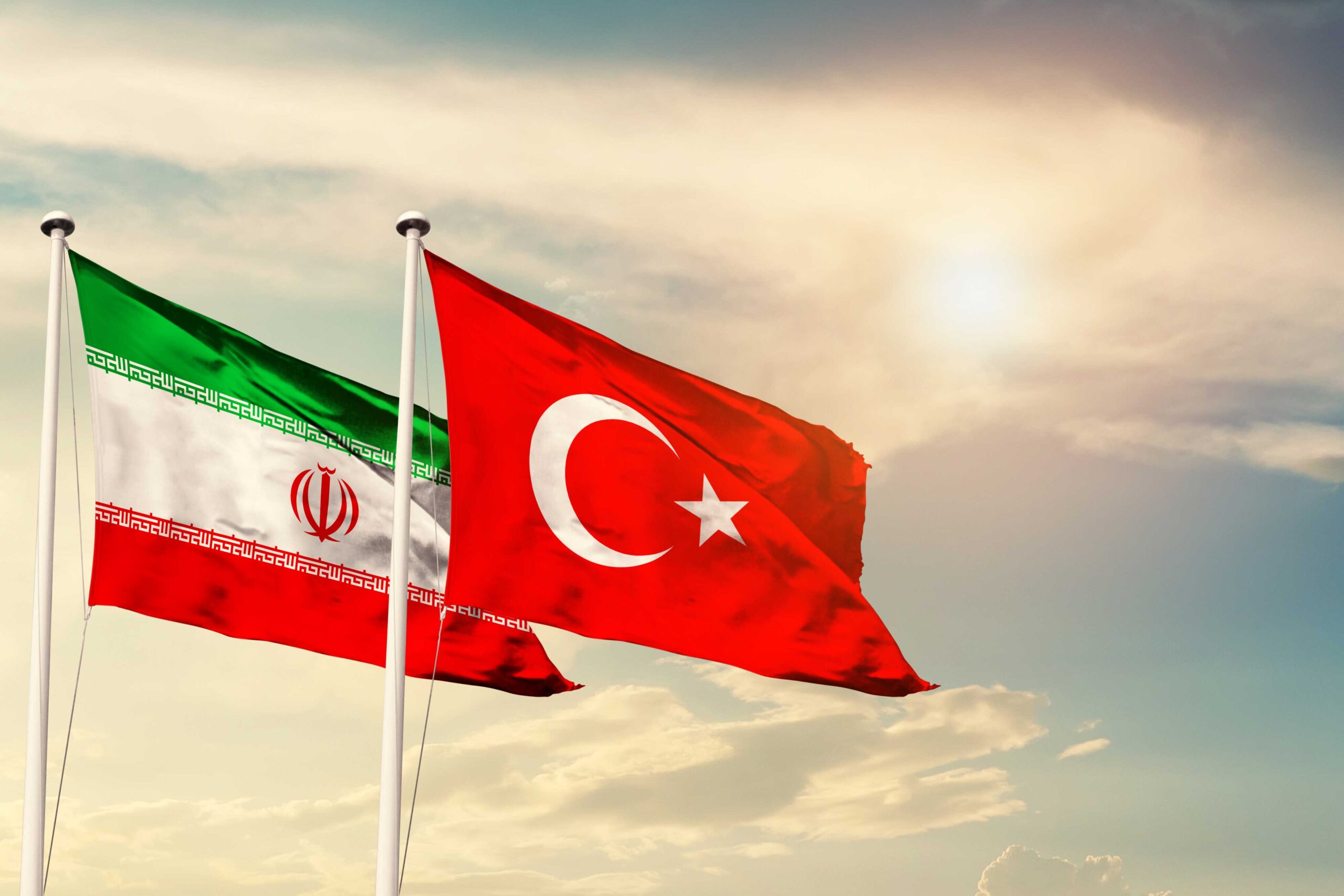
The Iran war puts Turkey in a peculiar position, posing several challenges. Since the beginning of the US and Israel’s military confrontation with Iran, Turkey has adopted cautious neutrality, which aimed to avoid the escalation of tensions with either side of the conflict. However, the question is how sustainable Ankara’s position is, given the rapidly changing conflict landscape, such as a new wave of refugees, increasing cost of war, the disruption of energy flows, surge in ethno-nationalistic conflict and Iran’s apparent intention to expand its target portfolio.
Turkey’s exclusion from Iran’s target portfolio initially provided reassurance. However, this shifted when NATO air defenses intercepted[i] an Iranian ballistic missile headed for Turkish airspace, despite Iranian denial.[ii] The incident underscores rapidly evolving risks and the fragility of Turkey’s security environment, suggesting that perceived neutrality may no longer insulate Ankara from the spillover of conflict. Ankara must recalibrate its strategy based on three potential scenarios: regime survival, swift regime transition, and a protracted civil war and chaos, each presenting varying degrees of impediments and difficult policy decisions.
Ankara’s preferred scenario: Regime survival
Since 2020, Turkey has gradually shifted from being a revisionist power to a status quo power. A tumultuous decade of the 2010s had exhausted the Turkish economy. Refugee waves from Syria and Afghanistan have caused a growing discontent against the Turkish government. Constant wars and regional rivalries did not reach a definitive victory for Ankara. New wars, one in the north (Ukraine) and another in the south (Gaza), have put further pressure on the Turkish government. This increasing burden of Turkey’s foreign policy led Ankara to prioritize the continuation of regional order and stability. This is why Turkey wants to see things remain as they have been.
The first scenario is regime survival, which Ankara appears to prioritize due to a decades-long but frequently volatile relationship. In light of Iran’s targeting of Gulf States and the resulting instability, Ankara may position itself as a mediator between Iran and other regional actors. Under this scenario, Ankara could also assess Iran’s influence as diminished.
However, the regime’s apparatus, including the IRGC and other hardliners, would likely continue pursuing regional objectives that directly compete with Turkey’s interests. Especially after a potential failure of the US and Israel to change the regime in Iran, the Iranian government could act more aggressively in foreign policy to repair its deterrence posture. This would mean a dangerous phase for Ankara in places like Iraq, Lebanon, and the south Caucasus – areas where Turkish interests compete with those of Iran.
In addition to this, a regime that survives the current war would be more determined to have a nuclear weapon. The US and Israeli could leave behind an Iran with nuclear weapons. This would further complicate Turkey’s regional policies. It could even trigger an appetite for nuclear weapons in Ankara as well as other regional capitals.
The US’ dream scenario: Regime collapse and swift transition
The second and preferred scenario[iii] for the United States and Israel involves an early regime collapse and swift transition in which a unifying opposition figure might oversee the process. While the least likely scenario in the eyes of decisionmakers in Ankara, regime collapse and swift transition might also be welcomed. Although there would be changes in Iran’s leadership, shared economic, security, and political interests would provide the necessary context for a return to pragmatic engagement. Turkey could establish a relationship with the new government, which would likely seek Ankara’s support for stability in Iran too.
However, there are three critical caveats in this scenario. The first one is that no matter how swift the transition to a new regime is, political uncertainty could lead to instability and an influx of refugees who would see Turkey as the primary target country or transition route to Europe. The ethno-nationalistic aspirations among several ethnic groups, including Kurds and Baluchi separatists, would like to seize opportunities by mobilizing their constituencies and intensifying armed conflict against the new regime.
Also, a regime transition will mean a change of balance of power in the region. New Iran could be more pro-American and pro-Israel. The emergence of such a posture would fundamentally transform Turkey’s own relationship with the US and Israel. A more pro-American Iran could decrease Turkey’s diplomatic, political, and military leverage in Washington. Besides, in its rivalry with Israel, Turkey could face an Israeli-Iranian alliance emerge.
Worst-case scenario: A protracted civil war and chaos
This scenario includes a protracted civil war and chaos, which may involve both US boots on the ground and a US and Israel-supported proxy campaign, which may include Kurdish and Baluchi ethno-nationalist groups.[iv] In the worst-case scenario, a protracted civil war and chaos will affect the broader regional landscape, leading to social, economic, and political instability and destruction, potentially creating a vacuum that attracts external actors to the conflict. Such chaos and instability would result in the forced displacement of hundreds of thousands, if not millions, of refugees and internally displaced persons (IDPs).
In 2025, Turkey’s annual trade volume with Iran was worth $5.5 billion. While $3 billion consists of Turkey’s exports[v], approximately $2.5 billion is from imports from Iran, and most of Turkey’s imports are natural gas. The Research Services of the Turkish Parliament report stated that “roughly 20 percent of Turkey’s crude oil[vi] imports originate from Gulf countries and transit through the Strait of Hormuz.” Similarly, the Baku-Tbilisi-Ceyhan pipeline could also be targeted by Iran, which possesses another vulnerability for Turkey’s energy security.
In the case of a prolonged civil war in Iran, including a long-term disruption in the Strait of Hormuz, Turkey will be one of the most affected countries. Turkey’s economic dependency on Iran could negatively affect Turkey’s economy[vii], with initial signs already evident.
The second and one of the most consequential risks in this war is the US’ plan to arm Kurdish groups in Iran and Iraq[viii] against the regime in Iran – an idea which received pushback from the Kurdish leaders in Iraq. The President of Iraq’s Kurdistan Region[ix] said, “The Kurdistan Region will not be a party to conflicts and will remain a force for peace.” While there is no consensus among the Kurdish groups in Iran, the Kurdistan Free Life Party (PJAK), an offshoot of the Kurdistan Workers’ Party (PKK), which Turkey considers a terrorist organization, could agree with the Trump administration. The deep distrust is partly due to how the Kurdish group in Syria was sidelined and forced to make significant concessions.
In any case, if an agreement for partnership were to become a reality between Kurdish groups in Iran and the United States and Israel, it could place Turkey in a very precarious position and potentially create a perception of an existential threat for a number of reasons.
First, if the Trump administration were to implement its plan to arm and provide both logistical and air support to the Kurds in Iran, Turkey could face security risks greater than those experienced during the Syrian civil war. Despite similarities that might be drawn between the Iran war and the Syrian civil war in this scenario, key structural differences exist, most notably, Turkey’s limited means to influence events in Iran compared to its active proxy engagements in Syria. In addition, past Iranian-linked covert operations in Turkey underscore Ankara’s vulnerability to destabilizing activities linked to Iran-affiliated external actors, further complicating risk assessments. Ankara does not possess these tools in the Iran case; on the contrary, Iran-linked small groupings, such as the Iranian Quds Force-linked Salam Tawhid (Selam Tevhid) cell structure[x], proved highly effective against regime dissidents living in Turkey as well as acting at the behest of the regime, carrying our targeted assassinations and terrorist attacks in Turkey.
In Syria, the new government in Damascus sided with Turkey to manage its reunification efforts and deal with the Syrian Democratic Forces (SDF). Turkey has controlled strategic territories in Syria, providing Ankara with direct access and engaging in a proxy military campaign. Such control was possible with the implicit approval of the US.[xi] On the contrary, Ankara’s influence in Iran is close to nonexistent. Any form of partnership between the US, Israel, and Kurds could involve long-term commitments and US boots on the ground, as well as a no-fly zone in Iran, which Kurds noted as the condition for their partnership.[xii] Such commitment could empower similar aspirations in Turkey and even renewed aspirations in Syria, thereby risking the ongoing peace process.
A protracted civil war will force people out of their homes, and many would see Turkey as a safe country, which may witness another exodus of refugees. Strained with long-term economic hardship and hosting more than 2 million Syrian refugees[xiii], having more refugees could become a serious burden to endure.
Another unintended consequence of the Iran war for Turkey could be its further isolation in the Eastern Mediterranean, as Greece, France, and the United Kingdom have decided to increase their naval presence there.
Conclusion
On the upside, though not too promising in the short term, the Iran war could present Ankara with some promising options. First, if Ankara maintains its cautious neutrality and leans toward the Gulf States, it could find its role elevated in the region. Iranian barrages of missiles and drones against Gulf states have torpedoed any future diplomatic normalization between the two sides of the Gulf. Even if they reach a ceasefire or an agreement, security concerns will persist. On the other hand, US security guarantees for allies in the Middle East will be questionable if the current campaign ends with a political disaster, even if not a military one. Turkey could fill this security vacuum, by deepening relations with Gulf countries.
However, this opportunity comes alongside major risks that all three scenarios pose. The war will fundamentally change Iran and the Middle East, which is a challenge for a status quo power like Turkey.
[i] Mitchell, E. (2026). “NATO shoots down Iranian missile headed toward Turkey’s airspace”, The Hill, 4 March 2026, retrieved from: https://thehill.com/policy/defense/5766972-iranian-missile-shot-down-turkey/.
[ii] Hubbard, B. et al. (2026). “Iran Denies Firing Missile Toward Turkey”, The New York Times, 4 March 2026, retrieved from: https://www.nytimes.com/2026/03/04/world/middleeast/nato-iranian-missile-turkey.html.
[iii] Borger, J. (2026). “Four scenarios: what are the possible outcomes of the US-Israel war on Iran?”, The Guardian, 3 March 2026, retrieved from: https://www.theguardian.com/world/2026/mar/03/what-next-for-iran-after-the-bombing-four-scenarios.
[iv] Ibid.
[v] Duran, A.E. (2026). “Concern that Iran war will increase inflation in Turkey”, [in Turkish], 2 March 2026, retrieved from: https://www.dw.com/tr/t%C3%BCrkiyede-i%CC%87ran-sava%C5%9F%C4%B1-enflasyonu-art%C4%B1racak-endi%C5%9Fesi/a-76186390.
[vi] Esen, M.E. (2026). “Ankara Expects the Iranian Regime to Survive but Risks for Turkey Persist”, Institude, 5 March 2026, retrieved from: https://www.institude.org/opinion/ankara-expects-the-iranian-regime-to-survive-but-risks-for-turkey-persist.
[vii] Egilmez, M. (2026). “The Effects of the U.S.-Iran War on the Turkish Economy”, 1 March 2026, retrieved from: https://www.mahfiegilmez.com/2026/03/komsudaki-savasn-turkiye-ekonomisine.html.
[viii] Bertrand, N. et al. (2026). “CIA working to arm Kurdish forces to spark uprising in Iran”, CNN Politics, 4 March 2026, retrieved from: https://edition.cnn.com/2026/03/03/politics/cia-arming-kurds-iran.
[ix] Middle East Monitor (2026). “Barzani tells Iran Kurdistan Region will not join regional conflict”, 5 March 2026, retrieved from: https://www.middleeastmonitor.com/20260305-barzani-tells-iran-kurdistan-region-will-not-join-regional-conflicts/.
[x] Ozeren, S., Cubukcu, S. and Bastug, M. (2020). “Where Will Erdogan’s Revolution Stop?”, 3 February 2020, retrieved from: https://www.hudson.org/foreign-policy/where-will-erdogan-s-revolution-stop.
[xi] BBC News (2019). “Trump makes way for Turkey operation against Kurds in Syria”, 7 October 2019, retrieved from: https://www.bbc.co.uk/news/world-middle-east-49956698.
[xii] Jacinto, L. (2026). “US reaches out to Iran’s Kurds, but will they also be ‘hung out to dry’“, France24, 5 March 2026, retrieved from: https://www.france24.com/en/middle-east/20260305-us-reaches-out-to-iran-kurds-but-will-they-be-hung-out-to-dry-this-time-middle-east-war.
[xiii] BBC Turkish (2025). “Syrians in Turkey…”, 5 December 2025, retrieved from: https://www.bbc.com/turkce/articles/c75v3kz4r9go.