Iran once again finds itself at the centre of global headlines for another period of nationwide protests, which have almost become synonymous with the Islamic Republic. When the wave of Iranian student protests erupted in July 1999, there were murmurs of regime collapse, yet over two decades later, the country is still led by its Supreme Leader, Ayatollah Ali Khamenei, the longest-serving head of state in the Middle East.
This time however, Iran has truly entered a phase of ultimate regime exhaustion, and finds itself at a moment of political rupture. The protests, the biggest since the death of Mahsa Amini in 2022, are the closest seen to the regime being toppled since it seized power during the 1979 Iranian Revolution.
Assuming that a reeling regime will automatically amount to a seamless democratic transition is to make a quantum leap in logic. It does, however, trigger a nostalgia born of desperation and longing for change that unites both the older Iranian generation, who remember life under the monarchy, and the youth seeking a prosperous future outside theocracy.
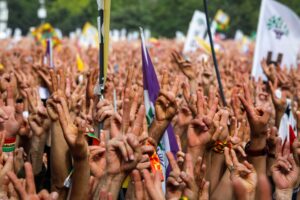
The nationwide protests that began on 28th December 2025 were initially sparked by anger over record-high inflation and currency depreciation, but rapidly descended into a larger movement spread across 340 locations in all of Iran’s 31 provinces[i] calling for an end to the country’s theocratic regime. Several reports claim that Ayatollah Khamenei plans to flee Iran for Russia if the unrest gains more traction.[ii] While it remains highly unlikely that the Islamic Republic’s symbol of revolutionary zeal and continuity for over three decades would flee, the mere fact that speculation about his potential exile has infiltrated scholarly circles and mainstream media underscores the extent to which the current protests have unnerved the regime. It fails to uncover what Iran would look like after the Islamic Republic, however.
In the absence of robust, established domestic opposition parties, a vacuum has been created that makes the country susceptible to being manipulated and misinterpreted by both domestic and external actors. To account for this dearth of credible leadership options, Iranian society has turned to the ghosts of the country’s past – figures whose autocratic rule was often unpopular, yet are remembered by many as symbols of order.
Reza Pahlavi, the exiled son of Iran’s last Shah, Mohammed Reza Pahlavi, has assumed the role of a public speaker from the United States[iii], praising both the protests in Iran and those led worldwide by the diaspora. Whilst he is a charismatic figure, Pahlavi’s prominence in Iranian politics by no means signals consensus. Instead, it reflects the fact that no alternative actor within Iran has stepped to the fore and consolidated domestic support.
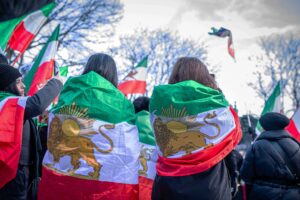
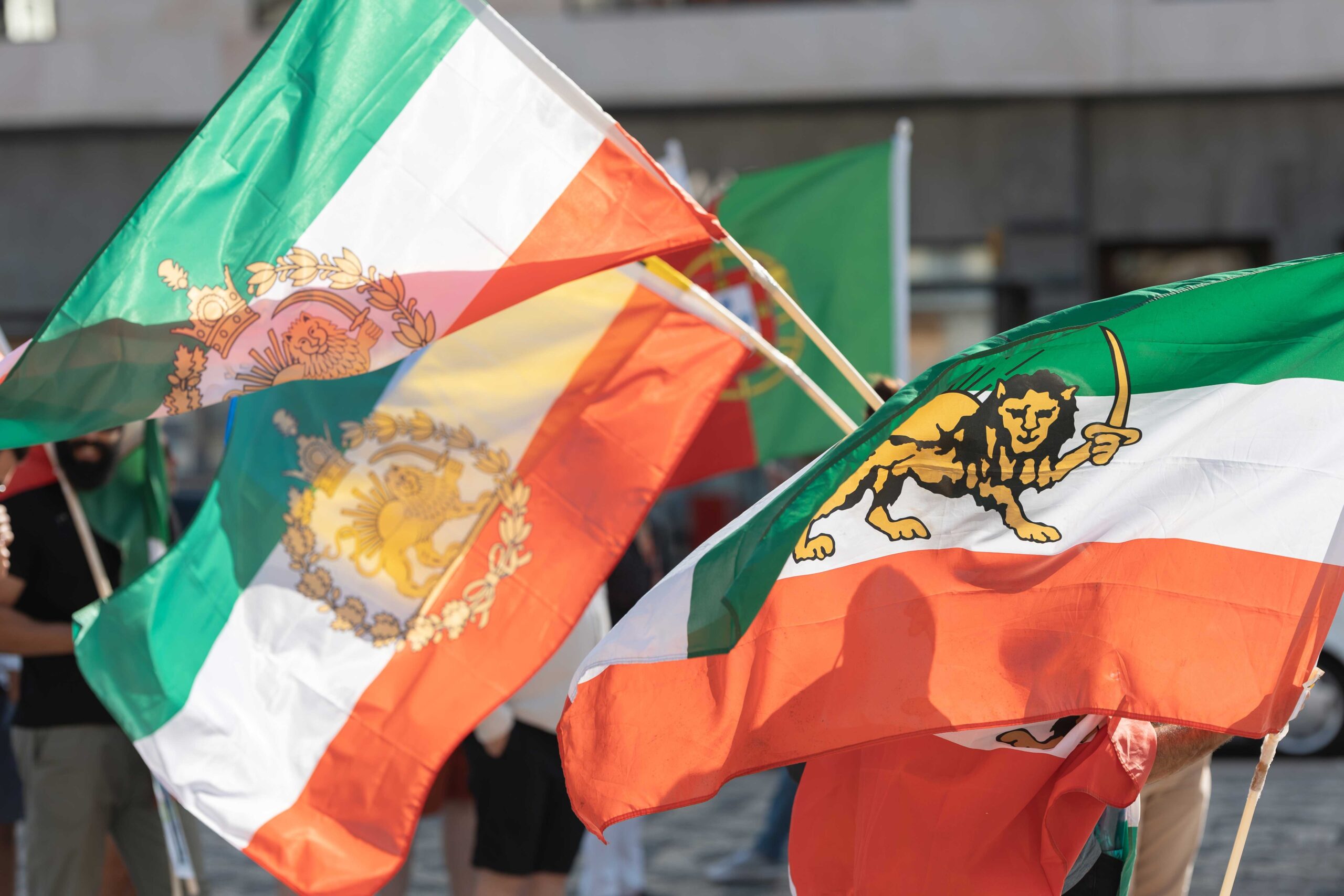
Nostalgia, largely driven by desperation rather than a coherent political programme, has begun to manifest symbolically. This has included chants of Pahlavi’s name throughout Iran’s streets as well as acts abroad, such as a protester in London replacing the Islamic Republic’s flag at the Iranian embassy with the pre-revolutionary lion-and-sun banner.[iv] However, an important distinction must be made. These acts speak less to monarchist restoration than to the rejection of clerical rule, which appears to be losing more legitimacy with each day of the protest.
Pahlavi has already sought to secure foreign backing, meeting with Israeli Prime Minister Benjamin Netanyahu[v], calling for the normalisation of relations between Israel and Iran through what he calls the ‘Cyrus Accords’[vi], and tweeting U.S. President Donald Trump, saying: “Thank you for your strong leadership and support of my compatriots… I have the plan for a stable transition for Iran and the support of my people to get it done. With your leadership of the free world, we can leave a legacy of lasting peace.”[vii] Whilst such acts ostensibly seem liberating for Iran, history hints that foreign association, particularly before a formal transition, is likely to be political suicide for Pahlavi.
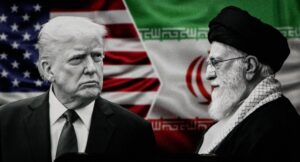
Although President Trump has explicitly avoided endorsing Pahlavi[viii], stressing that Washington is not choosing Iran’s future and that it will “see who emerges”, there are two critical points that underscore how the opposition is perceived domestically and internationally, and what risks this carries.
Seeking foreign alliances before a transition carries inherent risks, hardening suspicions of and emboldening the current regime’s claims that protests are part of a wider western ploy.
Firstly, western governments, particularly the U.S., frequently speak of ‘listening to the Iranian diaspora’. This language should be treated with much skepticism. The U.S. does not consult the Palestinian diaspora on Gaza policy, nor the Iraqi diaspora on Baghdad, nor the Yemeni diaspora on Sana’a. Diaspora voices are amplified as legitimate interlocutors when they align with the U.S.’ strategic regional interests, not necessarily because they represent the population inside the country. Despite President Trump’s refusal to meet with Pahlavi, his rhetoric has amplified protest narratives that mirror diaspora advocacy. Likewise, White House envoy Steve Witkoff met with Pahlavi to discuss the protests.[ix] Together, these actions feed into narratives of the U.S.’ alleged objective of delegitimising Iran’s current regime. Secondly, Pahlavi’s image as a puppet of American and Israeli interests in the Middle East persists in public perception. He has been in exile for almost half a century and has little to no domestic mandate or legitimacy.
During Iran’s 2009 Green Movement, the Bloody November protests, the Mahsa Amini demonstrations and the current protests, the slogan “Neither Gaza nor Lebanon, My Life for Iran”[x] echoed through Iran’s streets. Admittedly, the phrase expresses opposition to the Islamic Republic, but it reveals something much deeper about the psyche of the Iranian people. The slogan does not suggest Iranian indifference to Gaza or regional conflicts, nor support for Israel, but it reflects the Iranian people’s desire for the government to look inwards and to prioritise domestic matters before pursuing its regional ambitions. Seeking foreign alliances before a transition therefore carries inherent risks, hardening suspicions of and emboldening the current regime’s claims that protests are part of a wider western ploy to subjugate Iran to external influence. President Trump has already made clear that the U.S. is considering “very strong options” in Iran[xi], with reports indicating that this may manifest in cyberattacks, sanctions, or even military strikes.
Whilst some may interpret these warnings as U.S. benevolence, for many within Iran, they reinforce historical trauma and anxieties surrounding foreign intervention. After all, U.S. and British-backed forces staged a coup in 1953 against democratically-elected Mohammad Mossadegh. Similarly, the U.S.’ recent capture of Venezuelan President Nicolás Maduro and renewed interest in Greenland’s strategic resources, reinforce a perception that U.S. power prioritises leverage.
In this context, a weakening or post-Islamic Republic Iran is not viewed merely as a humanitarian concern, but a geopolitical opportunity for the U.S. Only Venezuela and Saudi Arabia possess larger oil reserves than Iran[xii], and greater U.S. influence over a future Iranian government could potentially shape sanctions enforcement and regional energy flows. Whether this is Washington’s primary objective or not far exceeds the scope of this piece. However, for many Iranians this possibility alone is sufficient to cast suspicion on any opposition figure perceived to be aligned with U.S. power. For Pahlavi this would mean having at least some of his domestic support eroded before he has even had an opportunity to consolidate it.
The Middle East’s history offers a cautionary lens. Several western-backed leaders returning from exile have repeatedly failed to consolidate authority at home. The U.S.-backed Ahmed Chalabi in Iraq was touted to be the democratic alternative the country needed, yet Iraq still spiralled into further instability. Likewise, Syrian opposition leaders during the civil war, recognised abroad, were widely dismissed on the ground as foreign proxies, corroborating that foreign recognition does not serve as a substitute for domestic legitimacy. Considering that Iran’s population has been shaped by deep nationalist memory, despite the “Pahlavi will return”[xiii] chants today, it would seem that they too may perceive a Pahlavi-led Iran to be politically problematic in the long-term.
On the surface, there seems to be a contradiction and paradox to this claim. After all, Pahlavi’s posse claims high domestic support, cited at 80-85%.[xiv] GAMAAN suggests that this figure is closer to 35%[xv], which is still very respectable. However, Pahlavi’s support is not as important as the question whether or not his return would provide Iran with stability.
For Iran, the monarchy of old is symbolic of a time of order, but it does not offer a blueprint for how the country is to develop durable stability and legitimacy. As outside observers, the central analytical error is failing to capture the nuance between exhaustion and readiness, nostalgia and genuine support, and foreign-aligned strategy and authentic Iranian self-determination. For Reza Pahlavi, legitimacy cannot be imported, but must be carefully nurtured at home so as not to be discredited and undermined as a foreign proxy. Hence, the question is not whether Iran’s regime changes, but whether this change repeats the vicious cycle of its history by allowing authority to be moulded from abroad rather than being contested and legitimised by Iranians themselves.
[i] Makoii, A. (2026). “Teetering Ayatollah has nowhere to turn”, The Telegraph, 10 January 2026, retrieved from: https://www.telegraph.co.uk/world-news/2026/01/10/iran-leader-khamenei-options-wearing-thin/.
[ii] Croft, A. and Singh, N. (2026). “Ayatollah Khamenei will ‘flee Iran for Moscow’ if protests overwhelm security forces, says intelligence report”, Independent, 6 January 2026, retrieved from: https://www.independent.co.uk/news/world/middle-east/iran-protests-ayatollah-khamenei-flee-plan-intelligence-b2894774.html.
[iii] Ward Agius, M. (2026). “Exiled crown prince Pahlavi cheers Iran protests from US”, DW, 11 January 2026, retrieved from: https://www.dw.com/en/exiled-crown-prince-pahlavi-cheers-iran-protests-from-us/a-75466258.
[iv] Badshah, N. (2026). “Protester pulls down national flag from Iranian embassy in London”, The Guardian, 10 January 2026, retrieved from: https://www.theguardian.com/world/2026/jan/10/protester-pulls-down-national-flag-from-iranian-embassy-in-london.
[v][v] Nashed, M. (2025). “After backing Israel, Iran’s self-styled crown prince loses support”, Al Jazeera, 3 July 2025, retrieved from: https://www.aljazeera.com/features/2025/7/3/son-of-former-shah-loses-credibility-after-justifying-israels-war-on-iran.
[vi] Iran International (2025). “Israeli minister endorses Reza Pahlavi for Iran regime change”, 3 September 2025, retrieved from: https://www.iranintl.com/en/202509037938.
[vii] Pahlavi, R. (2026). X/Twitter, retrieved from: https://x.com/PahlaviReza/status/2007139691494084909.
[viii] Al Jazeera (2026). “Trump will not meet Iran’s ‘Crown Prince’ Pahlavi as protests intensify”, 9 January 2026, retrieved from: https://www.aljazeera.com/news/2026/1/9/trump-says-meeting-irans-crown-prince-pahlavi-would-not-be-appropriate.
[ix] Reuters (2026). “US envoy Witkoff, Reza Pahlavi discussed Iran protests, Axios reports”, 13 January 2026, retrieved from: https://www.reuters.com/world/middle-east/us-envoy-witkoff-reza-pahlavi-discussed-iran-protests-axios-reports-2026-01-13/?.
[x][x] Talattof, K. (2026). “Iranian unrest is about more than economy – protesters reject Islamic Republic’s whole rationale”, Down To Earth, 7 January 2026, retrieved from: https://www.downtoearth.org.in/governance/neither-gaza-nor-lebanon-iranian-unrest-is-about-more-than-the-economy-protesters-reject-the-islamic-republics-whole-rationale.
[xi] Habibiazad, G., Namjoo, S. and Sekulich, H. (2026). “Trump mulls ‘very strong’ military options as hundreds killed in Iran protests”, BBC News, 12 January 2026, retrieved from: https://www.bbc.co.uk/news/articles/czdqy3rmp78o.
[xii] Stevenson, S. and Robinson, M. (2026). “Map Shows How Iran’s Oil Reserves Compare to Rest of World”, Newsweek, 13 January 2026, retrieved from: https://www.newsweek.com/map-iran-oil-reserves-compare-rest-world-11350088.
[xiii] Qlblawl, T. (2026). “The son of Iran’s last shah is rallying protesters. But do Iranians really want another king?”, CNN World, 9 January 2026, retrieved from: https://edition.cnn.com/2026/01/09/middleeast/analysis-does-iran-want-shah-son-pahlavi-latam-intl.
[xiv] Mukul, S. (2026). “Can crown prince Reza Pahlavi return to Iran?”, India Today, 10 January 2026, retrieved from: https://www.indiatoday.in/world/story/iran-protest-news-live-ayatollah-ali-khamenei-return-of-reza-pahlavi-shah-popularity-challenges-trump-us-stance-2849309-2026-01-10.
[xv] The Group for Analyzing and Measuring Attitudes in Iran (2025). “Analytical Report on ‘Iranians’ Political Preferences in 2024”, 20 August 2025, retrieved from: https://gamaan.org/2025/08/20/analytical-report-on-iranians-political-preferences-in-2024/.