In Afghanistan, the Taliban now enforce cultural[i] and linguistic erasure with unprecedented brutality.[ii] Echoing the policies of their first period in power (1996–2001), they have – since regaining control in 2021 – sought to marginalise Persian (Dari) in favour of Pashto, historically referred to as the ‘Afghani’ language. This linguistic imposition forms part of a broader pattern of cultural suppression.
A similar approach has been taken towards Nowruz, the Persian New Year, whose origins lie in Balkh, in northern Afghanistan — a region long acknowledged as the cradle of modern Persian culture. The Taliban banned Nowruz during the 1990s and again after 2021. Yet the festival continues to be celebrated widely across South Asia, Central Asia, the Caucasus, and the Middle East — from Afghanistan, Tajikistan, and Iran to Turkey, where it is officially recognised. On 16th January 2026, President Ahmad al-Sharaa of Syria declared Nowruz as a national day of celebration in a special decree.[iii] This gesture of goodwill towards Kurdish communities is nevertheless interpreted by some as a strategy[iv] primarily aimed at the eventual centralisation of power.
The Taliban’s rejection of such shared cultural traditions underscores their broader project of erasing pluralistic identities in favour of a narrow ideological and ethnolinguistic vision. This trajectory is not new. Its roots lie in the formation of the “state of Afghanistan” under Amir Abdul Rahman (1880–1901), when the country was carved out as a buffer zone between British India and Tsarist Russia, subsidised and influenced by the former.
Under Abdul Rahman’s successors, Habibullah and Amanullah, the state’s ideologues increasingly anchored sovereignty in a single ethnic, religious, and linguistic identity: the Pashtun (or Afghan) ethnic group, the Pashto (or Afghani) language, and Sunni Islam. These ideas were heavily influenced by late Ottoman and early Turkish republican thought, particularly through figures such as Mahmud Tarzi.[v] Exiled during Abdul Rahman’s reign, Tarzi was raised in Damascus and later studied in Istanbul in the 1890s, where he absorbed the ideologies of the Young Turks. In this worldview, ‘unity’ was pursued through the denial of diversity rather than its embrace.
Afghanistan’s diverse ethnic and sectarian communities resisted this homogenising vision, advocating instead for justice, inclusion, and pluralism. Yet under authoritarian rule, cultural and civilisational erasure intensified, even as the struggle between these competing visions of identity and belonging has persisted. For example, starting from the late 1930s and early 1940s Pashto or ‘Afghani’ was imposed as the main language of education and bureaucracy for several years. But the experiment failed, forcing the state to revert back to de facto Persian language. As a lingua franca of diverse communities, Persian in Afghanistan is a symbol of pluralism and hence a source of envy for the Taliban and other authoritarians and ethnonationalists who often use Islam as a cover.
It is within this historical context that one of Afghanistan’s most polarising debates has unfolded: the question of national identity, language, and belonging. This debate resurfaced recently when the BBC rebranded its Afghanistan Persian service as “BBC Dari” – a move that, albeit unintentionally, aligned with state-driven narratives that have historically marginalised large segments of the population of Afghanistan.
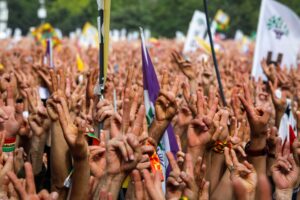
More than 180 prominent cultural figures from Afghanistan, Iran, and Tajikistan[vi] signed an open letter urging the BBC to reverse the decision.[vii] They argued that presenting Farsi and Dari as separate languages, rather than two names for the same language, was misleading, divisive and political. Protests followed in Kabul[viii] and London.
Afghanistan’s 1964 Constitution refers to the language as ‘Dari’, and the BBC’s Afghanistan Persian service had been called ‘Radio Dari’ since the 1980s. However, laws, particularly in post-colonial states, often grapple with integrating contested national identities. The 1964 renaming of Farsi to Dari was itself an imposed political act by the dominant Pashtun rulers, intended to assert a distinct Afghan or Pashtun identity[ix] and consolidate power within a Pashtun-dominated state.
This represents an unresolved identity struggle, which is inseparable from the broader question of nationhood in Afghanistan. While widely not seen as a political endorsement, the move nevertheless undermined the efforts of those advocating for equality, pluralism and democratic representation.
The timing of the BBC’s decision was especially fraught. In late 2017 and early 2018, the government of Afghanistan began distributing electronic identity cards under the long-delayed[x] Population Registration Act. The central controversy[xi] was whether to include the term ‘Afghan’ as a national identity – given its synonymy with ‘Pashtun’ – and whether ethnic identities should be explicitly stated.
During Hamid Karzai’s presidency, both houses of Parliament had agreed that neither ‘Afghan’ nor ethnic labels should appear on the new ID cards. But after the contested 2014 election, Ashraf Ghani and Abdullah Abdullah formed the National Unity Government (NUG), brokered by John Kerry, then U.S. Secretary of State, with Ghani as President and Abdullah as CEO. Ghani, a Pashtun, re-sent the law to Parliament via presidential decree[xii], citing protests by nationalist Pashtuns demanding the inclusion of ‘Afghan’. Tajik, Uzbek and Hazara communities opposed the move, arguing that the term should not be imposed as a blanket description of national identity.
Ghani ultimately used his executive authority to enforce the distribution of the ID cards, deepening national discord. The Taliban, predominantly Pashtun, continue along the path where Ghani left off. Widely interpreted as aligning with the Pashtun nationalist narrative, many Persian-speaking communities in Afghanistan[xiii] viewed the term “Dari” as an imposed political label that tried to dilute or deny their identity, and weaken their linguistic and cultural ties to the broader Persian-speaking world in Iran, Tajikistan, Uzbekistan and beyond.
For millions of Persian speakers, especially in Afghanistan where the Taliban continue to systematically marginalize their language[xiv], questions about Dari are still at the heart of identity, dignity and representation.[xv] Language is not merely a tool of communication; it is a vessel of memory, culture and political belonging. In Afghanistan, where over a dozen languages are spoken but where Persian is the de facto lingua franca between diverse communities, the politics of naming is never neutral.
Recent history offers sobering parallels. In Russian-occupied parts of Ukraine, the systematic replacement of Ukrainian with Russian[xvi] in schools and public life has been used to redefine belonging and legitimise control. In Turkey, decades of political opposition to Kurdish autonomy in the name of national unity also eroded the group’s collective cultural and political rights.[xvii] The current conflict between Damascus and the Syrian Democratic Forces (SDF)[xviii], which used to run the Autonomous Administration of North and East Syria (AANES) might lead to similar outcomes. While the BBC’s actions are neither coercive nor comparable in scale, these cases show how linguistic decisions can reinforce exclusionary narratives.
The term ‘Dari’ has long been deployed by dominant political forces to fragment the Persian language and obscure Afghanistan’s place in the wider Persianate world.
This is not a debate about semantics. It is about whether the BBC positions itself as a passive transmitter of state-imposed narratives or as an independent institution committed to pluralism, historical awareness and global responsibility. Today, the Taliban might have prevailed militarily. However, resistance and outright rejection[xix] of their brutal rule and their attempts at cultural and civilisational erasure remains strong, whether in the form of armed[xx], cultural[xxi], or civil resistance.[xxii] Afghanistan’s diverse communities will never accept the Taliban’s ideology[xxiii], knowing that its roots lie in geopolitics rather than in Afghanistan’s internal cultures.
[i] Shayan, Y. (2025). “On World Art Day, artists face censorship and silence under Taliban rule”, Amu TV, 15 April 2025, retrieved from: https://amu.tv/168784/.
[ii] Nishat, Z. (2025). “The Taliban’s Madrasa System Is Growing”, The National Interest, 15 December 2025, retrieved from: https://nationalinterest.org/blog/silk-road-rivalries/the-talibans-madrasa-system-is-growing.
[iii][iii] Sio, M. (2026). “Syrian president issues special decree guaranteeing Kurdish community’s rights”, AA, 17 January 2026, retrieved from: https://www.aa.com.tr/en/middle-east/syrian-president-issues-special-decree-guaranteeing-kurdish-community-s-rights/3801841.
[iv] Zwirahn, F. (2026). “How the Kurds Lost Eastern Syria”, New Lines Magazine, 22 January 2026, retrieved from: https://newlinesmag.com/reportage/how-the-kurds-lost-eastern-syria/.
[v] Gregorian, V. (1067). “Mahmud Tarzi and Saraj-ol-Akhbar: Ideology of Nationalism and Modernization in Afghanistan”, 21, 3, retrieved from: https://www.jstor.org/stable/4324163.
[vi] DID (2025). “Persian and Dari: One Language, Divided by Colonial Politics”, 13 November 2025, retrieved from: https://en.didpress.com/21296/.
[vii] BBC News [Farsi] (2017). “Prominent Persian-speaking figures protest the name change of the BBC’s Facebook page for Afghanistan”, 15 November 2017, retrieved from: https://www.bbc.com/persian/afghanistan-41998852.
[viii] BBC News [Farsi] (2017). “Protest in Kabul against the change of the name of the BBC Facebook for Afghanistan”, 20 November 2017, retrieved from: https://www.bbc.com/persian/afghanistan-42049879.
[ix] Habib, O. (2025). “Farsi vs. Dari: Examining Afghanistan’s 1964 Language Controversy”, 21 May 2025, retrieved from: https://www.omed.io/blog/2025/5/21/farsi-vs-dari-examining-afghanistans-1964-language-controversy.
[x][x] Bjelica, J. (2016). “The Troubled History of the E-tezkera (Part 1): Political upheaval”, Afghanistan Analysts Network, 25 January 2016, retrieved from: https://www.afghanistan-analysts.org/en/reports/rights-freedom/the-troubled-history-of-the-e-tazkera-part-1-political-upheaval/.
[xi] BBC Monitoring (2018). “Explainer: The long-running dispute over Afghan ID cards”, 12 January 2018, retrieved from: https://monitoring.bbc.co.uk/product/c1dolp4t.
[xii] Shalizi, H. (2018). “Who is an Afghan? Row over ID cards fuels ethnic tension”, Reuters, 8 February 2018, retrieved from: https://www.reuters.com/article/world/who-is-an-afghan-row-over-id-cards-fuels-ethnic-tension-idUSKBN1FS1WB/.
[xiii] Bezhan, F. (2017). “Dari Or Farsi? Afghanistan’s Long-Simmering Language Dispute”, RFERL, 7 November 2017, retrieved from: https://www.rferl.org/a/afghanistan-dari-farsi-persian-language-dispute/28840560.html.
[xiv] Hasht e Subh (2024). “The Consequences of Removing Persian Language from Afghanistan”, 29 May 2024, retrieved from: https://8am.media/eng/the-consequences-of-removing-persian-language-from-afghanistan/.
[xv] Ahwar, J. (2023). “Decoding the Taliban’s Anti-Persianism”, The Diplomat, 8 August 2023, retrieved from: https://thediplomat.com/2023/08/decoding-the-talibans-anti-persianism/.
[xvi] Support4Parternship (2025). “How Russia is re-educating Ukrainian children in the occupied territories”, 27 September 2025, retrieved from: https://support4partnership.org/en/news/how-russia-is-re-educating-ukrainian-children-in-the-occupied-territories.
[xvii] Aboutaam, S. (2024). “The Survival of Kurdish Identity in Turkey”, Human Rights Foundation, 4 September 2024, retrieved from: https://hrf.org/latest/the-survival-of-kurdish-identity-in-turkey/.
[xviii] Goudsouzian, T. (2026). “After defeating ISIS, Syria’s Kurds are abandoned”, Le Monde diplomatique, 21 Janaury 2026, retrieved from: https://mondediplo.com/outside-in/northeast-syria.
[xix] Nishat, Z. et al. (2022). “Why Do People in Afghanistan Object to Taliban Rule?”, Tony Blair Institute for Global Change, 22 September 2022, retrieved from: https://institute.global/insights/geopolitics-and-security/why-do-people-afghanistan-object-taliban-rule.
[xx] Coffey, L. (2025). “Afghanistan and the National Resistance Front”, Hudson Institute, 16 April 2025, retrieved from: https://www.hudson.org/terrorism/afghanistan-national-resistance-front-luke-coffey.
[xxi] Mosaic Global Foundation (2026). “Delivering Impact Against All Odds: Mosaic’s Education Initiative for Adolescent Girls in Afghanistan”, retrieved from: https://mosaicfoundation.global/105/delivering-impact-against-all-odds-mosaics-education-initiative-for-adolescent-girls-in-afghanistan.
[xxii] Nishat, Z. et al. (2022). “In Their Own Words: Civil Society’s Fights to Deny Taliban Legitimacy in Afghanistan”, Tony Blair Institute for Global Change, 22 September 2022, retrieved from: https://institute.global/insights/geopolitics-and-security/their-own-words-civil-societys-fight-deny-taliban-legitimacy-afghanistan.
[xxiii] Nishat et al. (2022). “Why Do People in Afghanistan Object to Taliban Rule?”