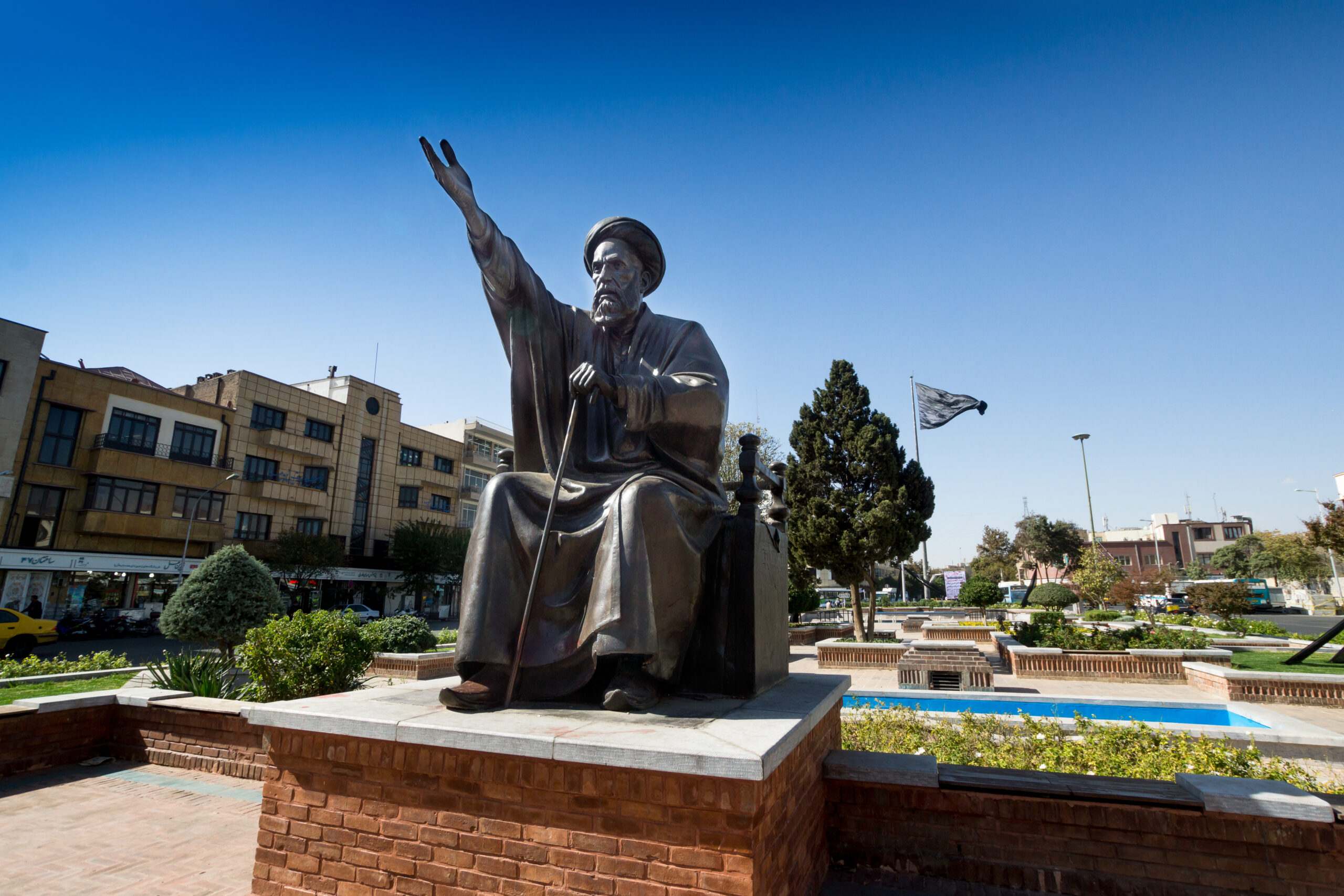
The enduring struggle between secular constitutionalism and religious authority continues to define the Iranian political landscape. Amidst ongoing protests and renewed debates over state legitimacy, the historical duality in Iranian constitutional thought remains a central point of contention. This conflict originates in Article 2 of the 1907 Supplementary Fundamental Law, which established the ideological divide between secular constitutionalism (mashruteh) and shari’a-constrained governance (mashru’eh).
This article later became known as the First-Class Principle or the Nuri Principle. The text made clear that no legislative provision could contradict the sacred precepts of Islam. It also provided for the creation of a committee of at least five mujtahids, to be selected by the Assembly from a list of twenty names nominated by the leading Shi’a sources of emulation. This committee was authorised to examine every proposed law carefully and to reject any provision incompatible with Islamic principles.[i]
In this way, the article established the formal mechanism of prior religious oversight, an arrangement that Nuri achieved through sustained advocacy and his sit-in at the shrine of Abd al-Azim. From that point onwards, two contrasting interpretations of governance took shape. Mashruteh envisaged a framework rooted in human legislation, separation of powers, and national sovereignty. Mashru’eh conceived of government as strictly bounded by Islamic shari’a with ultimate oversight vested in senior religious scholars. Tensions surfaced almost immediately, leading to a profound intellectual and political schism.[ii]
Shaykh Fazlollah quickly withdrew from the Assembly, describing parts of the constitutional movement as sedition and misguidance, and took leadership of the mashru’eh supporters. In response, the more secular constitutionalists and intellectuals accused him of attempting to restore religious despotism.[iii]
In the late Qajar period, Article 2 saw partial implementation, though political instability rendered it largely ineffectual. During the Pahlavi era, Reza Shah and subsequently Mohammad Reza Shah effectively sidelined this religious oversight. While this period was marked by substantial modernisation, secularisation of the judiciary, and administrative centralisation, it was also characterised by the consolidation of state authority and a unified approach to political participation. These developments facilitated rapid industrialisation but simultaneously reconfigured the traditional influence of the clergy and channelled independent political activities into a state-led institutional framework.[iv]
The 1979 overthrow of Mohammad Reza Shah marked a pivotal reversal. The original vision of mashru’eh returned in a far more institutionalised manner. The Islamic Republic gave concrete form to religious vetting through the Guardian Council, which assumed functions considerably broader than the initial 1907 committee. However, the current socio-political climate suggests that this model faces an unprecedented crisis of legitimacy.[v]
Nearly 120 years later, these competing discourses once again stand in opposition. One perspective urges a return to the original ethos of mashruteh, including equal citizenship and the primacy of popular will. In this evolving context, several visions for a transition to democracy have emerged. One prominent model is advocated by Reza Pahlavi, who presents a framework for secular democracy and national unity. He stresses the importance of a national referendum to determine the future political system while prioritising human rights and the separation of religion from state affairs. This approach represents a significant example of the contemporary effort to reconcile Iranian national identity with modern liberal values.[vi] By contrast, the other approach insists that legitimate government can only exist within the framework of shari’a and under the supervision of the jurist.
This enduring tension has now reached a highly sensitive point as questions of legitimacy, authority, and popular sovereignty once again dominate Iran’s political landscape. Signs of the beginning of a major transformation are once again emerging. This time one of these two views may become dominant for decades or even generations.
[i] Nuri, F.A. (2024). Encyclopaedia Iranica, available at: https://www.iranicaonline.org/.
[ii] Martin, V. (1989). Islam and Modernism: The Iranian Revolution of 1906, London: I.B.Tauris & Co Ltd.
[iii] Ibid.
[iv] Ansari, A.M. (2016). Iran’s Constitutional Revolution of 1906 and Narratives of the Enlightenment, Corte Madera, California: Gingko Press.
[v] Nuri, F.A. (2024). Encyclopaedia Iranica, on post-1979 developments, available at: https://www.iranicaonline.org/.
[vi] Pahlavi, R. (2026). “Iran is Ready for a Democratic Transition”, The Washington Post, 6 January 2026, retrieved from: https://www.washingtonpost.com/opinions/2026/01/06/pahlavi-iran-democracy-transition-planning/