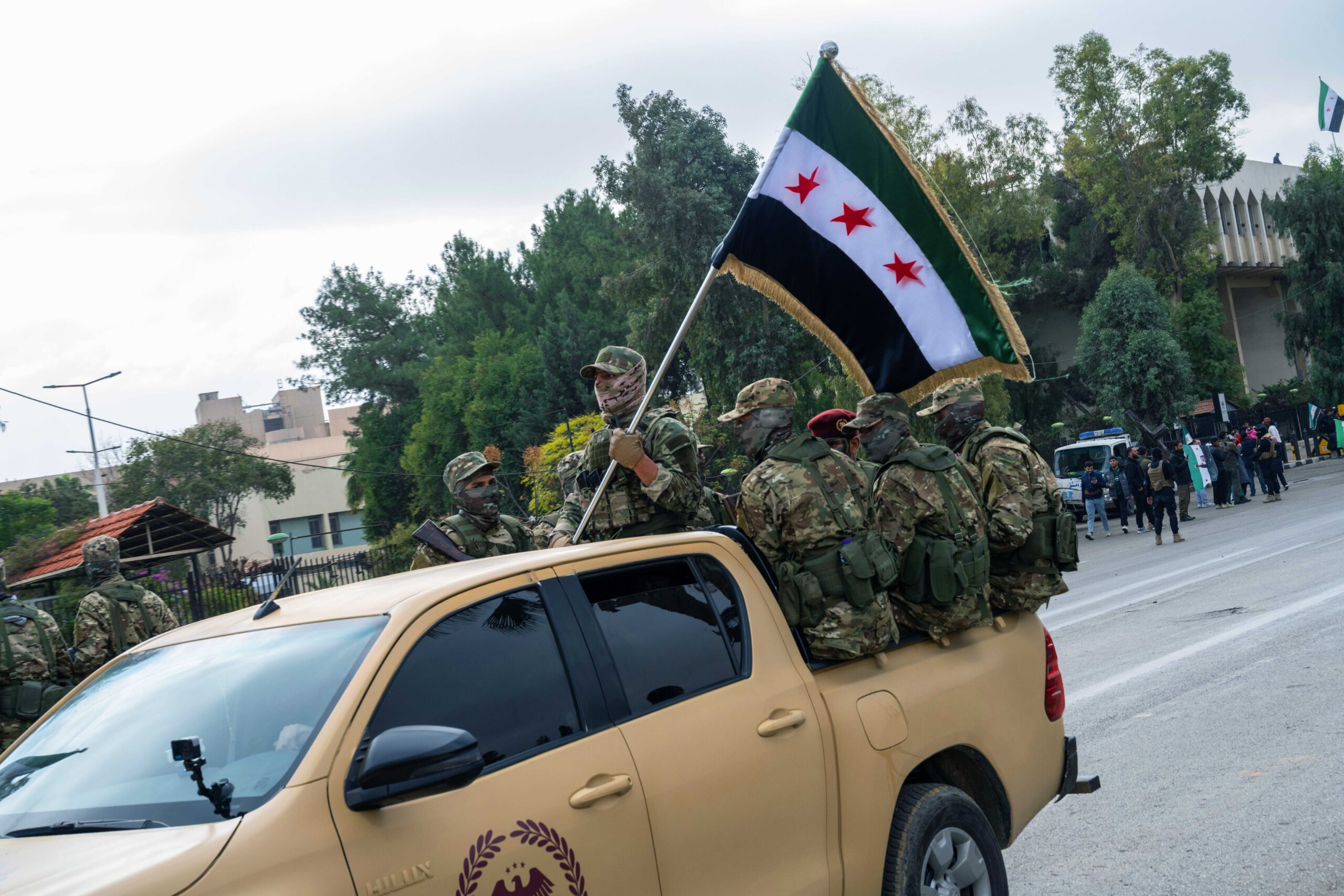
Recent media reports of US pressure on Syria to fight Hezbollah in the Bekaa have raised fears in war-torn Lebanon.
A scenario that has long preoccupied many in Lebanon has gained renewed attention in recent days: A potential Syrian military ground offensive against Hezbollah in the Bekaa.
On 17th March, more than two weeks after the breakout of the war between Hezbollah and Israel, Reuters reported that “the United States has encouraged[i] Syria to consider sending forces into eastern Lebanon” to help disarm the Shiite party and militant group.
The rationale behind this move would be to encircle the group from all sides, with Israel continuing its air and ground operations, and the Lebanese army speeding up the disarmament process officially launched in September 2025. Prior to the resumption of the war on 2nd March, the Lebanese army had announced[ii] that it had completed the first phase of the disarmament plan, which concerns the area south of the Litani River, located around 30 km (18 miles) from the Lebanese-Israeli border. They have not made any noticeable progress since the war broke out, as ongoing strikes and clashes complicate their mission.
Meanwhile, some Arab countries have reportedly discouraged[iii] Syrian President Ahmad al-Sharaa from yielding to Israeli-American pressures and launching such an operation. So far, Syria has not made its decision, as it is reluctant to embark on such a mission for fear of being sucked into the broader war in the Middle East.[iv]
As for Israel, the idea of a Syrian intervention seems attractive, especially as Tel Aviv believes that some of Hezbollah’s long-range missiles are launched from the Bekaa. Israel might even attempt to lure Syria into entering Lebanon by proposing to give back some territories it had seized in southwestern Syria after the fall of the Assad regime in December 2024.
Risk of sectarian strife in both countries
Such an intervention could risk being read across both Lebanon and Syria through deeply sectarian and historical lenses. In Syria, the move would most likely not be taken as a security operation in a narrow sense, especially if it is perceived as being undertaken under U.S. and Israeli pressure. It would even risk re-igniting internal strife between the Syrian authorities and the Alawite minority. The massacres against the Alawites took place[v] just one year ago.
Meanwhile, in Lebanon, fears of further military escalation are exacerbated by concerns about increased sectarian polarization too. Any overt Syrian role inside the country would allow Hezbollah to frame the confrontation not simply as a dispute over arms or sovereignty, but as a broader communal assault backed by foreign powers. That framing could potentially help Hezbollah recover political legitimacy among its constituents, especially if Israeli attacks and displacement continue to hit predominantly Shiite areas.
What looks externally like a strategic opportunity to constrain Hezbollah may therefore look internally, on both sides of the border, like the opening of a sectarian chapter that neither state can afford, and which could last for a long period of time.
Syria’s relations with the Gulf and Lebanon
Aside from the sectarian risks in both countries, an intervention might not even be in Damascus’s foreign policy interest. In fact, if an Arab opposition to a Syrian intervention in Lebanon gathers force, and Syria proceeds regardless, the new round of normalization and expansion of Syrian-Arab relations could suffer as a result. Arab countries would likely oppose such an operation, also fearing that it would result in the resumption of sectarian tensions in Syria, which might spiral beyond the control of the new regime.
Furthermore, Syria’s foreign relations with Lebanon, which have been progressively improving in recent months, would undoubtedly be impacted. A month after an agreement was reached between Lebanese and Syrian authorities regarding Syrian prisoners in Lebanon, Beirut released[vi] more than 130 Syrian inmates, who had been jailed for years. This move is considered a milestone in the evolution of Syrian-Lebanese relations. In fact, many of these prisoners supported the Syrian opposition during the civil war in their country more than a decade ago, explaining why the Syrian authorities, now controlled by the opposition, have been rooting for their cause.
Any Syrian military attack on Lebanon would recall the years-long occupation of the former Syrian regime in Lebanon (between 1976 and 2005), which would lead to a unified Lebanese opposition. Furthermore, fears of Syria taking over some parts of the Bekaa or the North and annexing them would further exacerbate ever-present anti-Syrian sentiments in Lebanon.
Policy recommendation
While the war between Hezbollah and Israel remains the primary focus of the Lebanese authorities, it is important not to dismiss reports of a potential Syrian attack against the Bekaa. Lebanese authorities could initiate diplomatic engagement with European partners and Gulf states to highlight the risks associated with such a scenario, whose consequences would likely extend beyond Lebanon and Syria. Lebanon may also seek to encourage these actors to exert pressure on the United States and, where feasible, Israel, to avoid incentivizing Damascus to launch an operation in Lebanon. Furthermore, Beirut could continue to seek assurances that no operation will be carried out against Hezbollah.
The stakes of such a scenario are especially high given the potential for civil strife. A new internal conflict could trigger a massive wave of migration, with people fleeing to Europe, as well as other Arab countries. It could also invite foreign intervention to support one party against another, effectively turning Lebanon into a theater of proxy warfare, reminiscent of the dynamics seen in the Syrian Civil War and the Lebanese Civil War between 1975 and 1990. Such involvement would risk prolonging the state of conflict, potentially sparking a civil war with no clear timeline or guarantees for resolution; the previous civil war lasted 15 years before a ceasefire was reached. The ongoing war already exceeds the country’s capacity to absorb further strain, and the involvement of additional actors risks escalating the situation to a point of no return.
[i] Dalatey, F., Gebeily, M. and Azhari, T. (2026). “US encourages Syrian action against Hezbollah, Damascus is hesitant, sources say”, Reuters, 17 March 2026, retrieved from: https://www.reuters.com/business/aerospace-defense/us-encourages-syrian-action-against-hezbollah-damascus-is-hesitant-sources-say-2026-03-17/.
[ii] Al Jazeera (2026). “Lebanon army says phase one of disarming non-state groups in south complete”, 8 January 2026, retrieved from: https://www.aljazeera.com/news/2026/1/8/lebanons-army-says-phase-one-of-hezbollah-disarmament-in-south-completed.
[iii] Dalatey, F., Gebeily, M. and Azhari, T. (2026). “US encourages Syrian action against Hezbollah, Damascus is hesitant, sources say”.
[iv] Ibid.
[v] Reuters (2025). “Syrian committee reports, 1,426 killed in March violence, says commanders did not order it”, 22 July 2025, retrieved from: https://www.reuters.com/world/middle-east/syrian-committee-reports-1426-killed-march-violence-says-commanders-did-not-2025-07-22/.
[vi] Arab News (2026). “Lebanon transfers more than 130 Syrian prisoners under bilateral agreement”, 17 March 2026, retrieved from: https://www.arabnews.com/node/2636716/middle-east.