The ongoing turmoil in the Middle East has brought the Mediterranean Island of Cyprus back under the international spotlight. The conflict in Iran and the wider region has reminded the international community and commentators of Cyprus’s geopolitical and strategic importance, in addition to its complex politics and history.
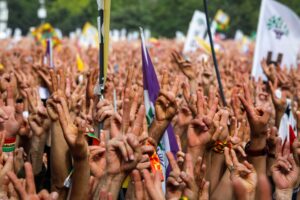
This has particularly been the case since the drone strike on the UK’s RAF Akrotiri base, located on the southwest of the island, in early March[i], with Lebanon’s Iran-backed group Hezbollah accused of responsibility.[ii] This triggered an angry response from the Cypriot government, with fears raised that the presence of the military base could drag the country into the escalating conflict. A series of protests have subsequently taken place across the island, with demonstrators calling for an end to the UK’s military bases which are increasingly viewed as a security risk and an unwanted colonial legacy.[iii] The British government has nonetheless confirmed that the future of its military bases is ‘not in question’, citing their strategic proximity to the Middle East.[iv]
Cyprus peace process
There has so far been little reflection on what the unfolding events could mean for the Cypriot conflict and peace process. An entrenched, ‘frozen’ conflict has consumed the island since it was divided following Turkey’s 1974 invasion. The United Nation’s (UN’s) ‘Buffer Zone’ continues to separate the southern two-thirds of the island (the Republic of Cyprus) and the Turkish Republic of Northern Cyprus (TRNC), a breakaway region still only recognised by Turkey[v].
Official peace negotiations, mediated by the UN, have taken place periodically since 1974, but have so far proven unsuccessful in settling the island’s lingering conflict. The most hopeful and politically consequential attempt to resolve the conflict was the 2003-04 Annan Plan, named after UN Secretary-General Kofi Annan. In line with previous arrangements, the plan was to create a new ‘United Republic of Cyprus’, consisting of Greek and Turkish Cypriot states joined by a federal government apparatus.[vi] The proposals were put to a referendum, where they were accepted by 65% of Turkish Cypriots (TCs), who felt the plan would end their isolation and economic dependency on Turkey. However, 72% of Greek Cypriots (GCs) rejected the plan. They believed some of their main concerns had not been addressed, given Turkey was allowed to maintain its role as a guarantor power and keep its estimated 40,000 troops stationed on the island.[vii][viii] As such, the plan failed, but this did not prevent Cyprus from controversially joining the European Union in 2004.
The failed Annan Plan contributed to growing calls for a ‘Cypriot-led, Cypriot-owned’ peace process, whereby Cypriots would take full responsibility for any future peace talks, sometimes termed the ‘Cypriotisation’ of the process, with the UN taking a secondary role.[ix] This phrase stems from a speech delivered by former UN Secretary-General Kofi Annan, who claimed that future peacebuilding efforts must lay ’first and foremost with the Cypriots themselves’ if they are to have any realistic chance of success.[x]
Despite these calls for a Cypriot-owned peace process over 20 years ago, subsequent peace talks, including the most recent in 2017, continued to be shaped and influenced by external actors – the UN and EU, in addition to Britain, Greece and Turkey, all of whom brought their priorities and vested interests to the table. The 2017 talks were convened by the UN’s mediator and Special Adviser on Cyprus, Espen Barth Eide, and were attended by the UN Secretary-General, António Guterres. Although the leaders of the Greek and Turkish Cypriot administrations participated in the unsuccessful peace talks, wider Cypriot society had no representation at the negotiating table, a point of contention for Cypriot peace activists. This was one of the reasons why a group of Greek and Turkish Cypriots established a grassroots movement called Unite Cyprus Now in May 2017. The movement organised various demonstrators and events designed to ‘put pressure on the leaders, hold them accountable and remind them of their promise to unite Cyprus’.[xi]
‘Cypriot-led, Cypriot-owned’ at last?
An interesting dimension of the Middle East crisis is that Cypriot society is perhaps finally accepting that the island’s communities need to take full responsibility and ownership of their conflict, given they cannot rely on external powers to act in their best interests or guarantee their security. Cypriot protestors and demonstrators, in addition to politicians and journalists, increasingly acknowledge that recent developments have been something of a wake-up call about the continuing presence of external actors on the island.
The language used by Cypriots is even similar to Kofi Annan’s framing of a ‘Cypriot-led, Cypriot-owned’ peace process. One of the founders of Unite Cyprus Now, a prominent political scientist and peace activist, claims that the peace negotiations ‘won’t succeed’ unless ‘Cypriots take control of the island’ and ‘stop allowing outsiders to decide for themselves what a united Cyprus should look like’.[xii] The peace activist, who also took part in the recent ‘British Bases Out’ protests, describes the British as continuing to ‘occupy’ parts of Cyprus. She admits that although large swathes of the Cypriot population are hostile towards Turkey’s continued role and influence on the island, growing calls for the removal of British military bases are largely unprecedented, signalling how ‘we are completely sick of foreign intervention and occupation…they’re all a burden and shouldn’t be here…I’ve not seen as many people take an interest in Cyprus’s future since Crans-Montana’.[xiii]
As with other members of Unite Cyprus Now, the activist is unsure whether ongoing issues will help to restart peace negotiations (which requires formal agreement between Cypriot leaders and the UN) but believes they will lead to growing calls for a Cypriot peace settlement. She claims that the people attending the ‘British Bases Out’ protests are not only the island’s peace or political activists, but ‘people from diverse backgrounds who are worried about their safety and their country’.[xiv]
These views are largely shared by politicians on both sides of the island, including a former Minister of the Interior who claims that the Cypriot population has traditionally ‘expected outsiders to do the work for them’, when it comes to mediating or attempting to resolve the conflict, but that this ‘no longer looks like a realistic or viable strategy… the world is just too dangerous for other countries to decide what our future should look like’.[xv]
There is some mild optimism that developments in the region might kickstart peace talks, or at least lead to serious conversations between the Greek and Turkish Cypriot leaders:
‘If you look at the modern history of Cyprus, you’ll see that the most optimistic periods, when peace looks most likely to happen, is when there have been major political developments. There was optimism when Erdoğan was first elected in Turkey, because he seemed committed to resolving the Cyprus Problem in the early days… the different periods when we’ve had peace talks have been when the north and south of the island have elected leaders willing to negotiate… I think the issues are too significant for our political leaders to not do anything…we can’t have drones landing here and simply do nothing, surely both sides need to come together and think about what is best for Cyprus’.[xvi]
Adding to this sense of optimism is the fact that, since October 2025, both the Republic of Cyprus and the Turkish Republic of Northern Cyprus (TRNC) have been led by politicians committed to Cypriot reunification. Tufan Erhürman, a Turkish Cypriot lawyer and academic who was involved in negotiations to resolve the Cypriot dispute between 2008 and 2010, was elected President of Northern Cyprus in October 2025, defeating the incumbent President, Ersin Tatar, who had initiated closer ties with Turkey and supported a two-state solution (Stamouli 2025).[xvii] The current President of the Republic of Cyprus, Nikos Christodoulides, is similarly committed to resolving the Cypriot conflict and has publicly declared his willingness to restart official negotiations (Kambas 2023).
Although there are no immediate signs that negotiations are set to resume, it is true that peace talks have tended to take place when the leaders of both communities are broadly in agreement as to the future of the island. This happened most recently in the build-up to the 2017 negotiations, when the island’s two leaders, Nicos Anastasiades and Mustafa Akıncı, resumed official dialogue given their shared commitment to resolving the conflict.
While there is widespread optimism that a combination of domestic political developments and regional upheaval could trigger a fresh round of negotiations, there is also some uncertainty as to how Cypriot leaders could realistically overcome Turkey’s commitment to a two-state solution:
‘I think a case can be made for future negotiations to be Cypriot-led, in the sense that Cypriot leaders will be in a position to resolve certain issues given they are broadly in agreement about things…I’d also like civil society to have a much greater role in any further talks…the issue will be how Turkey responds. They are committed to a two-state solution and that won’t change while Erdoğan is around, so future proposals will still need to navigate this very familiar issue’.[xviii]
Conclusion: A sign of optimism?
As the crisis in the Middle East, the Cypriot peace process has also shown itself to be unpredictable over the past 50 years, with many positive developments quickly leading to a familiar sense of failure. There are nonetheless some signs of progress (and even optimism) regarding the island’s future. Despite calls for a ‘Cypriot-led, Cypriot-owned’ peace process, the Greek and Turkish Cypriot communities have always been somewhat reticent to assume control of their country’s future – a sign of Cyprus’s colonial past and reliance on external actors. However, a combination of regional instability and security risks posed by external actors retaining a military presence on the island have led to a growing realisation amongst Cypriots that they themselves should determine their own destiny. Both sides of the island are, for the first time in several years, led by politicians willing to negotiate and resolve the Cyprus conflict. Over 20 years on from the Annan Plan, perhaps now is the time for Cypriots to finally ‘own’ their conflict and put Kofi Annan’s ‘Cypriot-led, Cypriot-owned’ peace process into practice.
[i] Sabbagh, D (2026). ‘’Hezbollah said to have launched drone that struck UK RAF airbase in Cyprus’’, The Guardian, 2 March 2026, retrieved from: https://www.theguardian.com/world/2026/mar/02/uk-airbase-raf-akrotiri-cyprus-suspected-drone-strike.
[ii] Parker, J (2026). ‘’War fuels debate in Cyprus over UK military bases’’, BBC News, 8 March 2026, retrieved from: https://www.bbc.co.uk/news/articles/cx2r1xldl1ko.
[iii] Ibid.
[iv] Cleaver, T (2026). ‘’Future of British bases in Cyprus ‘not in question’’’, Cyprus Mail, 17 March 2026, retrieved from: https://cyprus-mail.com/2026/03/17/future-of-british-bases-in-cyprus-not-in-question.
[v] The Republic of Cyprus is regarded by the EU as legally responsible for the entirety of the island, even though the northern third of the island is de facto governed by a semi-autonomous administration financially and politically backed by Turkey.
[vi] Axt, H-J (2009). ‘’Cyprus: Conflict Resolution through Europeanisation? Most Recent Experiences and Perspectives’’. The Cyprus Review 21(2): 69-89. https://cyprusreview.org/index.php/cr/issue/view/14.
[vii] Barrow, M (2023). ‘’Enabling Within Constraints: Assessing International Aid’s Impact Upon Cypriot Peacebuilding Organisations’’. Journal of Peacebuilding and Development 18(3): 295-309. https://doi.org/10.1177/154231662311931.
Barrow, M (2024) ‘’Widening Participation:
ow Cypriot Peacebuilding Practitioners are Responding to the “Usual Suspects” Problem’’. Negotiation Journal 40(1-2): 75-97. https://doi.org/10.1162/ngtn_a_00005.
[viii] These issues remain a point of contention whenever official peace negotiations take place. The Greek Cypriot community insists that Turkey has no mandate to retain a military presence in Cyprus, but Turkey’s President Erdoğan has said their withdrawal is ‘out of the question’ given they are needed to guarantee the protection of Turkish Cypriots (Fisher 2001: 314; Ker-Lindsay 2011: 53). Turkey’s role as a guarantor power stems from the 1960 Treaty of Guarantee, which granted Turkey, Greece and Britain powers to protect the newly independent Cyprus if its sovereignty was judged to be under threat (Barrow 2024).
[ix] Michael, M. S (2013). ‘’Cypriot-led, Cypriot-owned: Cyprus Talks Revisited’’. Australian Journal of International Affairs 67(4): 526-539. https://doi.org/10.1080/10357718.2013.803028.
[x] Ibid.
[xi] Unite Cyprus Now (2026). ‘’Our History’’, retrieved from: https://www.unitecyprusnow.org/about-unite-cyprus-now/our-history.
[xii] Interview with a Unite Cyprus Now founder 2026.
[xiii] The participant is here referring to the most recent official peace negotiations, which took place in the Swiss resort of Crans-Montana in 2017.
[xiv] Ibid.
[xv] Interview with Greek Cypriot politician 2026.
[xvi] Ibid.
[xvii] Turkey and President Erdoğan advocate a ‘two-state solution’ to resolving the Cypriot conflict, which would recognise the TRNC independently from the Republic of Cyprus. This position is opposed by the Greek Cypriots, the EU and wider international community which see a ‘united Cyprus’ as the only solution to the conflict.
[xviii] Interview with Greek Cypriot academic 2026.