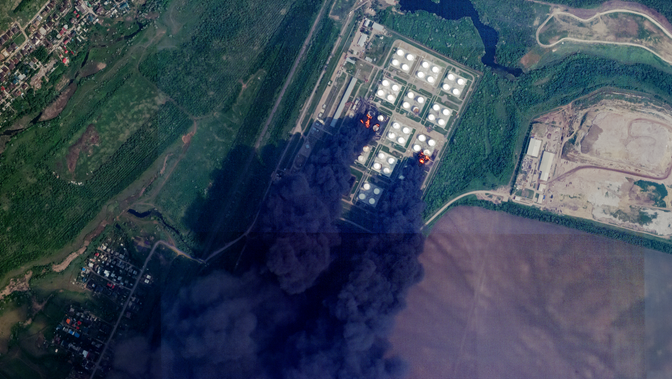
The rapid expansion of commercial satellite constellations, such as Planet, has fundamentally transformed maritime domain awareness (MDA).[i] Governments, industry, and maritime security centres such as the Information Fusion Centre (IFC) can potentially possess unprecedented ability to map “dark ships”, that is, vessels that intentionally obscure their identity, location, or cargo to avoid detection.
Dark shipping has enabled Russia and Iran to move sanctioned oil to major markets in China, India, and across Asia. These vessels are typically old, uninsured, poorly maintained, and frequently operate with their AIS transponders disabled or spoofed, posing significant navigational, environmental, and geopolitical risks.[ii]
From a practitioner’s operational and strategic perspective, dark shipping represents a compound threat – one that affects safety, environmental protection, sanctions compliance, crisis management, and geopolitical stability simultaneously.
Strategic context
China purchases approximately 90% of Iran’s seaborne crude exports, despite U.S. sanctions targeting Iran’s nuclear programme.[iii] It has also become the largest buyer of Russian oil since the 2022 invasion of Ukraine, due to discounted pricing resulting from Western sanctions.[iv] India, pursuing strategic autonomy and energy security, has increased its own imports of discounted Russian crude.
On 28 November 2025, Ukrainian naval drones struck two shadow-fleet tankers, Kairos and Virat, in the Black Sea while the vessels were en route to load Russian crude at Novorossiysk. The attacks occurred within Turkey’s Exclusive Economic Zone (EEZ).[v] Although both ships were unladen, preventing an environmental catastrophe, the episode illustrates the new strategic reality. First, commercial vessels are now targets in irregular maritime conflict. Second, regional Search and Rescue and coast guard agencies are exposed to new operational risks. Third, grey-zone escalation at sea is becoming normalised, with spillover risk into the Eastern Mediterranean, the Indian Ocean, and the Indo-Pacific.
From a whole-of-government (WOG) lens, such incidents require coordinated responses from navies, coast guards, port regulators, intelligence agencies, financial authorities, and energy ministries to deal with the consequences.
The rising shadow fleet and its threat
To circumvent sanctions, Russia and Iran operate a large shadow fleet that relies on AIS transponder disablement or manipulation, opaque ownership structures, flags of convenience, covert ship-to-ship (STS) transfers, and fraudulent insurance or the complete lack thereof.
The Ukrainian “War-Sanctions” site notes that “the shadow tanker fleet continues to provide multibillion-dollar revenues for the Kremlin” by masking ownership and employing high-risk shipping practices that threaten coastal states and the environment.[vi]
MT Kairos (IMO 9236004), built in 2002, exemplifies dark shipping practices. The tanker has shifted between Greek, Liberian, Panamanian, and Gambian flags over its lifetime, strongly suggesting that it may be attempting to avoid scrutiny. It was sanctioned by the EU, Switzerland, and the UK in mid-2025 for violating embargoes and engaging in high-risk maritime practices.[vii] The vessel has visited ports in China, India, Russia, Egypt, Turkey, Singapore, Angola, and Lebanon[viii], and it has reportedly conducted AIS-dark manoeuvres near Novorossiysk and in STS anchorages near Kithira, corroborating with known patterns-of-life behaviour of similar shadow-fleet tankers currently actively deployed to these places.[ix]
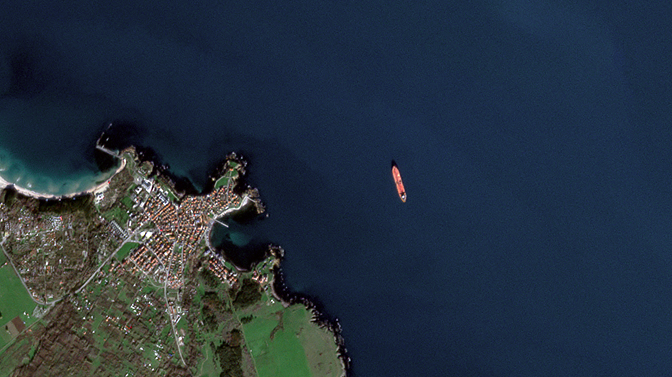
PlanetScope® image of a vessel allegedly the MIT Kairos near Ahtopol, Bulgaria, captured on January 13, 2026. © 2026, Planet Labs PBC. All Rights Reserved.
From a maritime practitioner’s operational-strategic lens, the threat posed by dark shipping spans five dimensions:
- Maritime safety & environmental risk – Ageing, uninsured tankers raise the probability of catastrophic spills, especially when struck or grounded in confined waters such as the Black Sea or Malacca Strait.
- Regulatory & sanctions evasion – Dark shipping undermines the credibility of global sanctions regimes and complicates the work of regulators across finance, customs, and port operations.
- Illicit & dual-use cargo smuggling – Beyond crude oil, such vessels are used for weapons, dual-use equipment, and sanctioned materials, heightening regional insecurity.
- Hybrid & grey-zone conflict – The November 2025 Ukrainian strikes reveal that dark ships are now entangled in hybrid warfare, serving as revenue nodes for sanctioned states.[x]
- Regional spillover risks – A single dark-vessel accident or attack could trigger a multi-country search and rescue operation, a pollution emergency, or a major chokepoint disruption, reinforcing the need for multi-agency preparedness.
This is where whole-of-government coordination and regional information-sharing networks such as the IFC become essential to coordinate ground actions and even to cue the actions of partners further afield to mitigate the potential threats posed.
Future outlook
China and India will likely remain key buyers of Russian and Iranian crude. Even as sanctions tighten, several dynamics remain clear. Pipeline routes offer Russia resilience against maritime sanctions
while independent Chinese refiners (“teapots”) will continue to rely on shadow-fleet shipments. The utilisation of the Northern Sea Route (NSR) will grow seasonally[xi] and shadow fleet expansion will continue as long as sanctioned oil remains profitable. At the same time, targeted attacks on dark vessels might increase, heightening miscalculation risks. For operational agencies, this means preparing for low-probability, high-impact maritime crises, such as search and rescue operations, mass evacuations, major oil spills, and port shutdowns.
Managing dark-shipping risks at the baseline requires integrating at the minimum geospatial intelligence (GEOINT), synthetic aperture radars (SAR), maritime AIS analytics, financial and ownership data, and information-sharing through regional and national maritime security centres. Platforms like the IFC exemplify how navies, coast guards, regulators, shipping companies, and intelligence agencies can collaborate to detect, map, and mitigate dark shipping.
The 2025 Ukrainian strikes show that dark vessels are now at the crossroads of sanctions enforcement, hybrid conflict, and maritime safety. A sustained whole-of-government, whole-of-community maritime security approach – supported by commercially available satellite intelligence – is essential to managing these risks in an increasingly contested and multipolar world.
Actionable insights from integrated datasets are essential for coordinated responses across agencies. However, traditional approaches to acquiring data often fall short on the speed and accuracy required for timely and critical decisions. This is where emerging commercial space technologies can fill the gap. Planet, a leading provider of satellite data and analytics, operates hundreds of satellites in orbit, delivering high-resolution imagery with near-daily coverage and multiple revisits of areas of interest. This is especially valuable in maritime security strategies where an always-on monitoring capability is critical to enable agencies to detect risks early and respond to anomalies before they escalate.
By integrating satellite data and analytics combined with machine learning, defence agencies can now enhance their MDA across territorial and open seas using automated vessel recognition, attribution, and tracking. This author discussed this next-generation, AI-driven capability in a live webinar[xii], drawing on examples from the Asia-Pacific. With access to high-frequency and reliable insights, defence strategists can establish a baseline of normal operations and detect suspicious activities early on.
Disclosure & Ethical Statement: This analysis was commissioned and sponsored by Planet Labs PBC to provide expert regional context on the evolving security landscape in Asia-Pacific. While Planet provided the underlying geospatial imagery and data support, the analysis, threat forecasting, and conclusions are entirely independent. Planet is committed to the “Democratization of Intelligence”—providing transparent, verifiable satellite data to foster global peace and security. The views expressed are those of Professor Rohan Gunaratna and do not necessarily reflect the official position of Planet Labs PBC.
[i] Hamm, M. (2025). “Why Satellite Imagery Is Critical to Maritime Domain Awareness Solutions”, Planet.com, 25 February 2025, retrieved from: https://www.planet.com/pulse/why-satellite-imagery-is-critical-to-maritime-domain-awareness-solutions/.
[ii] KSE Institute (2024). “Global Shadow Fleet (June 2024 report)”, retrieved from: https://kse.ua/wp-content/uploads/2024/06/Global-Shadow-Fleet-June-2024.pdf.
[iii] South China Morning Post (2025). “As war threatens China’s Iran investments, Middle East still beckons”, retrieved from: https://www.scmp.com/economy/global-economy/article/3316085/boom-goes-deal-war-threatens-chinas-iran-investments-middle-east-still-beckons.
[iv] S&P Global (2025). “Tankers with Russian crude sail via Arctic route to China—some without permits”, https://www.spglobal.com/commodity-insights/en/news-research/latest-news/crude-oil/081225-tankers-with-russian-crude-sail-via-arctic-route-to-china-some-without-permits.
[v] South China Morning Post (2025). “Ukraine’s naval drones strike Russian oil tankers near Turkish coast”, retrieved from: https://amp.scmp.com/news/world/russia-central-asia/article/3334644/ukraines-naval-drones-strike-russian-oil-tankers-black-sea-turkish-coast.
[vi] War Sanctions (2025). “KAIROS IMO 9236004”, retrieved from: https://war-sanctions.gur.gov.ua/en/transport/shadow-fleet/483.
[vii] Council of the European Union (2025). “Russia’s war of aggression against Ukraine: EU agrees 17th package of sanctions”, retrieved from: https://www.consilium.europa.eu/en/press/press-releases/2025/05/20/russia-s-war-of-aggression-against-ukraine-eu-agrees-17th-package-of-sanctions/.[viii] Vesselfinder (n.d.). “MT Kairos (IMO 9236004)”, retrieved from: https://www.vesselfinder.com/ru/vessels/details/9236004.
[ix] KSE Institute (2024). “ROT_APR24 (April 2024 report)”, retrieved from: https://kse.ua/wp-content/uploads/2024/04/ROT_APR24.pdf.
S&P Global (2025). “Tankers with Russian crude sail via Arctic route to China—some without permits”, https://www.spglobal.com/commodity-insights/en/news-research/latest-news/crude-oil/081225-tankers-with-russian-crude-sail-via-arctic-route-to-china-some-without-permits.
[x] South China Morning Post (2025). “Ukraine’s naval drones strike Russian oil tankers near Turkish coast”, retrieved from: https://amp.scmp.com/news/world/russia-central-asia/article/3334644/ukraines-naval-drones-strike-russian-oil-tankers-black-sea-turkish-coast.
[xi] S&P Global (2025). “Tankers with Russian crude sail via Arctic route to China—some without permits”, https://www.spglobal.com/commodity-insights/en/news-research/latest-news/crude-oil/081225-tankers-with-russian-crude-sail-via-arctic-route-to-china-some-without-permits.
[xii] Planet.com (2025). “APAC GeoGov Insights: AI-Powered Maritime Intelligence”, available at: https://learn.planet.com/ai-powered-maritime-intelligence-gated.html?utm_source=d&iinfluencer&utm_medium=third-party-advertising&utm_campaign=fy26&utm_content=pros-apj-leads-article2-mitigatingmaritimerisks-rohangunaratna-apacgeogovinsights-mda-dec2025.