When asked “where are you from, Iraq or Syria?” by a journalist, two children not older than nine shouted from afar “neither – we are from the Islamic State.”[i]
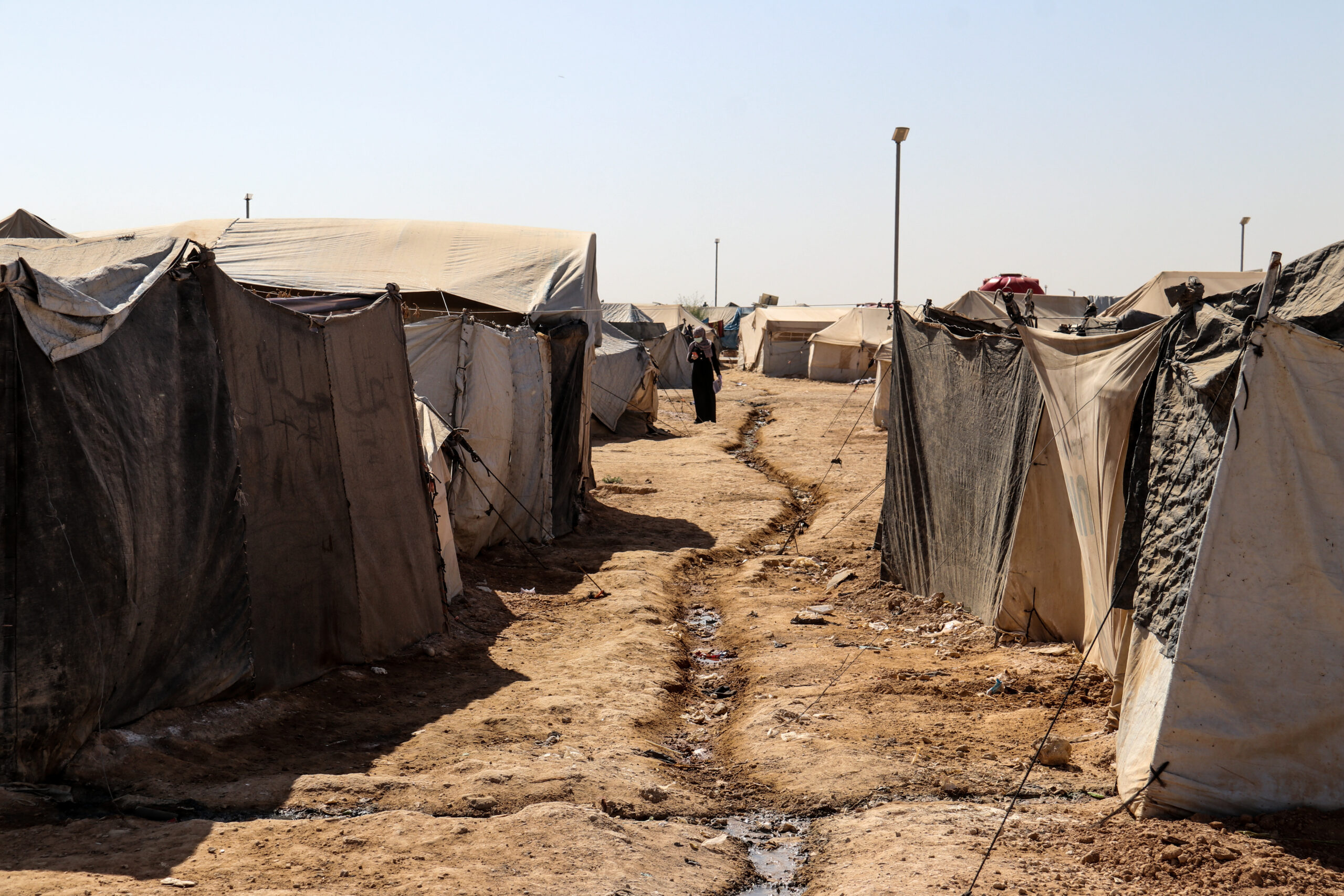
This moment, captured in a video in Al-Hol camp in January, depicts the unresolved reality of post-ISIS dynamics in Syria. While the organization was militarily defeated in 2019 by the U.S.-led international coalition, the ideological threat it poses persists. In the absence of a clear political, legal, or moral authority willing to assume responsibility for Al-Hol, the camp has become a space where extremist ideas are not only preserved but also reproduced.
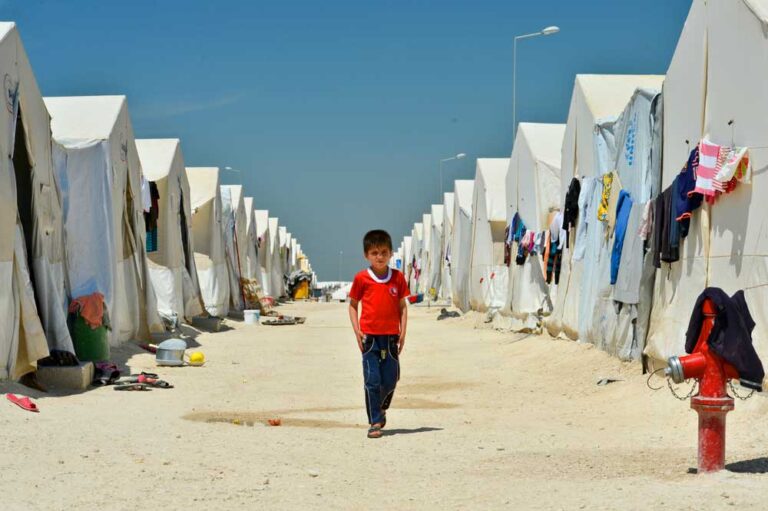
Originally created in the 1990s for displaced Iraqi refugees after the First Gulf War, Al-Hol camp in gradually emptied out in the early 2000s, only to be filled again between 2016 and 2019, first by the families of Islamic State fighters, then by Islamic State fighters themselves. According to the Norwegian Refugee Council, the camp holds around 26,000 people today – a sizable population, but a major decrease from registered peaks of around 70,000 in previous years. 60% of those who remain in the camp are children. While a large repatriation effort was undertaken in 2025 to return Iraqi citizens to Iraq, it is estimated that around 14,000 Syrians and 4,000 Iraqis remain here, as well as over 6,000 third-country nationals.[ii]
During the Syrian conflict, the international community offloaded the responsibility and practical handling of these individuals on the Syrian Democratic Forces (SDF). In late January, following the SDF’s retreat and their ceasefire with the HTS–led Syrian interim government, surroundings of the camp were declared as a ‘closed security zone’[iii], leading to several humanitarian and security concerns. While such concerns have been emphasized for years by various regional and international bodies monitoring the situation, now that reports of families breaking out of the camp have emerged,[iv] they feature high in policy agendas again.
The transmission of ISIS ideology
What makes Al-Hol camp particularly dangerous is not only the presence of former Islamic State fighters and affiliates, but the everyday reproduction of their ideology. Ideology is often transmitted through informal authority structures and peer socialization, as demonstrated in early empirical socialization studies (Easton & Dennis, 1969, Niemi and Hepburn, 1995, Dennis and McCrone 1970; Jennings and Niemi 1974; Sears and Valentino 1997). Children’s ability to quickly learn which narratives offer protection and belonging enhance their vulnerability to ideologies of violent extremism. As has been reported over the years, cycles of violence, ranging from setting tents on fire to killings, have repeatedly emerged in the camp.[v]
Women in the camp act as key agents of socialization through indoctrination programmes and the enforcement of ideological rules. According to the Washington Institute, pro-ISIS women have formed religious police units to monitor the implementation of religious obligations and hold anyone who does not conform accountable, going as far as imposing heavy penalties such as flogging, torture, food deprivation, the burning of tents, and even murder. Women’s ambiguous legal and political status provides them with the flexibility to entrench radicalization in the camp, with serious long-term consequences.[vi] This is best exemplified in the ‘jihadi bride’ discourse which brought to light the question of women’s roles and accountability within the Islamic State context.[vii] Their prosecution in the European context, for example, has led to judicial questions around their roles as victims and/or perpetrators. Are they ‘only mothers’, or also part of the (violent) ideological foundations of the Islamic State? From 2018 onwards, for example, female returnees in Germany and the Netherlands were being investigated and prosecuted not only for child neglect (in other words, taking their children to a war zone), but also for supporting slavery and war crimes (see, for example, the case against Jennifer W.[viii]). In France, on the other hand, the involvement of women in the planning of attacks has also changed the perception of women involved in terrorism, resulting in longer prison sentences for female jihadis compared with other neighboring countries. In the Netherlands and Belgium, deprivation of nationality and no-entry ban and return decisions can have human rights implications for the female returnees.[ix] According to the Center for Research and Evidence on Security Threats, existing research suggests that women in general are more likely to be met with a lenient sentence due to prevailing perceptions of women as victims rather than perpetrators “bearing no more liability than children”, as well as false gendered assumptions about their limited agency.[x]
The political vacuum surrounding Al-Hol has only reinforced this dynamic. For years, the lack of responsibility transformed the camp into a space of managed neglect; essentially, a detention camp with inhumane conditions. None of those within the camp, including Islamic State fighters, have been tried and sentenced for terrorism-related offenses. Security-first governance, combined with legal ambiguity over citizenship and avenues for repatriation, have reduced thousands of individuals to remain stuck in a permanent state of suspension – neither prosecuted nor reintegrated, neither victims nor fully recognized perpetrators. This ambiguous status actively produces new forms of resentment, grievance, and identity formation in the group. The camp, hence, functions less as a containment mechanism and more as an incubator, where violent ideologies can potentially re-emerge in unpredictable forms in the close future.
The international dimension of ISIS
The situation at Al-Hol camp is the result of the collective failure of international governance, international law, and international responsibility. Nobody knows what to do with those detained and, more importantly, nobody wants to deal with them.
Many of those in the camp acquired their radical ideological stance in a transnational process, which traveled far beyond Syrian and Iraqi territories. Failed integration policies, identity struggles, and online bubbles – including in Western societies – contributed to this process. Beyond individual cases, estimates made in 2024 by the UN suggest that the group retains up to 6,000 fighters in Afghanistan, up to 3,000 between Iraq and Syria, and is expanding in West Africa.[xi] ACLED’s conflict data further show that the group is one of the most violent armed groups and has strategically exploited the security vacuum left by the withdrawal of French troops in 2025. There are currently around 3,000 fighters between Mali, Burkina Faso and the Niger, with the potential of expanding regionally.[xii] More importantly, the Islamic State’s ability to attract individuals to its cause is far from over, as individual terrorist cases repeatedly highlight.[xiii] The neglect of the Al-Hol camp within this broader context has effectively allowed ISIS ideology to outlive the organization that institutionalized it.
Although the UN has agreed to taking over management responsibilities of the camp, the question remains as to whether final responsibility lies with the new Syrian government – which continues to face profound state-reconstruction challenges – the international coalition established to fight ISIS, or the states who are represented in the camp by virtue of their citizens. Iraq, with the support of U.S. Central Command (CENTCOM) started taking back individuals from Syria to place them in detainment camps for prosecution, raising some questions around the legal process and their treatment within the prison system.[xiv] There had previously been concerns of mass prison executions within Iraq.[xv] Yet the question of what should be done with European Islamic State fighters and their families remains unanswered.[xvi] The repatriation approach in their case has been to take back the most vulnerable among them, including mothers with children and other minors. Taking back men has been repeatedly opposed by Germany, Austria, the UK, and France.[xvii]
Indecision risks resurgence
Concerns notwithstanding, time is of the essence as countries neighboring Syria, such as Lebanon, Turkey, and Jordan, and Western states, including Germany, France, and the UK, have started to debate returning refugees to Syria en masse, including by means of terminating their refugee status if necessary.
It has been almost seven years since the battle against the Islamic State in Baghouz took place. Further delaying the question of prosecution and rehabilitation will only lead to new cycles of violence and a possible resurgence of ISIS. To continue ignoring the problem is simply to postpone a major security threat, and the longer the detained remain confined to a space defined by abandonment and ideological residue, the more likely it is that the world – and Syrians returning to their homeland – will once again confront the ISIS problem.
[i] Al Taleaa television, aired on the 25th of January 2026.
[ii] Norwegian Refugee Council (2026). “Syria: Insecurity around Al Hol Camp forces suspension of critical aid services, aid agencies warn”, retrieved from: https://www.nrc.no/news/2026/syria-al-hol-insecurity.
[iii] Shafaq (2026). “Syrian military labels al-Hol Camp area a closed security zone”, 30 January 2026, retrieved from: https://shafaq.com/en/Middle-East/Syrian-military-labels-Al-Hol-Camp-area-a-closed-security-zone.
[iv] Kurdistan 24 (2026). “Violence and mass escape reported at al-Hol camp following Syrian military takeover”, https://www.kurdistan24.net/en/story/890252/violence-and-mass-escape-reported-at-al-hol-camp-following-syrian-military-takeover.
The Gaurdian (2022). “3 More than 100 murders in 18 months in Syria’s al-Hawl camp, UN says”, retrieved from: https://www.theguardian.com/world/2022/jun/28/more-than-100-murders-in-18-months-in-syrias-al-hawl-camp-un-says.
[vi] Saleh, J. (2021). “The Women of ISIS and the Al-Hol Camp”, Washington Institute, retrieved from: https://www.washingtoninstitute.org/policy-analysis/women-isis-and-al-hol-camp.
[vii] See Jackson, L.B. (2021). The Monstrous and the Vulnerable. Framing British Jihadi Brides. London: C. Hurst & Co.
[viii] Koller, S. (2023). “ISIS Women in Court: Jennifer W. – Enslavement Resulting in Death”, retrieved from: https://www.counterextremism.com/blog/isis-women-court-jennifer-w-enslavement-resulting-death.
[ix] Mehra, T., Renard, T. and Herbach, M. (2024). “Female Jihadis Facing Justice. Comparing Approaches in Europe”, International Centre for Counter-Terrorism (ICCT), retrieved from: https://icct.nl/publication/female-jihadis-facing-justice-comparing-approaches-europe.
[x] Squires, C. (2024). “Prosecuting female terrorists: What do we know?”, Centre for Research and Evidence on Security Threats, retrieved from: https://crestresearch.ac.uk/comment/prosecuting-female-terrorists-what-do-we-know/.
[xi] UNSC (2024). “Thirty-fourth report of the Analytical Support and Sanctions Monitoring Team submitted pursuant to resolution 2734 (2024) concerning ISIL (Da’esh), Al-Qaida and associated individuals and entities”, retrieved from: https://docs.un.org/en/S/2024/556.
[xii] Nsebia, H. (2024). “Newly restructured, the Islamic State in the Sahel aims for regional expansion”, ACLED Data, retrieved from: https://acleddata.com/report/newly-restructured-islamic-state-sahel-aims-regional-expansion.
[xiii] Broekaert, C. and Clarke, Dr. C. (2025). “The New Orleans Attack: The Technology Behind IS-Inspired Plots”, retrieved from: https://gnet-research.org/2025/01/30/the-new-orleans-attack-the-technology-behind-is-inspired-plots/.
[xiv] CENTCOM (2026). “U.S. Forces Launch Mission in Syria to Transfer ISIS Detainees to Iraq”, retrieved from: https://www.centcom.mil/MEDIA/PRESS-RELEASES/Press-Release-View/Article/4383698/us-forces-launch-mission-in-syria-to-transfer-isis-detainees-to-iraq/.
[xv] OHCHR (3034). “Iraq must immediately stop mass, unannounced executions: UN experts”, retrieved from: https://www.ohchr.org/en/press-releases/2024/01/iraq-must-immediately-stop-mass-unannounced-executions-un-experts.
[xvi] Unger, C. and Shihabi, A. (2026). “Should Germany bring its own Islamists back from Syria?”, Westfälische Rundschau, retrieved from: https://www.wr.de/politik/article410993023/soll-deutschland-die-eigenen-islamisten-aus-syrien-zurueckholen.html.
[xvii] Global Repatriations Tracker (2026). Retrieved from: https://www.rightsandsecurity.org/resources/global-repatriations-tracker/.