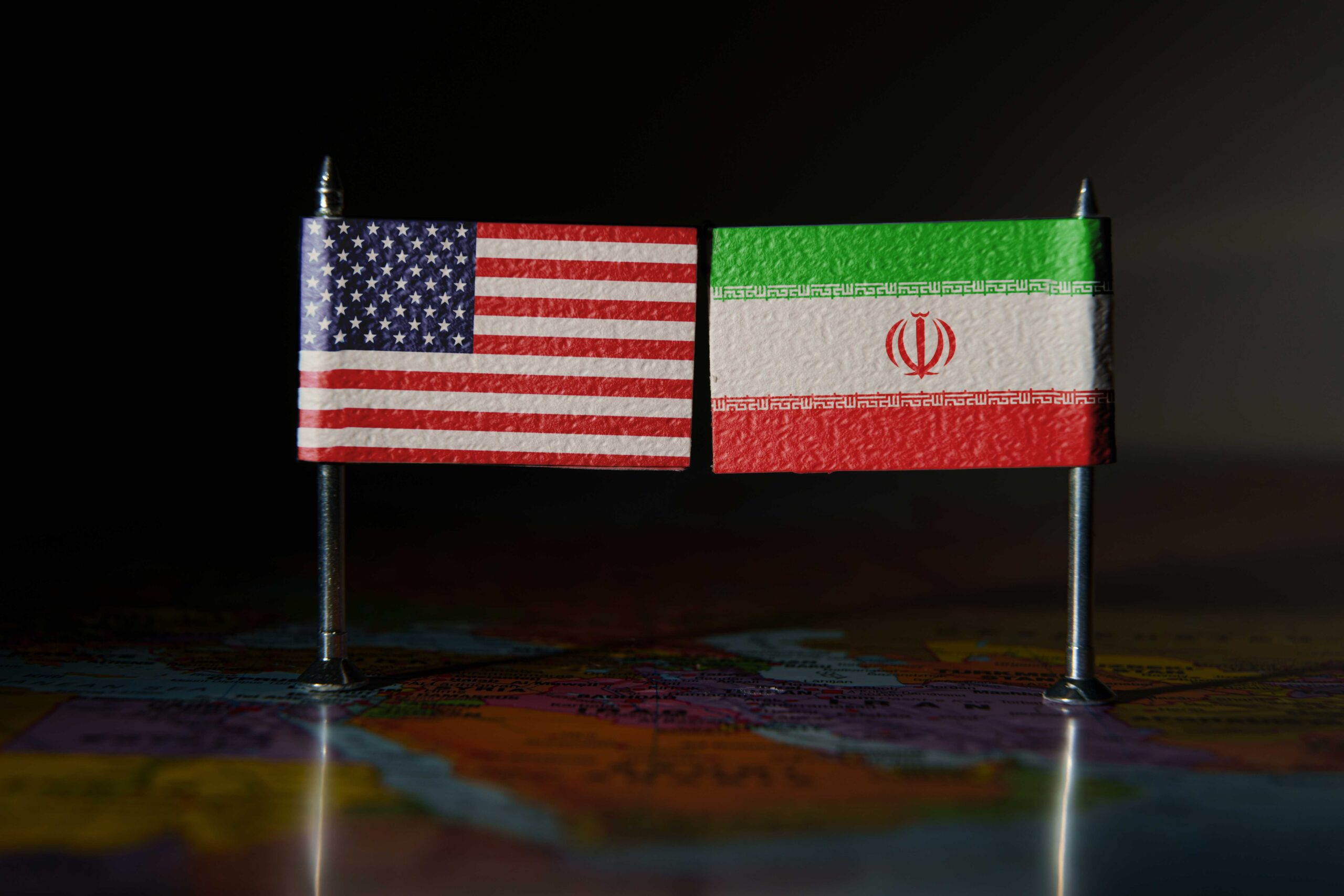
Indirect negotiations in the shadow of threats of war
While the transfer of U.S. military equipment and forces to the Middle East continues and the threat of a new war against Iran by the United States and Israel remains, the mediation efforts of regional countries – including Turkey, Saudi Arabia, Qatar, and Egypt – have paved the way for indirect negotiations between Iran and the United States amid high tensions.
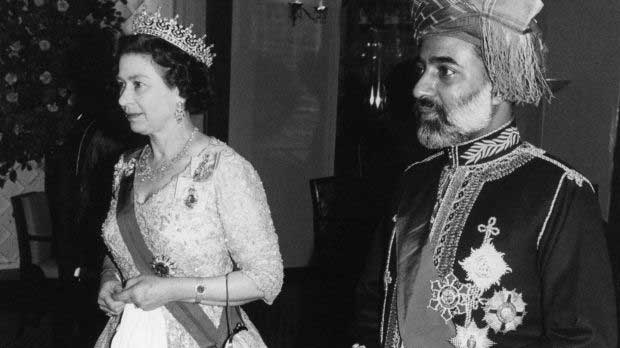
Muscat once again hosted indirect negotiations between Iran and the United States on 6 February. Iranian authorities described the talks with the US in Oman as “positive”, while US President Donald Trump said they were “very good”, but they did not offer a roadmap to alleviate growing fears of a US attack on Iran.[i] The talks took place as the first between the primary conflicting sides after five rounds of indirect negotiations in Oman and Italy, which were halted and yielded no results due to an Israeli military attack and the bombing of Iran’s nuclear facilities by the United States in June 2025.
The second round of indirect negotiations between Iran and the US, also mediated by Oman, was held in Geneva on 17 February. While Abbas Araghchi, Iran’s Minister of Foreign Affairs, stated that “good progress” had been made,[ii] White House Press Secretary Karoline Leavitt added that the two sides remain “very far apart on some issues.”[iii] In these circumstances, President Donald Trump signalled on 19 February the U.S. would decide its next moves within 10 days if Iran did not agree to a nuclear deal, potentially giving the Islamic Republic a new deadline as he weighs a second set of strikes on the country.[iv]
The challenge of defining the framework of negotiations
Unlike the negotiations between Iran and the P5+1 that resulted in the 2015 JCPOA and which were limited solely to Iran’s nuclear issues, there is now significant disagreement between the US and Iran over how to expand the framework of the talks. The U.S. position – supported by Israel and European countries – advocates a broad framework and agenda that includes three areas: nuclear issues, missile building capabilities, and Iran’s regional influence via its proxy groups.
In this regard, U.S. Secretary of State Marco Rubio said on 4 February that negotiations with Iran cannot be limited to the nuclear file. Speaking in Washington at a summit on critical mineral development, Rubio emphasized that “That includes the range of their ballistic missiles, that includes their sponsorship of terrorist organizations across the region, that includes a nuclear program and that includes the treatment of their own people.”[v] In addition, following Israeli Prime Minister Binyamin Netanyahu’s visit to Washington on 11 February, President Trump commented that a good deal with Iran would mean “no nuclear weapons, no missiles,” without elaborating further.[vi]
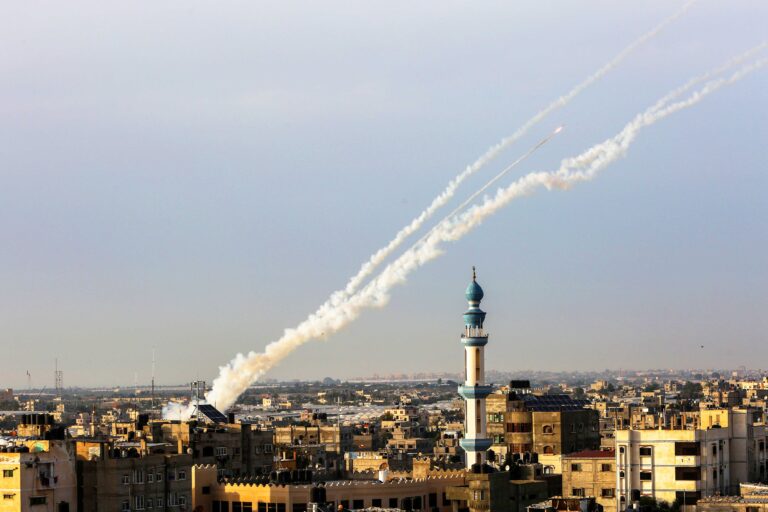
Israel undoubtedly fears that the US might pursue a narrow nuclear deal that does not include restrictions on Iran’s ballistic missile program or an end to Iranian support for armed proxies in the region. Iran has the largest stockpile of ballistic missiles in the Middle East, according to the U.S. Office of the Director of National Intelligence.[vii] Iranian missiles have a self-imposed range of 2,000 km (1,240 miles), which officials in the past said was enough to protect the country since it covers the distance to Israel. The arsenal also encompasses multiple long-range missiles that can reach Israel, according to the Center for Strategic and International Studies.[viii] These include the Sejil, with a range of 2,000 km; Emad, 1,700 km; Ghadr, 2,000 km; Shahab-3, 1,300 km; Khorramshahr, 2,000 km; and Hoveyzeh 1,350 km. The unveiling of a new missile city in Iran – particularly the hypersonic Khorramshahr-4 missile on 6 February – carried out at the peak of tensions and amid the large-scale deployment of U.S. forces and equipment to the Middle East, showcased a new level of Iran’s missile capabilities.[ix] The Khorramshahr-4 hypersonic missile can cover a distance of 2,000 kilometers in 12 minutes, posing a potential threat to Israel’s missile-defense shield known as the Iron Dome.
Therefore, from Israel’s perspective, unlike during the 12-day war in June 2025, Iran’s missile capabilities – and especially its ballistic missiles – constitute a more immediate threat. In this context, Netanyahu is exerting significant pressure on Washington to ensure that any agreement with Iran includes reductions in Iran’s missile capabilities, including cutting missile ranges to below 500 kilometers; otherwise, if no deal is reached, the destruction of those missile capabilities should be placed high on the agenda as an immediate priority in any subsequent strike.
By contrast, senior Iranian officials have repeatedly stated that negotiations are limited solely to nuclear issues and do not include other matters such as missile capabilities or proxy groups – referred to by Iran as the “axis of resistance.” In this regard, Admiral Ali Shamkhani, the former Secretary of Iran’s Supreme National Security Council and the current representative of the Supreme Leader in the Defense Council – a council established after the 12-day war in June – has emphasized that “Iran’s ballistic missile capabilities are a red line that will never be placed on the negotiating table”.[x] In addition, Iranian Foreign Minister Abbas Araghchi reiterated that Iran’s missile program has never been, and never will be, part of the agenda in the nuclear talks”.[xi]
Iranian officials are also strongly opposed to any reduction in missile ranges. In this regard, Ali Larijani, secretary of Iran’s Supreme National Security Council, said that “reducing missile ranges to “below 500 kilometers” would effectively mean accepting coercion and surrender. “If you were in our position and negotiating, would you be willing to take away the country’s most important defensive weapon from us?” he asked, describing such a demand as tantamount to seriously weakening the country’s defensive capabilities.[xii]
Therefore, it seems that if the American side insists on a broader negotiation agenda, including missile capabilities, range, and proxy groups, the negotiation framework will face failure. Iran has returned to indirect negotiations with the United States and put forward several new proposals. These include diluting enriched uranium to reduce enrichment levels, and allowing U.S. investment in Iran’s oil and gas sector, as well as in its industrial and mining industries in exchange for sanctions relief. Tehran may demonstrate some flexibility regarding a temporary suspension of domestic enrichment through the establishment of a regional nuclear consortium. Nevertheless, the scope of its flexibility is unlikely to extend to missile capabilities, which are considered to be the most important elements of the country’s defense and deterrence capabilities. The same goes to proxy groups in Iran’s “Axis of Resistance.” From the perspective of the Islamic Republic, such concessions would be tantamount to surrender and national humiliation.
Concerns over this very gap – whether the negotiating framework and agenda should be narrow or broad – has pushed some mediators, such as Turkey, toward middle-ground solutions. “My advice always to the American friends, close the files one by one with Iran. Start with nuclear, close it, then the others”,[xiii] said Turkish Foreign Minister Hakan Fidan. Nevertheless, as mentioned, it appears highly unlikely that Iran would agree to even a gradualist approach – after negotiating and reaching a deal on nuclear issues. Its missile capabilities are regarded as a red line in Iran’s national security doctrine and a key element of its defensive deterrence.
Three main challenges
Even if the Iranian and American sides agree to define the negotiation framework exclusively around nuclear issues, three main challenges would remain in the negotiation process and any potential agreement: First, the issue of Iran’s right to enrich uranium domestically, or the possibility of zero enrichment and the prohibition of any enrichment by Iran. Second, the inspection of Iran’s nuclear facilities in Fordow, Natanz, and Isfahan by International Atomic Energy Agency (IAEA) experts, which were damaged during the 12-day war. Third, the transfer of 400 kilograms of enriched uranium from Iran to another country, with Turkey and Russia being potential destinations.
The Iranian side has explicitly emphasized its right to enrich uranium domestically as a sovereign, legitimate, and legal right, and has also clearly opposed the transfer of enriched uranium abroad. In this regard, Ali Bagheri Kani, Deputy of Ali Larijani in Iran’s Supreme National Security Council, stated that “Iranian officials have no intention of transferring enriched nuclear materials to any country, and that the negotiations are not centered around such an issue at all”.
It seems that the only issue Iran is currently willing to show flexibility on in the nuclear discussion is the reduction of uranium enrichment from 60% to 20%. Admiral Ali Shamkhani, the advisor and representative of the Supreme Leader in the Defense Council, recently referred to this issue in an interview with the Al-Mayadeen TV network in Lebanon: “the 60% enrichment level can be reduced and diluted to 20%. If they are concerned, we can lower the enrichment level to 20%, but they will have to bear the cost of that. There is no reason to transfer enriched materials out of Iran, and their concerns about these materials can be addressed. In fact, this is yellowcake that has been reduced to 60%, and there is a possibility of returning it to 20%. Therefore, there is no need for all this trouble and all these complex steps to transfer these hazardous materials out of Iran”. It is clear that this differs significantly from the expectations of the American side.
Conclusion
Current negotiations are expected to focus solely on the general framework of the talks and their process. It appears that this framework may include an agreement between the two sides that the negotiations will be strictly limited to nuclear issues and will not extend to other topics, such as Iran’s missile capabilities, their range, or proxy groups in the region. Nevertheless, even regarding nuclear issues, there are significant differences in views and serious challenges between the two sides.
The transfer of enriched uranium abroad – including to Russia – similar to the JCPOA experience and the transfer of 11,000 kg of Iran’s enriched uranium to Russia,[xiv] could potentially be considered in exchange for establishing a regional uranium-enrichment consortium with Iran’s participation, an idea that has been repeatedly proposed in recent years. Alternatively, a phased, step-by-step policy of “suspension for suspension” – a temporary rather than permanent suspension of enrichment by Iran in return for the gradual suspension of sanctions – aimed at building confidence and paving the way for a broader, more lasting agreement, might help break the current deadlock and facilitate a deal.
[i] Motamedi, M. (2026). “Iran says talks with US in Oman ‘a good start’, more discussions expected”, Al Jazeera, 6 February 2026, retrieved from: https://www.aljazeera.com/news/2026/2/6/iran-us-hold-talks-in-oman-as-fears-of-war-hang-over-region.
[ii] Al Jazeera (2026). “Iran says ‘good progress’ made in nuclear talks with US in Geneva”, 18 February 2026, retrieved from: https://www.aljazeera.com/news/2026/2/18/irans-araghchi-hails-good-progress-in-nuclear-talks-with-us.
[iii] TVP World (2026). “White House says Iran should ‘make a deal’ as talks show limited progress”, 19 February 2026, retrieved from: https://tvpworld.com/91674797/us-iran-should-act-very-wise-in-deal-talks.
[iv] The Wall Street Journal (2026). “Trump Hints at 10-Day Window for Decision on Iran”, 19 February 2026, retrieved from: https://www.wsj.com/world/middle-east/trump-hints-at-10-day-window-for-decision-on-iran-6370e477.
[v] Jewish News Syndicate (2026). “Iran negotiations must include ballistic missiles, domestic repression, Rubio says”, 4 February 2026, retrieved from: https://www.jns.org/iran-negotiations-must-include-ballistic-missiles-domestic-repression-rubio-says/.
[vi] Spetalnick, M. and Hunnicutt, T. “Trump says no ‘definitive’ agreement with Netanyahu, US talks with Iran to continue”, Reuters, 10 February 2026, retrieved from: https://www.reuters.com/business/aerospace-defense/israels-netanyahu-expected-press-trump-over-iran-diplomacy-2026-02-11/.
[vii] CGTN (2026). “Explainer: What are Iran’s ballistic missile capabilities?”, 10 February 2026, retrieved from: https://news.cgtn.com/news/2026-02-10/Explainer-What-are-Iran-s-ballistic-missile-capabilities–1KDVh3DzC3S/index.html.
[viii] Reuters (2026). “What are Iran’s ballistic missile capabilities?”, 4 February 2026, retrieved from: https://www.reuters.com/business/aerospace-defense/what-are-irans-ballistic-missile-capabilities-2026-02-04/.
[ix] Khabar Online (2026). “Khorramshahr-4 Enters Iran’s Missile Cities, Sending a New Deterrence Signal”, 6 February 2026, retrieved from: https://english.khabaronline.ir/news/200589/Khorramshahr-4-Enters-Iran-s-Missile-Cities-Sending-a-New-Deterrence.
[x] Iranian Students News Agency (ISNA) (2026). “Shamkhani: Iran’s missile program will never be on negotiating table”, 12 February 2026, retrieved from: https://en.isna.ir/news/1404112313706/Shamkhani-Iran-s-missile-program-will-never-be-on-negotiating.
[xi] Ibid.
[xii]Jahan Sanat(2025). “Agreement with the United States to reduce Iran’s missile range to under 500 kilometres; Ali Larijani’s reaction”, [In Persian], 23 October 2025, retrieved from: https://jahanesanat.ir/%D8%AA%D9%88%D8%A7%D9%81%D9%82-%D8%A8%D8%A7-%D8%A2%D9%85%D8%B1%DB%8C%DA%A9%D8%A7-%D8%A8%D8%B1%D8%A7%DB%8C.
[xiii] Hürriyet Daily News (2026). “Türkiye urges US to resolve Iran disputes one by one”, 28 January 2026.retrieved from: https://www.hurriyetdailynews.com/turkiye-urges-us-to-resolve-iran-disputes-one-by-one-218342.
[xiv] The Guardian (2015). “Iran ships 25,000lb of low-enriched uranium to Russia as part of nuclear deal”, 28 December 2015, retrieved from: https://www.theguardian.com/world/2015/dec/28/iran-ships-uranium-russia-nuclear-deal.